Ecommerce AI agents: definition, examples, features, and use cases
Sirazum Monir Osmani
A store with 50,000 monthly visitors has 50,000 different reasons people buy, hesitate, or leave. Yet most ecommerce brands talk to all of them the same way: same cart recovery email, same discount, same timing. Ecommerce AI agents like Markopolo flip that model. They give every single visitor their own dedicated AI that reads behavior in real time, decides the best next move, and executes it across email, SMS, WhatsApp, voice, or push without a human touching a workflow. The result is personalization that actually works at scale, not "Hi {FirstName}" but strategies built around how each individual actually shops. This guide covers what ecommerce AI agents are, how they work under the hood, the types available today, and how to put them to work in a real store.
What are ecommerce AI agents?
Ecommerce AI agents are autonomous application systems that observe individual customer behavior, make real-time decisions, and execute personalized actions across multiple channels without human intervention. Think of them as individual sales associates, one per customer, that never sleep, never forget a past interaction, and learn from every touchpoint.
Unlike a marketing automation flow that waits for a trigger and runs a preset sequence, an AI agent continuously analyzes behavioral signals like scroll depth, hesitation patterns, comparison shopping, and time-of-day preferences, then generates a unique strategy for each person. It decides what to say, when to say it, where to say it, and whether to say anything at all.
How AI agents differ from marketing automation and chatbots
Marketing automation tools follow a simple model: a human builds a workflow, applies it to a segment, and hopes it works. If a customer abandons a cart, they enter a static sequence. Email at hour one. Another at day one. A discount at day three. Every customer in that segment walks the same path regardless of intent, browsing behavior, or channel preference. Chatbots are similarly limited. They respond to direct queries using scripted decision trees or basic NLP, but they don't initiate outreach, predict behavior, or orchestrate across channels.
Rule-based workflow automation runs on a simple IF/THEN structure.
If the cart is abandoned, send email template A after one hour.
If email is not opened, send template B after 24 hours.
This approach has a hard ceiling. No matter how sophisticated the branching logic gets, the same rules apply to everyone in the segment.
On the other hand, AI tools for ecommerce work on a completely different model. Instead of waiting for rules to fire, the AI agents observe behavioral data in real time, build an understanding of individual intent, and generate a unique action plan for each customer. A chatbot can answer "Where's my order?" An AI agent can detect that a customer has checked the shipping policy three times, is comparing prices on a competitor's tab, and responds best to social proof on WhatsApp at 7 PM, then act on all of that without a human writing a single rule.
The revenue agent paradigm: One customer, one AI agent
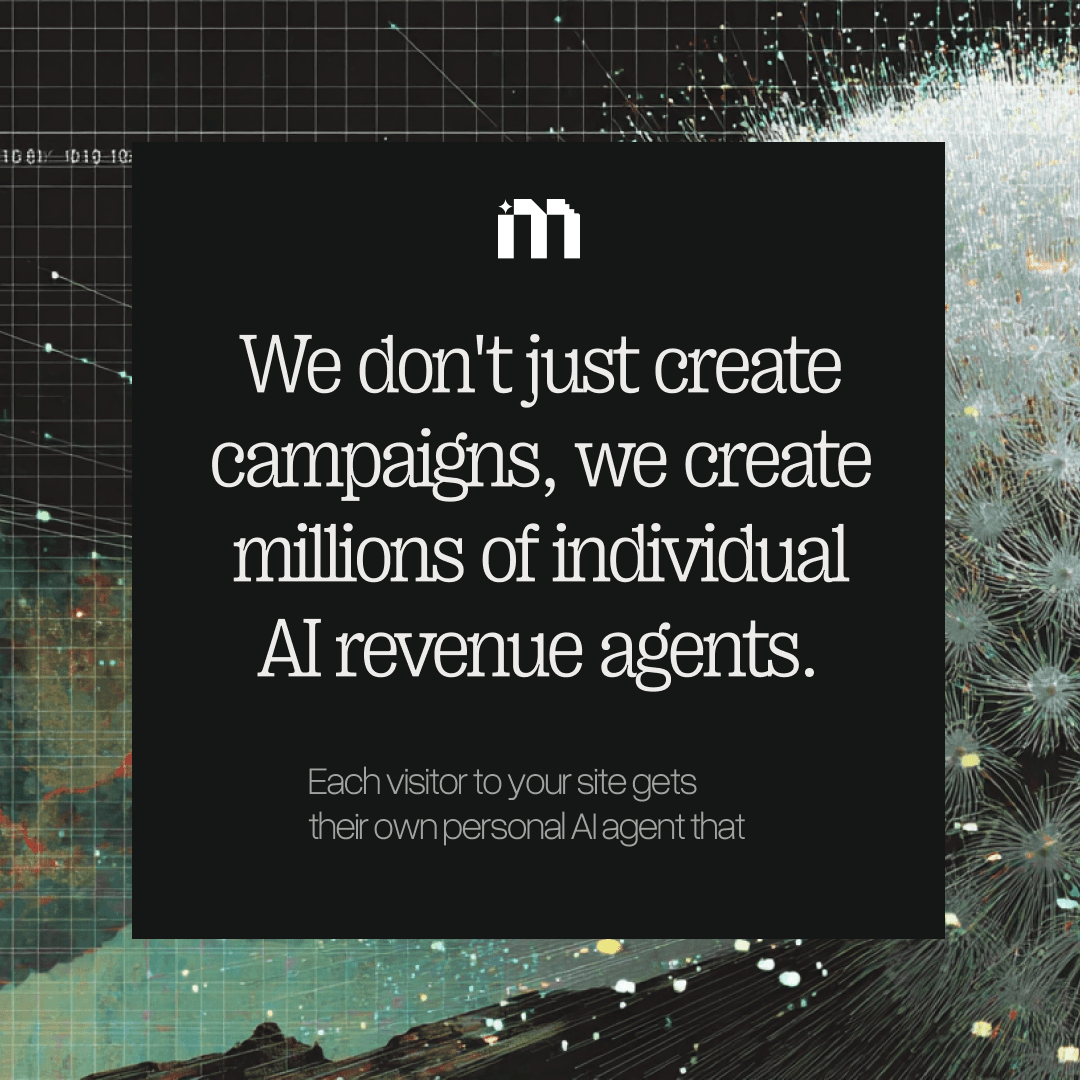
The core idea behind Markopolo AI's agents in ecommerce is the "revenue agent" model. Every visitor to a store gets assigned their own AI agent. That agent has access to the customer's full behavioral history: every page view, every hesitation, every abandoned checkout. It creates a strategy tailored to that individual and executes it across whichever channels that person actually uses.
This is what makes the approach fundamentally different from segmentation. A segment might label someone "high-value cart abandoner." An AI agent knows that Sarah typically researches across three sessions before buying, that her price sensitivity is low but her need for social proof is high, that she browses during work breaks but engages with WhatsApp in the evening, and that she needs customer reviews, not a discount code, to convert. Multiply that level of understanding by every visitor, and the result is millions of unique customer journeys running simultaneously.
5 types of ecommerce AI agents
Revenue agents for cart recovery and conversion
Revenue agents focus on the highest-impact moment in ecommerce: the gap between intent and purchase. When a customer abandons a cart, a revenue agent doesn't just fire off a reminder. It evaluates behavioral signals to determine why they left and what will bring them back. A price-sensitive shopper might get a strategically timed discount via SMS. Someone who spent ten minutes reading reviews might get a WhatsApp message featuring customer testimonials. Each recovery attempt is generated in real time, shaped by the individual's behavioral profile rather than a pre-built template.
Campaign agents for automated customer journeys
Campaign agents handle the end-to-end orchestration of multi-channel campaigns. They pull from behavioral data, audience segments, and business objectives to design and run campaigns autonomously. A campaign agent can select the right audience cohort, choose the optimal channel mix across email, SMS, push notifications, WhatsApp, and voice, generate personalized content, configure discount logic, and launch with minimal human input. The human sets the objective. The agent builds and executes the plan. Platforms like Markopolo let merchants choose between fully autonomous content generation and a human-in-the-loop mode where AI drafts and the merchant approves.
Voice agents for conversational commerce
Voice agents bring AI into the phone channel, the one most ecommerce tools ignore entirely. These agents make outbound calls that sound like a real SDR, not a robocall. They operate with full context: they know what the customer browsed, what they abandoned, and what kind of conversation is most likely to convert them. A voice agent might call a relationship-driven buyer at lunch, their historically high-engagement window, to walk them through product details. After the call, the AI generates a summary and logs the outcome, feeding it back into the customer's behavioral profile for future interactions.
Recommendation agents for product discovery
Recommendation agents go beyond "customers who bought X also bought Y." They use behavioral foundation models trained across hundreds of business domains to predict what a specific individual is likely to do next, not just what similar users have done. By analyzing browsing sequences, engagement depth, and cross-category interest, these agents surface product recommendations that align with the customer's actual intent stage. Someone in early research mode gets discovery-oriented suggestions. Someone showing high purchase momentum gets complementary products positioned for bundling.
Customer success agents for retention
Customer success agents manage the post-purchase relationship. For subscription or SaaS-style ecommerce, they monitor product usage, feature adoption, and engagement signals to spot churn risk before it becomes cancellation. For traditional ecommerce, they handle personalized re-engagement by surfacing new arrivals that match past purchase patterns, timing reorder reminders based on consumption cycles, and triggering loyalty-building touchpoints when the customer is most receptive. The goal is lifetime value, not just the first transaction.
How ecommerce AI agents work: key features
Behavioral data collection and real-time analysis

Real-time event tracking
AI agents start with data capture far more granular than standard analytics. A typical tracking pixel records page views, add-to-carts, and purchases. A behavioral intelligence system like MarkTag captures micro-interactions: mouse movements, scroll depth, hesitation patterns (how long someone hovers before clicking), rage clicks (rapid repeated clicks on unresponsive elements), comparison behavior (toggling between product tabs), form field interactions, and session environmental data like device type, referral source, and time of day. All of these signals get recorded as they happen, creating a high-resolution map of what a customer is actually doing, not just which pages they visited.
Behavioral vectorization and intent prediction
Raw behavioral events become useful to AI through a process called vectorization. Each customer's actions are transformed into a multi-dimensional mathematical representation, a behavioral vector, that captures the semantic meaning of their behavior. Markopolo's system converts actions into 384-dimensional vectors encoding patterns like price sensitivity, research phase, channel preference, and purchase momentum. Powering this is ATHENA, a behavioral foundation model trained across 603 independent businesses and 43.7 million events, which achieves 72.67% accuracy in predicting a user's next action. The vector isn't a label or a segment. It's a nuanced, continuously updated mathematical portrait of individual intent.
AI-powered decision making and next-action prediction

Next-action prediction models
Once the behavioral vector exists, prediction models determine what the customer is likely to do next and what intervention will most effectively guide them toward conversion. These models combine temporal pattern recognition (what actions typically follow this sequence), intent classification (is this person researching, comparing, or ready to buy), and outcome optimization (which action from the business drives the highest expected revenue). Inference happens in milliseconds. ATHENA runs predictions in 0.01ms, fast enough for the AI agent to react to behavior as it happens rather than after the session ends.
Personalization at the individual level
With the behavioral vector and next-action prediction in hand, the AI agent builds a personalized strategy for each customer. This isn't "Hi {FirstName}" personalization. It's the AI determining that Customer A needs a price-match guarantee via SMS within 42 minutes, while Customer B needs a VIP early-access offer on WhatsApp within an hour, and Customer C needs a detailed technical comparison by email the next morning. The strategy accounts for the individual's behavioral signature, the merchant's business goals, real-time inventory, and product margin. Every journey is generated fresh, not pulled from a template library.
Omnichannel orchestration

Email, SMS, and WhatsApp coordination
AI agents don't pick one channel and blast it. They evaluate which channel each individual is most likely to engage with, at what time, and in what sequence. One customer might get an email first because they have a history of opening emails during their morning commute, followed by a WhatsApp message if no engagement happens within a set window. Another might skip email entirely and go straight to SMS because their behavioral data shows that's where they convert. The AI coordinates the sequence so channels reinforce each other without creating message fatigue.
Voice AI integration
Voice is the channel most marketing tools leave on the table. AI voice agents add a conversational layer to the orchestration strategy. If a high-value customer hasn't responded to email and SMS, the AI can schedule an outbound voice call during the customer's historically optimal engagement window. The voice agent speaks with full context. It knows the browsing history, the abandoned product, and the messaging already sent. This makes the call feel like a personal follow-up, not a cold dial. Markopolo's voice agent operates as a step in the campaign workflow alongside email, SMS, and WhatsApp, not as a separate tool.
Push notification timing
Push notifications are high-frequency and low-tolerance. Send them at the wrong time and they get dismissed. Worse, they trigger an uninstall of the app. AI agents use behavioral timing data to determine when an individual typically engages with push notifications, how often they've responded in the past, and what content type gets taps versus swipes. From there, the agent selects the optimal send window. A notification about a flash sale hits differently at 7 PM during a customer's habitual browse time than at 9 AM during their commute. The AI makes that call on a per-customer basis.
Continuous learning from customer interactions

Every customer interaction makes the AI agent smarter, not just for that customer, but across the system. When a specific approach works for a price-sensitive mobile shopper in a fashion store, that learning informs similar patterns in other stores, other categories, and other contexts while maintaining privacy boundaries. This compound intelligence effect means performance improves steadily over time. Month 1 establishes baselines. Month 3 identifies micro-patterns. Month 6 hits 85%+ prediction accuracy. By Month 12, the AI knows returning customers better than any human marketer could.
Benefits of using AI agents in ecommerce
Increased cart recovery rates (30-40% vs. 10-15% industry average)
The most immediate, measurable benefit is cart recovery. Industry-standard abandoned cart flows recover 10-15% of abandonments. AI agents that personalize recovery at the individual level, matching the message, channel, timing, and offer to each customer's behavioral profile, consistently achieve 30-40% recovery rates. On a store doing $1M in monthly abandoned cart value, that's the difference between recovering $100K-$150K and recovering $300K-$400K. Same traffic, same products, dramatically different outcome.
Higher customer engagement and conversion
When every message a customer receives is relevant to their actual behavior and intent, engagement rates rise sharply. AI-agent-driven campaigns achieve 60-80% engagement rates compared to the 20-30% open rates typical of batch email campaigns. Higher engagement directly feeds higher conversion because customers are interacting with content that matches where they are in their decision process, not generic promotional blasts that hit everyone the same way.
Reduced manual marketing workflow management
Building, testing, and maintaining multi-channel marketing workflows is a full-time job, sometimes several. AI agents eliminate the manual work of designing flows, writing segment rules, A/B testing subject lines, and monitoring drip sequences. The marketing team shifts from building and managing campaigns to setting objectives and reviewing performance. Markopolo's campaign agent handles audience selection, channel mix, content generation, discount logic, and scheduling autonomously.
Improved customer experience through relevance
Customers notice when follow-up messages are relevant. They notice even more when they're not. AI agents eliminate the "spray and pray" approach that trains customers to ignore marketing emails. Every touchpoint is contextually appropriate: the right product, the right channel, the right time, and the right reason to reach out. This builds trust and brand affinity. Customers feel understood, not targeted.
Scalable personalization across thousands of customers
True personalization has always had a scaling problem. A human can craft a perfect follow-up for one customer, but not for 50,000. AI agents solve this by generating unique strategies for each individual simultaneously. Whether a store has 1,000 visitors or 1 million, every person gets their own agent, their own journey, and their own experience. There's no trade-off between personalization quality and audience size.
Better ROI on marketing spend
Traditional tools deliver 8-10x ROI on marketing spend. AI agents push this to 25-40x by recovering more revenue per dollar invested. The value-based pricing models common among AI agent platforms, like Markopolo's revenue-share structure, further improve ROI by aligning the platform's cost with actual recovered revenue. Merchants pay more only when they earn more.
Real-world use cases
Cart abandonment recovery with behavioral intelligence
Consider 1,000 cart abandonments on a peak sales day. A traditional tool sends all 1,000 the same three-email sequence and recovers about 100 (10%). An AI agent system analyzes each abandoner's behavioral data and routes them into individualized strategies. Impulse buyers get immediate SMS about limited stock. Researchers get comparison guides via WhatsApp. Social-proof seekers get customer stories by email. Relationship-driven buyers get an AI voice call at their optimal engagement window. Result: 350+ recoveries (35%+), three times the revenue recovered from the same traffic and the same products.
Price-sensitive vs. premium customer differentiation
A segment-based tool might group both price-sensitive and premium buyers into the same "abandoned cart > $100" segment and send both a 10% discount. That discount is wasted on the premium buyer who doesn't need it and might not be enough for the price-sensitive one. An AI agent identifies price sensitivity from behavioral signals like coupon searches, competitor tab switching, and price-page dwell time, then adjusts accordingly. The premium buyer gets a VIP packaging upgrade offer with no discount. The price-sensitive buyer gets a strategically timed price-match guarantee. Neither gets the wrong message.
Post-purchase retention and upsells
The relationship doesn't end at checkout. An AI agent monitors post-purchase behavior: how quickly the customer opens their order confirmation, whether they revisit the store, what categories they browse next. From there, it generates retention strategies tailored to each person. A customer who immediately browses complementary products gets a personalized cross-sell recommendation. A customer who goes quiet for 30 days gets a re-engagement message timed to their historical response patterns. A VIP who's purchased three times gets early access to a new collection. All automated, all individual, all driven by actual behavior.
How to implement AI agents in your ecommerce store
Step 1: Choose an AI agent platform
Start by evaluating platforms on three criteria:
Behavioral intelligence depth (does it go beyond basic event tracking?)
Channel coverage (email, SMS, WhatsApp, push, voice)
Autonomy level (does it generate strategies or just execute rules?)
Markopolo AI combines a behavioral intelligence layer (MarkTag), an AI-powered audience studio, a campaign agent with autonomous content generation, a voice agent, and cross-channel analytics in a single platform built specifically for ecommerce and D2C brands.
Step 2: Set up behavioral tracking
Install the behavioral tracking tag on your store. This is similar to installing a Facebook pixel, but the data captured is far richer. MarkTag captures micro-interactions like scroll depth, hesitation patterns, product image zoom, and form-field behavior, not just page views and purchases. Connect your CRM, app data, and content sources to centralize all customer intelligence in one data room. The richer the behavioral input, the more accurate the AI's predictions become.
Step 3: Configure channels and objectives
Connect your outbound channels: email provider, SMS gateway, WhatsApp Business API, push notification service, and voice agent. Then define your campaign objectives, whether that's cart recovery, re-engagement, product launch, direct sales, or call booking. Markopolo's campaign agent lets you choose between event-based triggers (like cart abandonment) and audience-based targeting (like high-engagement users), select products, set discount rules, and pick a content generation mode that's either fully autonomous or human-in-the-loop.
Step 4: Launch and monitor performance
Launch the campaign and let the AI agent handle execution. Monitor performance through real-time analytics that track events, conversions, engagement rates, and revenue attribution across every channel and touchpoint. The AI continuously optimizes, learning which approaches work for which behavioral profiles and adjusting strategies in real time. Review performance weekly to refine business objectives and let the compound learning effect build over time.
Measuring AI agent performance
Key metrics
Recovery rate
Recovery rate measures the percentage of abandoned carts that convert after AI agent intervention. This is the primary metric for evaluating revenue agents. Industry baseline with traditional tools is 10-15%. AI agents targeting 30-40% recovery represent a 2-3x improvement. Track this weekly and segment by intervention type (channel, timing, offer) to understand which strategies the AI is deploying most successfully. |
|---|
CLV
Customer lifetime value (CLV) captures the long-term impact of AI agents beyond the first recovery. Because AI agents build behavioral profiles that improve over time, repeat purchase rates and average order values tend to increase as the system learns each customer's preferences, timing, and channel responsiveness. Measure CLV at 90-day, 180-day, and 365-day intervals to quantify the compound intelligence effect. |
|---|
Revenue attribution
Revenue attribution ties specific AI agent actions to actual revenue outcomes. Unlike last-click attribution, which credits only the final touchpoint, AI agent platforms track the full causal chain: which behavioral signal triggered the intervention, which channel delivered the message, what content converted the customer, and how earlier touchpoints influenced the outcome. Markopolo's analytics layer measures revenue contribution across every touchpoint, giving merchants a clear picture of where their AI-driven revenue actually comes from. |
|---|
ROI expectations and benchmarks
Traditional marketing automation tools typically deliver 8-10x ROI. Merchants spending $299/month on a standard platform and recovering 10% of abandoned carts see solid but capped returns. AI agent platforms consistently exceed this. Markopolo merchants on the Growth plan ($99/month plus a revenue share on recovered sales) see 25-40x ROI because the system recovers 2-3x more revenue from the same traffic.
The real ROI extends beyond immediate recovery numbers. AI agents generate compounding intelligence: every interaction trains the model, improving future predictions. After 6-12 months, merchants have a behavioral intelligence asset that knows their customers better than any survey, focus group, or analytics dashboard could. That knowledge drives better product decisions, smarter inventory planning, and marketing that customers actually want to receive. The platform cost is the line item. The intelligence gained is the moat.