Behavioral Marketing and Targeting in eCommerce: Definition, Strategies, Examples, and Mistakes to Avoid
Sirazum Monir Osmani
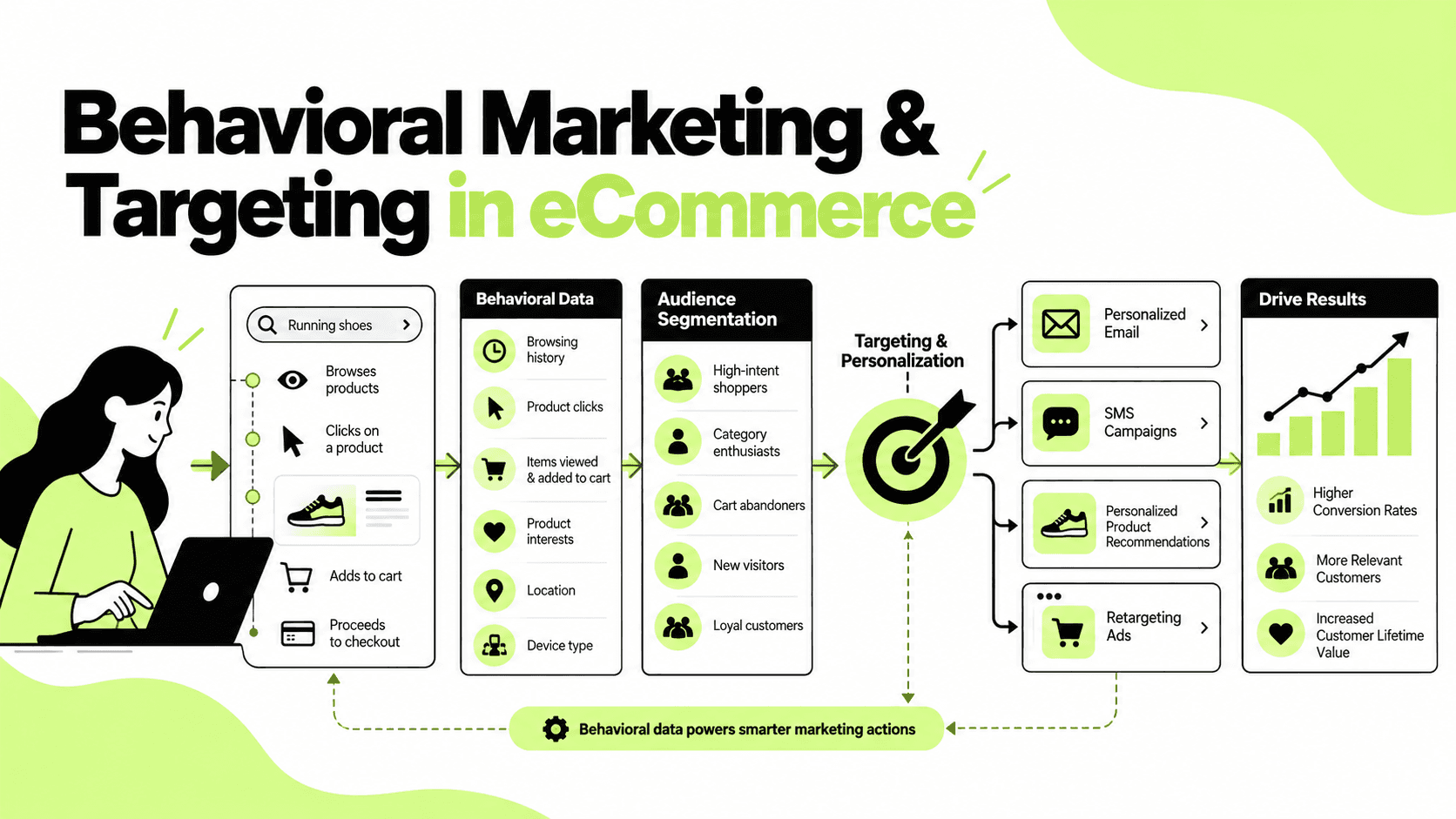
Behavioral marketing in eCommerce usually refers to using customer actions to deliver more relevant marketing messages, recommendations, and offers.
Customer actions, such as browsing products, searching for specific items, adding products to carts, and making purchases, generate behavioral data. This data helps eCommerce businesses understand what shoppers are interested in and respond with targeted marketing at appropriate moments.
For eCommerce marketers and store owners, behavioral marketing offers a way to move beyond generic promotions and make customer engagement more relevant to individual shopping behavior.
This guide explains how behavioral marketing works in eCommerce, the strategies businesses can implement, the behavioral data they need, and how AI and automation can improve targeting, conversion, and customer retention.
What Is Behavioral Marketing or Behavioral Targeting in eCommerce?
Behavioral marketing or behavioral targeting in eCommerce is the practice of using shoppers' observed actions to deliver relevant messages, product recommendations, and offers throughout their customer journeys.
Behavioral marketing and behavioral targeting are often used interchangeably because both rely on customer behavior to make marketing more relevant. However, behavioral marketing covers the broader strategy, while behavioral targeting focuses specifically on identifying and reaching audiences based on their actions.
In eCommerce, every interaction can reveal something about a customer's interests or purchase intent. These interactions include product views, browsing history, on-site searches, clicks, cart additions, purchases, repeat visits, and email engagement.
For example, consider a customer who visits an online skincare store and repeatedly views a particular moisturizer but leaves without purchasing.
The store can use this browsing behavior to identify the customer's interest and send a relevant product reminder through email. If the customer later adds the moisturizer to their cart without completing checkout, that action can trigger a different message addressing the incomplete purchase.
This is how behavior-based marketing connects customer actions with targeted marketing responses.
Behavioral targeting also supports eCommerce personalization by helping brands tailor recommendations, content, offers, and communication to individual interests. A solid strategy ensures these personalized experiences reflect meaningful behavioral signals rather than assumptions based solely on customer demographics.
What Are the Main Strategies for Behavioral Marketing in eCommerce?
The main strategies for behavioral marketing in eCommerce include welcome campaigns, abandonment recovery, product recommendations, behavioral emails, retargeting, upselling, cross-selling, churn prevention, and customer retention initiatives.
The behavioral marketing strategies for eCommerce are listed below.
Welcome Strategy
Browse, Cart, and Checkout Abandonment Recovery Strategy
Product Recommendation Strategy
Behavioral Email Strategy
Retargeting Strategy
Upselling and Cross-Selling Strategy
Churn Prevention and Win-Back Strategy
Customer Retention and Loyalty Strategy
1. Welcome Strategy
A welcome strategy means sending an automated welcome email or message sequence after signup to introduce your brand, answer early questions, and encourage a first purchase.
The welcome sequence represents an early stage of the customer journey, when subscribers have expressed interest but may not be ready to buy.
Marketing automation can use the customer's signup source, product interests, or initial browsing activity to make the welcome communication more relevant.
For example, if a shopper subscribes after exploring a store's running shoes category, the welcome email could introduce popular running shoes, sizing information, and relevant buying guides.
A shopper who subscribes through a skincare product page might receive information about ingredients, skin types, and product benefits instead.
Both customers receive a welcome message, but the content reflects what initially attracted them to the store.
2. Browse, Cart, and Checkout Abandonment Recovery Strategy
A browse, cart, and checkout abandonment recovery strategy means using marketing automation to re-engage shoppers who leave before purchasing, often through a behavior-triggered email.
Although these abandonment events are related, they represent different stages of purchase intent.
Browse abandonment occurs when customers view products without adding them to their carts. Businesses can respond with reminders, product information, or relevant recommendations.
Cart abandonment occurs when shoppers add products to their carts but leave without purchasing. An automated cart abandonment email can remind eligible customers about the items they considered.
Checkout abandonment occurs when shoppers begin checkout but do not complete their orders. These customers may benefit from messages addressing delivery costs, payment options, return policies, or other purchasing concerns.
For example, a customer who leaves a running shoe in their cart might receive a reminder featuring the product, available sizes, and delivery information.
If the customer has already completed the purchase, the recovery sequence should stop automatically.
This distinction helps eCommerce marketers avoid sending identical messages to customers with different levels of purchase intent.
3. Product Recommendation Strategy
A product recommendation strategy means using a recommendation engine to suggest relevant products based on browsing behavior, purchase history, and the shopper's current interests.
Recommendation engines analyze customer interactions to identify products that may be useful or appealing to individual shoppers.
These recommendations can appear on eCommerce websites, in marketing emails, or through other customer engagement channels, depending on the technology being used.
For example, an online electronics store can recommend compatible accessories to customers who recently purchased a smartphone. Someone browsing wireless headphones might instead receive recommendations for similar models within their preferred price range.
Product recommendations can also account for purchase frequency, category preferences, and previously purchased items.
The objective is to make product discovery easier while helping customers find items that match their demonstrated interests.
4. Behavioral Email Strategy
A behavioral email strategy means using automation to send a customer segment timely emails when specific actions, such as product views, purchases, or inactivity, occur.
Unlike conventional email campaigns sent to large subscriber lists at scheduled intervals, behavioral emails are triggered by customer actions or changes in their engagement patterns.
These triggers can include visiting a product page, adding an item to a wishlist, completing a purchase, or becoming inactive.
For example, a customer purchasing a coffee machine can receive an automated email introducing compatible coffee capsules or maintenance accessories.
A customer who frequently browses a particular clothing category can receive relevant product updates when new items become available.
For CRM and lifecycle marketing managers, behavioral email automation creates opportunities to maintain relevant communication throughout the customer lifecycle without manually managing every interaction.
5. Retargeting Strategy
A retargeting strategy means grouping website visitors into an audience based on their product interactions and reaching eligible shoppers with relevant advertising through an ad platform.
Retargeting uses behavioral signals to identify people who have previously interacted with an eCommerce store but may not have completed a desired action.
These audiences can be created based on product views, category visits, cart activity, or past purchases, subject to applicable privacy requirements and advertising platform capabilities.
For example, an online furniture retailer might create an audience of visitors who explored office chairs but did not purchase.
The retailer can then serve relevant office chair advertisements through platforms such as Google Ads or Meta Ads, where the necessary permissions and matching capabilities exist.
Retargeting becomes more effective when different audiences receive messages appropriate to their purchase stage.
Someone who viewed a product once may need more information, while someone who abandoned checkout may benefit from reassurance about delivery, warranties, or returns.
6. Upselling and Cross-Selling Strategy
An upselling and cross-selling strategy means using product catalog and order data to recommend higher-value alternatives or complementary items that fit a shopper's demonstrated preferences.
Upselling encourages customers to consider a more advanced or higher-value version of a product they are already interested in.
Cross-selling focuses on recommending complementary products that improve or support the original purchase.
For example, a customer browsing a basic laptop might receive a recommendation for a higher-specification model with additional storage. This would be an upselling opportunity.
The same customer could also receive recommendations for a laptop sleeve, wireless mouse, or USB-C hub. These would be cross-selling opportunities.
Behavioral data helps businesses determine which recommendations are appropriate by connecting customer interests, purchase history, and product compatibility.
Relevant upselling and cross-selling can increase average order value while making the shopping experience more useful.
7. Churn Prevention and Win-Back Strategy
A churn prevention and win-back strategy means identifying customers at risk of customer churn through purchase data and engagement patterns, then initiating timely re-engagement.
Customer churn in eCommerce can occur when previous buyers stop purchasing or engaging with a brand over an extended period.
However, the definition of inactivity should reflect the business's product category and typical repurchase cycle.
For example, a skincare brand may expect regular customers to reorder certain products every few months. If a customer passes their expected replenishment period without returning, the store can initiate a reminder or personalized re-engagement campaign.
A furniture retailer, however, should not interpret the same period of inactivity as a churn signal because customers typically purchase furniture less frequently.
Behavioral targeting helps distinguish normal purchase intervals from potentially declining customer interest.
Businesses can then use relevant product updates, replenishment reminders, loyalty incentives, or personalized offers to encourage customers to return.
8. Customer Retention and Loyalty Strategy
A customer retention strategy means using CRM data, automated lifecycle communication, and a loyalty program to encourage repeat purchases and strengthen long-term relationships with existing shoppers.
Customer retention becomes particularly important after the initial purchase because existing customers already have experience with the brand.
Behavioral targeting allows eCommerce businesses to personalize post-purchase engagement according to order history, purchase frequency, customer preferences, and loyalty activity.
For example, a customer who regularly purchases pet food could receive replenishment reminders based on their previous buying intervals.
Another customer who frequently purchases premium pet accessories might receive early access to relevant product launches or exclusive loyalty benefits.
A CRM can help organize these customer records, while marketing automation delivers communication when relevant behavioral conditions are met.
Implementing behavioral targeting across the customer lifecycle makes retention campaigns more contextual and gives customers a stronger reason to continue engaging with the brand.
How to Implement Behavioral Targeting in eCommerce?
The implementation of behavioral targeting in eCommerce involves collecting data, tracking user actions, segmenting shoppers, and delivering personalized real-time experiences across suitable marketing channels.
A practical implementation requires businesses to connect behavioral data with marketing decisions rather than simply collecting more information about website visitors.
The following steps explain how to implement behavioral targeting in an eCommerce business.
1. Collect and Track Customer Behavioral Data
Begin by identifying the customer actions that matter most to your marketing objectives.
These actions may include browsing history, product views, category visits, search queries, clicks, cart additions, checkout activity, purchases, and email interactions.
Behavioral tracking tools, website analytics platforms, eCommerce integrations, and customer data platforms can help collect these signals.
For example, Google Analytics 4 supports eCommerce events such as view_item, add_to_cart, begin_checkout, and purchase.
Your tracking setup should connect the relevant events with product and transaction information so they can support meaningful analysis.
Businesses should also establish appropriate consent, data handling, and identity management practices before using behavioral information for personalized marketing.
2. Segment Customers Based on Their Behavior
Once behavioral data is available, the next step is grouping customers according to shared actions, interests, and engagement patterns.
These behavioral segments can include:
High-intent shoppers: Customers repeatedly viewing products, searching for specific items, or starting checkout.
Cart abandoners: Customers who added products to their carts without purchasing.
Category-interested shoppers: Visitors frequently exploring particular product categories.
Repeat customers: Shoppers who have made multiple purchases over a defined period.
At-risk customers: Previous buyers whose purchasing or engagement activity has declined relative to expectations.
Loyal customers: Customers demonstrating frequent purchases, sustained engagement, or participation in loyalty programs.
Unlike demographic segmentation, behavioral segmentation focuses on what customers actually do.
For an eCommerce marketer, this provides a more practical basis for identifying customer intent and deciding which groups should receive different marketing messages.
3. Connect Behavioral Segments With Relevant Marketing Responses
Behavioral segments become useful when they influence how the business communicates with shoppers.
Each segment should have a corresponding marketing objective, relevant message, and appropriate delivery channel.
For example:
Customer behavior | Marketing response | Primary objective |
|---|---|---|
Repeated product views | Product information or reminder | Encourage consideration |
Cart abandonment | Automated cart recovery message | Recover potential sales |
Completed purchase | Post-purchase communication | Improve customer experience |
Frequent repeat purchases | Loyalty rewards or exclusive updates | Strengthen retention |
Declining purchase activity | Replenishment or win-back message | Re-engage customers |
Interest in related products | Personalized recommendations | Support cross-selling |
These responses can be delivered through email, SMS, WhatsApp, push notifications, or suitable advertising channels.
Website-based product recommendations and personalized search experiences may also be used when the business has the necessary technology.
The important consideration is matching the message and channel to the customer's current context.
4. Use AI and Automation to Personalize Customer Engagement
Traditional behavioral targeting typically uses predefined conditions.
For example, a marketing automation workflow might send an email whenever a customer abandons a cart for a specified period.
AI-powered behavioral targeting can extend this approach by analyzing additional signals, identifying patterns, and predicting which communication may be more relevant.
An AI system might consider browsing frequency, recent purchases, engagement history, product interests, and past responses before recommending an action.
Depending on the platform's capabilities, AI can support decisions about audience selection, message content, product recommendations, channel selection, or communication timing.
For eCommerce brands managing large customer bases, this can reduce the manual work involved in creating numerous behavioral segments and campaigns.
However, AI implementation should still follow clear marketing objectives, customer permissions, and performance measurement practices.
5. Measure Results and Improve the Strategy
After launching behavioral campaigns, evaluate whether they lead to meaningful customer and business outcomes.
Monitor conversion rates, recovered carts, average order value, repeat purchases, and customer lifetime value.
Compare performance across customer segments and marketing channels to identify which behavioral responses are producing better results.
Where possible, use controlled experiments or holdout groups to determine whether campaigns generate incremental purchases rather than simply receiving credit for orders that would have happened anyway.
Different types of data and different marketing objectives may require different approaches to measurement.
When evaluating platforms for behavioral marketing, consider tracking quality, segmentation flexibility, automation capabilities, channel coverage, consent management, and reporting before making a decision.
What Are the Types of Data Used for Behavioral Targeting in eCommerce?
The types of behavioral data used in eCommerce include browsing patterns, on-site searches, cart and purchase activity, and engagement with marketing messages, advertisements, and content.
The types of behavioral data used in eCommerce are listed below.
Browsing Behavior: Browsing behavior refers to how shoppers navigate an eCommerce website, including pages viewed, product views, category visits, time spent browsing, and recurring navigation patterns.
Search Behavior: Search behavior refers to shoppers' on-site search queries, search frequency, and product or category interests, which can indicate their needs and potential purchase intent.
Cart and Purchase Behavior: Cart and purchase behavior refers to add-to-cart events, cart abandonment, completed orders, purchase frequency, average order value, and combinations of products purchased together.
Engagement Behavior: Engagement behavior refers to how customers interact with marketing communications and content, including email opens, email clicks, advertisement interactions, returning visits, and content engagement.
These data types become more valuable when businesses analyze them together.
For example, a customer who searches for a product, views it multiple times, and adds it to their cart provides a different behavioral context from someone who briefly visits the product page.
However, behavioral signals indicate possible interests or intentions rather than guaranteeing that a customer will purchase.
What Are the Benefits of Behavioral Marketing in eCommerce?
The benefits of behavioral marketing in eCommerce include more relevant customer experiences, better conversion opportunities, higher average order values, and stronger customer retention.
The benefits are describe below.
1. Creates More Relevant Customer Experiences
Behavioral marketing creates more relevant customer experiences by using browsing or purchase signals to select products and messages that match immediate interests, making contextual marketing more useful.
For example, shoppers exploring winter clothing can receive relevant product updates rather than unrelated promotions, improving the relevance of brand communication.
2. Improves Conversion Opportunities
Behavioral marketing improves conversion opportunities by identifying a high-intent shopper through repeated views, searches, and cart activity, then prioritizing communication that supports their purchase intent.
This allows businesses to focus more attention on customers demonstrating meaningful buying signals without assuming every visitor is equally ready to purchase.
3. Increases Average Order Value
Behavioral marketing increases average order value by using past orders and recent product interest to guide relevant upselling, cross-selling, and recommendations that add useful items.
By recommending compatible accessories or suitable upgrades, eCommerce businesses can encourage additional purchases without relying exclusively on general promotions.
4. Strengthens Customer Retention
Behavioral marketing improves customer retention by timing replenishment, post-purchase support, and loyalty outreach around buying patterns, supporting lifecycle marketing and longer-term customer lifetime value.
These ongoing interactions help brands stay relevant after a customer's initial purchase while providing measurable retention metrics for evaluating campaign performance.
How to Measure Behavioral Marketing?
Behavioral marketing is measured using conversion rate, average order value, cart recovery rate, repeat purchase rate, and customer lifetime value alongside engagement and campaign-level performance metrics.
The following metrics help eCommerce marketers understand whether behavioral targeting produces meaningful business results.
Metric | What it measures | Why it matters |
|---|---|---|
Conversion Rate | Percentage of eligible visitors or recipients who complete a purchase | Evaluates how effectively behavioral engagement leads to purchases |
Average Order Value (AOV) | Revenue generated per order | Helps assess the contribution of upselling and cross-selling |
Cart Recovery Rate | Percentage of eligible abandoned carts recovered within a defined period | Measures the effectiveness of abandonment recovery |
Repeat Purchase Rate | Percentage of customers making more than one purchase during a defined period or cohort | Indicates whether retention initiatives encourage additional purchases |
Customer Lifetime Value (CLV) | Estimated value a customer contributes throughout their relationship with the business | Supports long-term evaluation of customer relationships |
Conversion Rate: Calculate the number of customers who purchased divided by the relevant number of visitors or campaign recipients, multiplied by 100. Use a consistent denominator when comparing campaigns.
Average Order Value: Divide total order revenue by the number of orders during the measurement period.
Cart Recovery Rate: Divide the number of recovered abandoned carts by the number of eligible abandoned carts, multiplied by 100. Establish consistent eligibility and recovery windows.
Repeat Purchase Rate: Divide the number of customers who made multiple purchases by the number of customers in the defined group, multiplied by 100.
Customer Lifetime Value: Estimate the revenue or contribution margin a customer generates across their relationship with the business. For profitability decisions, a margin-based CLV estimate is generally more informative than revenue alone.
AI-powered behavioral marketing should also be evaluated using incremental revenue, customer acquisition and retention costs, unsubscribe rates, and other indicators relevant to the campaign.
To avoid common measurement mistakes, distinguish revenue attributed to marketing from revenue actually generated because of marketing.
A campaign may receive credit for a purchase even when that customer would have bought the product without receiving the message.
Consistent attribution rules, appropriate comparison groups, and regular reporting help businesses make better decisions about which behavioral marketing strategies deserve additional investment.
What Mistakes Should eCommerce Brands Avoid When Implementing Behavioral Targeting?
The mistakes to avoid when implementing behavioral targeting in eCommerce include collecting unreliable data, using overly broad segments, ignoring purchase context, overcommunicating, offering unnecessary discounts, overlooking privacy, and measuring performance incorrectly.
These mistakes are explained below.
1. Relying on Incomplete or Inaccurate Behavioral Data
Incomplete tracking, duplicate events, and disconnected customer records can lead to incorrect behavioral segments and irrelevant marketing messages. Regularly validate event tracking, product data, customer profiles, and integrations before using them for targeting.
2. Creating Overly Broad Behavioral Segments
Grouping customers according to general actions without considering recency, frequency, or purchase intent can reduce the relevance of targeting. Build meaningful segments that distinguish occasional visitors, active product researchers, cart abandoners, and existing customers.
3. Ignoring Changes in Customer Behavior
A customer who viewed a product several weeks ago may no longer have the same interest, especially if they have already purchased something similar. Keep behavioral segments updated and use purchase events, recent activity, and suppression rules to prevent outdated messages.
4. Sending Too Many Automated Messages
Triggering a separate message for every customer interaction can overwhelm shoppers and lead to unsubscribes or disengagement. Apply frequency limits, journey priorities, and channel preferences to maintain appropriate communication.
5. Offering Discounts Without Considering Purchase Intent
Automatically giving discounts to every cart abandoner can reduce profit margins and reward customers who were already likely to purchase. Use behavioral data to identify when a reminder, additional product information, or a targeted incentive is more appropriate.
6. Ignoring Customer Privacy and Marketing Permissions
Collecting behavioral information without appropriate transparency, permissions, or safeguards can create legal and customer trust risks. Apply relevant data protection requirements, respect channel-specific marketing consent, and make preference management straightforward.
7. Measuring Campaign Attribution Instead of Actual Impact
Evaluating behavioral campaigns only through clicks, attributed revenue, or email engagement can exaggerate their commercial contribution. Measure incremental conversions, recovered revenue, retention, and profitability alongside conventional engagement metrics.
8. Choosing Marketing Platforms Without Evaluating Their Capabilities
Some behavioral marketing platforms offer basic rule-based automation, while others provide predictive targeting, customer data integration, and more advanced AI capabilities. Evaluate behavioral targeting platforms for eCommerce like Markopolo AI against your store's data infrastructure, customer engagement needs, supported channels, and measurement requirements.
Avoiding these mistakes is particularly important as eCommerce businesses increase the number of automated campaigns and incorporate AI into their marketing operations.
How Does Markopolo AI Help With Behavioral Marketing in eCommerce?
Markopolo AI helps with behavioral marketing in eCommerce by capturing first-party behavioral signals, interpreting customer purchase intent, and automating personalized marketing communication across multiple customer engagement channels.
The platform uses its behavioral data infrastructure, MarkTag, to capture and organize customer interactions such as browsing activity, product interest, cart behavior, and purchase-related signals.
This behavioral data provides the context needed to understand individual shoppers beyond broad demographic groups or static audience segments.
Markopolo AI's behavioral foundation model, ATHENA, uses customer information to support intent-based targeting and personalized engagement decisions.
For example, a shopper repeatedly viewing a product may require information that helps them evaluate the purchase, while a returning customer with a history of repeat orders may benefit from replenishment reminders or complementary product recommendations.
These different behaviors can inform the messages, offers, and engagement strategies delivered to each customer.
Markopolo AI supports behavior-driven campaigns and automated flows across email, SMS, WhatsApp, web and app push notifications, and AI voice calls. This allows businesses to coordinate customer engagement across supported channels while maintaining behavioral context.
For eCommerce marketers and CRM managers, the implementation of AI and automation can help reduce manual segmentation and make customer communication more responsive to individual intent.
Proper measurement remains important because the success of a behavioral marketing strategy depends on its contribution to conversions, recovered purchases, average order value, and customer retention.
By connecting behavioral data, audience targeting, automated communication, and performance analytics, Markopolo AI helps eCommerce businesses build more relevant customer engagement throughout the buying journey.