Cart Abandonment vs. Checkout Abandonment: Differences, Recovery, and Prevention
Sirazum Monir Osmani
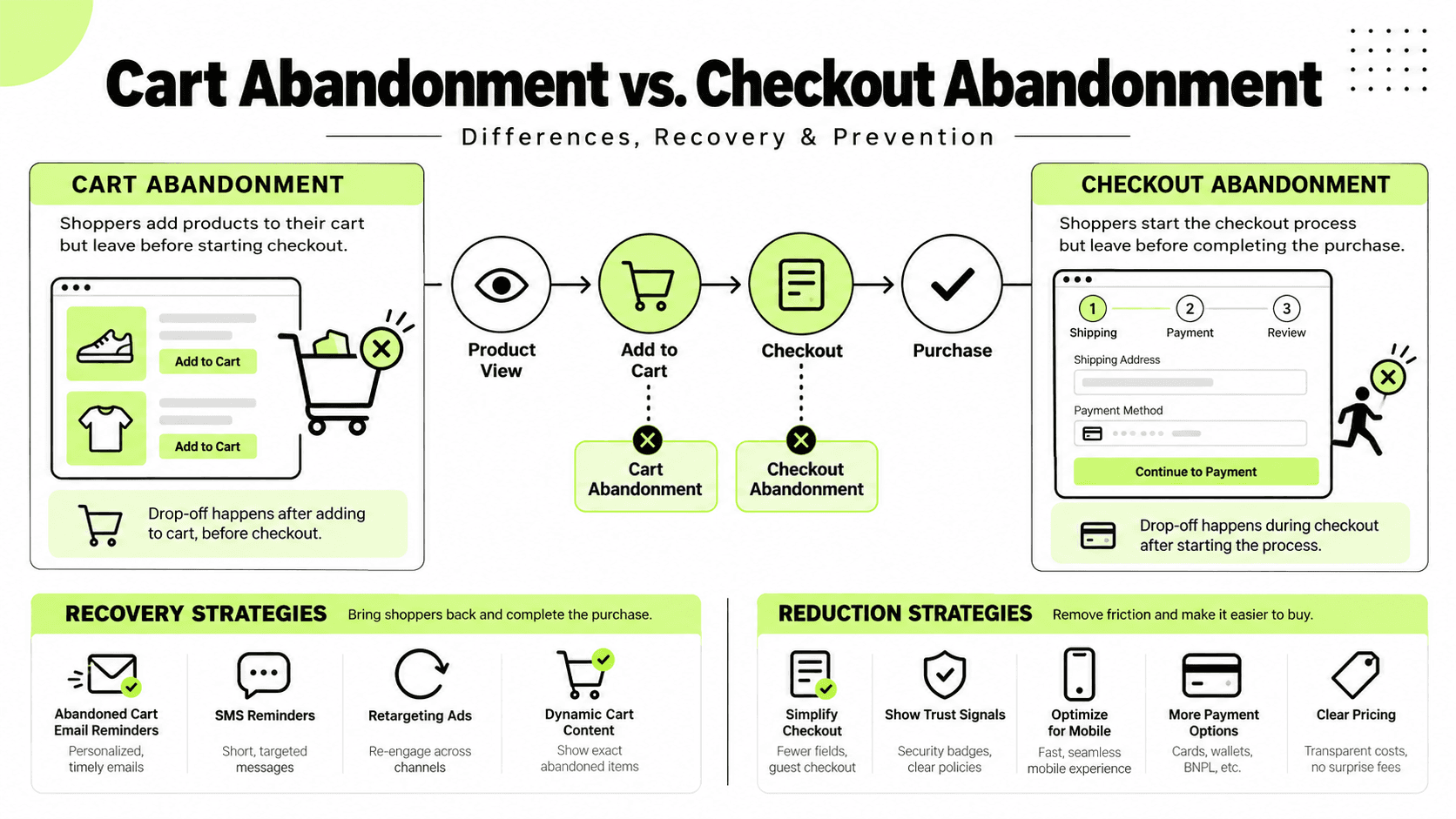
The main difference between cart abandonment and checkout abandonment is where shoppers leave: before or after checkout begins.
Both occur within the eCommerce purchase funnel, but they represent different stages of customer commitment. A shopper who adds products to their cart may still be comparing options, while someone who starts checkout has taken a more deliberate step toward purchasing.
For eCommerce businesses, understanding this distinction is important because the reasons behind each abandonment event, the customer data available, and the opportunities for recovery are not necessarily the same.
This guide explains how cart abandonment and checkout abandonment differ, why they happen, how to calculate their rates, and which recovery and prevention strategies can help convert more shoppers into customers.
What is the Difference Between Cart Abandonment and Checkout Abandonment?
The difference between cart abandonment and checkout abandonment involves the point at which a shopper exits the purchasing journey. Cart abandonment happens before checkout initiation, while checkout abandonment occurs after the checkout flow has started but before an order is completed.
That difference matters because each funnel stage reveals something about purchase intent. Shoppers who reach checkout generally demonstrate stronger buying intent, although their reasons for leaving may involve different obstacles.
The difference between cart abandonment and checkout abandonment is presented in the table below.
Factor | Cart Abandonment | Checkout Abandonment |
|---|---|---|
Drop-off point | After adding to cart, before checkout starts | After checkout starts, before purchase completion |
Checkout status | Not started | Started but incomplete |
Purchase intent | Lower or uncertain | Typically higher |
Available customer data | Often anonymous or limited | More likely identifiable if details were submitted |
Common causes | Hesitation, price comparison, cart-level friction | Shipping costs, account creation, lengthy forms, payment problems |
Recovery approach | Product reminders and cart links | Direct checkout links and reassurance |
Primary objective | Encourage checkout initiation | Help shoppers complete their purchase |
The important distinction is that these are separate abandonment events when classifying shoppers by their last reached stage.
However, a store's overall cart abandonment metric may also include shoppers who reached checkout but did not purchase. Understanding that reporting distinction is essential when measuring the performance of either stage.
What Is Cart Abandonment?
Cart abandonment is when a shopper adds an item to a shopping cart but leaves the online store before initiating checkout, leaving the selected products unpurchased.
Adding a product to a shopping cart signals interest, but it does not necessarily indicate immediate purchase intent. Many shoppers use their carts to organize products, compare prices, or revisit items before making a decision.
For example, a customer browsing an electronics store might add a pair of wireless headphones to their cart, check the total price, and then visit another retailer to compare alternatives.
If the customer leaves without proceeding beyond the cart page, that represents cart abandonment under the stage-specific definition.
The resulting abandoned cart may still offer an opportunity for recovery because the retailer knows which products attracted the customer's attention.
However, unlike checkout abandonment, the shopper has not yet demonstrated a willingness to begin the transaction. As a result, the recovery approach should focus on encouraging consideration and guiding the shopper toward checkout.
What Is Checkout Abandonment?
Checkout abandonment is when a shopper begins the checkout flow but leaves before completing the transaction, whether during shipping details, payment information, or final order review.
This shopper has progressed further through the purchasing process than someone who only added products to a cart. By starting checkout, the customer has demonstrated a stronger intention to complete an order.
For example, a customer buying running shoes may enter their shipping information and proceed to the payment step, only to discover an unexpected delivery charge.
If they leave without completing payment, the store records an abandoned checkout.
Checkout abandonment can happen at several points, including account selection, address entry, shipping selection, payment information, and final order confirmation.
These stages are important because the reason for leaving may have more to do with transaction friction than uncertainty about the product itself.
For an eCommerce marketer, the recovery opportunity is therefore different. Rather than reminding shoppers why they liked the product, an effective checkout recovery flow should help them overcome the obstacle preventing the purchase.
Where Do Cart and Checkout Abandonment Occur in the Ecommerce Funnel?
Cart abandonment occurs at the cart stage of the ecommerce funnel, whereas checkout abandonment occurs after checkout initiation but before the customer completes a purchase.
A typical eCommerce conversion funnel follows this sequence:
Product Page → Add to Cart → Checkout Started → Shipping Information → Payment Information → Purchase → Order Confirmation
Two distinct drop-off points emerge within this journey:
Cart abandonment: The shopper exits after adding an item to the cart but before starting checkout.
Checkout abandonment: The shopper starts checkout but exits before completing the purchase.
Consider an online fashion retailer receiving thousands of product page visits each day.
Some visitors browse without taking further action. Others add clothing to their carts but never begin checkout, while another group reaches the shipping or payment stage and leaves without ordering.
Although all three behaviors represent missed conversion opportunities, they should not trigger identical recovery campaigns.
A visitor who only viewed a product belongs to the browse abandonment stage. A shopper who added clothing to their cart but never started checkout belongs to cart abandonment, while someone who entered checkout belongs to checkout abandonment.
For CRM managers and lifecycle marketers, identifying the last completed funnel stage makes it easier to investigate the reason for abandonment and deliver a relevant response.
Why Do Customers Abandon Their Cart?
The reasons customers abandon their cart involve uncertain purchase intent, product evaluation, price sensitivity, and difficulties navigating the shopping cart before checkout begins.
Not every abandoned cart indicates a problem with the store. In many cases, shoppers are simply exploring their options rather than preparing to place an immediate order.
In fact, Baymard Institute's research reports that 42% of surveyed US online shoppers had abandoned a cart within the previous three months because they were browsing or not ready to buy.
The reasons customers abandon their cart are listed below.
Price Comparison: Shoppers may add products to their carts to compare prices across competing retailers before making a decision. If another store offers better overall value, they may leave without starting checkout.
Browsing Without Intent to Buy: Some visitors use online stores to discover products, explore collections, or understand available options. Their interaction with the cart reflects curiosity rather than an immediate intention to purchase.
Saving Products for Later: Customers sometimes treat their shopping carts as temporary wishlists for products they might purchase in the future. They may abandon the current session because they intend to return after receiving their salary, consulting someone, or reconsidering their budget.
Cart Page Friction: Confusing quantity controls, unclear pricing, unexpected product changes, or difficult navigation can discourage shoppers from proceeding. Friction at the cart page makes the transition from product consideration to checkout unnecessarily difficult.
Poor Mobile Experience: Small buttons, slow-loading cart pages, intrusive pop-ups, and difficult navigation can interrupt shopping on mobile devices. These obstacles can cause users to leave before checkout, even when they are genuinely interested in purchasing.
For eCommerce teams, separating these causes is useful because not every cart requires an incentive to recover.
A shopper comparing products may benefit from reviews or product information, while someone struggling with the cart interface needs a smoother purchasing experience.
Why Do Customers Abandon Checkout?
The reasons customers abandon checkout involve unexpected costs, complicated purchasing requirements, payment difficulties, and concerns about transaction security or delivery reliability.
Unlike earlier cart-stage hesitation, checkout abandonment often occurs when a customer encounters an obstacle while attempting to complete a purchase.
Research from Baymard Institute identifies additional costs, trust concerns, forced account creation, and complicated checkout processes among significant reasons customers leave without purchasing.
The reasons customers abandon checkout are listed below.
Unexpected Shipping Costs: Customers may reach checkout expecting one price and discover that delivery significantly increases the order total. Unexpected shipping charges can make the purchase feel less attractive than it did on the product or cart page.
Unexpected Taxes: Taxes introduced late in the checkout process can create a mismatch between the advertised price and the final amount payable. That mismatch may prompt customers to reconsider the purchase or compare alternatives.
Additional Fees: Handling charges, service fees, and other unexplained costs can reduce confidence in the transaction. Customers may abandon checkout when the final total appears unnecessarily complicated or higher than expected.
Mandatory Account Creation: Requiring shoppers to register before purchasing introduces an additional commitment they may not want to make. Customers looking for a quick transaction may abandon the process rather than create an account.
Long Checkout Forms: Excessive fields, repetitive information requests, and unclear validation messages increase the effort required to place an order. The longer or more confusing the process becomes, the greater the opportunity for customers to disengage.
Payment Problems: Declined transactions, malfunctioning payment gateways, and unavailable preferred payment methods can prevent otherwise willing buyers from completing their orders. Customers who repeatedly encounter payment errors may eventually abandon the checkout entirely.
Trust Concerns: An unfamiliar retailer, unclear return policies, or missing contact information can make shoppers hesitate before committing their money. These concerns become particularly important when the customer is asked to provide personal or financial details.
Security Concerns: Suspicious payment pages, insecure connections, or unfamiliar payment redirects may make customers uncomfortable entering sensitive information. Even legitimate businesses can lose sales if their checkout experience appears unreliable.
Understanding these causes is useful when calculating the checkout abandonment rate because the percentage alone cannot explain why shoppers are leaving.
A high rate may indicate technical failures, pricing issues, or customer hesitation. Identifying which factor is responsible is necessary before selecting a suitable intervention.
How to Calculate Cart Abandonment Rate?
Cart abandonment rate is the percentage of created shopping carts that do not result in completed purchases during a defined measurement period, based on consistent ecommerce tracking.
The standard cart abandonment rate formula is:
Cart Abandonment Rate = [(Carts Created − Completed Purchases) ÷ Carts Created] × 100
For example, imagine an online store records the following activity:
Carts created: 1,000
Completed purchases: 300
Using the formula:
Cart Abandonment Rate = [(1,000 − 300) ÷ 1,000] × 100 = 70%
This means 70% of the carts did not convert into completed purchases.
However, there is an important measurement distinction.
The standard cart abandonment rate includes carts that were abandoned before checkout as well as carts that progressed into checkout but never resulted in an order.
Therefore, if you want to isolate customers who left before checkout initiation, you need to calculate the pre-checkout cart drop-off rate separately.
Pre-Checkout Cart Drop-off Rate = [(Carts Created − Checkouts Started) ÷ Carts Created] × 100
Suppose 600 of the 1,000 carts progressed into checkout.
Pre-Checkout Cart Drop-off Rate = [(1,000 − 600) ÷ 1,000] × 100 = 40%
In this example, the store has a 70% overall cart abandonment rate but a 40% pre-checkout cart drop-off rate.
Both figures are useful, but they answer different questions.
The calculation is important for eCommerce analytics because platforms may define carts created, checkout initiation, and abandonment events differently. For reliable reporting, use consistent cart or journey identifiers, attribution windows, and event definitions rather than simply subtracting unrelated event totals.
You should also monitor related funnel metrics:
Add-to-cart rate: The percentage of eligible visitors or sessions that add a product to their cart.
Cart-to-checkout rate: The percentage of created carts that progress to checkout.
Conversion rate: The percentage of visitors or sessions that complete a purchase.
Together, these metrics provide a more complete understanding of where potential sales are lost.
How to Calculate Checkout Abandonment Rate?
Checkout abandonment rate is the percentage of initiated checkouts that do not result in completed purchases, measuring drop-off between checkout initiation and successful transaction completion.
The formula is:
Checkout Abandonment Rate = [(Checkouts Started − Purchases Completed) ÷ Checkouts Started] × 100
Continuing the previous example:
Checkouts started: 600
Purchases completed: 300
Checkout Abandonment Rate = [(600 − 300) ÷ 600] × 100 = 50%
This means half of the initiated checkouts failed to convert into completed orders.
The corresponding checkout completion rate, also called the checkout conversion rate in some reporting systems, would be:
Checkout Completion Rate = (Purchases Completed ÷ Checkouts Started) × 100
Checkout Completion Rate = (300 ÷ 600) × 100 = 50%
Unlike the overall cart abandonment rate, checkout abandonment measures friction specifically within the transaction process.
You can investigate that friction further by tracking movement between individual checkout stages, including shipping information, payment information, and order submission.
For example, if customers consistently leave at the payment step, the problem may involve payment reliability, available methods, or transaction security rather than product pricing.
The key is to measure checkouts and resulting purchases consistently, allowing enough time for shoppers to finish their orders and accounting for customers who return later.
Google Analytics 4 supports this analysis through recommended eCommerce events such as add_to_cart, begin_checkout, add_shipping_info, add_payment_info, and purchase, as documented in Google's eCommerce measurement guide.
How to Recover Abandoned Carts?
To recover abandoned carts, re-engage shoppers with relevant product reminders, automated emails, and appropriate SMS or retargeting campaigns that encourage them to resume shopping before checkout.
Cart recovery works best when the communication reflects the shopper's earlier funnel stage.
Because these customers have not started checkout, their hesitation may relate to product suitability, perceived value, delivery expectations, or simply forgetting the items they selected.
An effective recovery flow should therefore provide a useful reason to return rather than immediately offering a discount.
1. Start with an abandoned cart email
A personalized abandoned cart email can remind shoppers about the items they selected, including product names, images, prices, and a convenient cart link.
Keep the message relevant to their shopping activity and make it easy to resume without searching for the products again.
2. Address potential purchase hesitation
If the shopper does not respond, a follow-up message can introduce product reviews, comparisons, delivery information, or other details that support the purchase decision.
This is especially helpful for products that require more consideration, such as electronics, furniture, and premium consumer goods.
3. Use additional channels selectively
SMS and retargeting advertisements can help reach eligible shoppers who did not engage with the initial email.
However, channel selection should consider customer consent, previous engagement, message frequency, and the value of the potential order.
4. Introduce incentives when appropriate
Discounts, free shipping, or limited-time offers may help recover customers whose behavior indicates price sensitivity.
Offering incentives indiscriminately can reduce margins and train customers to abandon carts in anticipation of future discounts.
For lifecycle marketers, the objective of email automation should be to move shoppers toward checkout while preserving relevance and profitability.
That objective requires a recovery before checkout approach rather than the same messaging used for shoppers who have already attempted payment.
How to Recover Abandoned Checkouts?
To recover abandoned checkouts, bring shoppers back into the checkout flow with personalized reminders, direct checkout links, and reassurance addressing possible payment, shipping, or trust concerns.
Unlike cart recovery, checkout recovery targets customers who have already shown a stronger intention to buy.
These customers may not need additional product persuasion. Instead, they may need help completing the transaction they previously started.
1. Send an abandoned checkout email
An abandoned checkout email should acknowledge the unfinished purchase and provide a direct way to continue.
Whenever technically supported, use a checkout recovery link that preserves the shopper's order and previously entered information, reducing the effort required to complete the transaction.
2. Address checkout-specific objections
If shipping charges, delivery timelines, or payment options could be contributing to abandonment, make the relevant information easy to find.
For example, a reminder could clarify available delivery options or direct customers to alternative payment methods.
3. Reinforce transaction confidence
Relevant trust signals, clearly presented return policies, accessible customer support, and secure payment information can reassure hesitant buyers.
These elements are particularly important for first-time customers who may be unfamiliar with the store.
4. Automate follow-ups without unnecessary repetition
A checkout recovery flow can follow up through email or an appropriately consented SMS when the initial reminder does not produce a purchase.
However, the automation should stop when the customer completes the order, avoiding irrelevant messages after conversion.
Although these strategies can recover otherwise lost sales, prevention is better than repeatedly asking shoppers to return to a checkout experience that caused them difficulty.
How to Prevent Cart Abandonment?
Preventing cart abandonment involves improving product clarity, minimizing shopping cart friction, displaying accurate pricing, and helping interested visitors move naturally toward checkout.
The goal is not to force every shopper into an immediate purchase. Instead, it is to reduce avoidable obstacles that interrupt genuine buying intent.
The ways to prevent cart abandonment are listed below.
Improve Cart UX: Design a clean shopping cart with visible product details, editable quantities, clear totals, and intuitive navigation.
Make Pricing Clear: Show accurate product prices, discounts, and relevant charges before customers reach the transaction stage.
Make Product Information Clear: Provide complete product specifications, sizing details, images, and availability information to reduce purchase uncertainty.
Make Shipping Information Transparent: Display delivery charges, estimated delivery times, and shipping eligibility early enough for shoppers to evaluate the total purchase.
Improve the Mobile Experience: Ensure cart pages load quickly, buttons are easy to tap, and product details remain readable across mobile screens.
Reduce Unnecessary Friction: Remove distracting elements, confusing cart updates, and unnecessary steps between selecting products and proceeding to checkout.
Make the Path to Checkout Obvious: Use a prominent checkout button and a straightforward progression that helps shoppers understand their next action.
These improvements can increase cart-to-checkout conversion without depending entirely on promotional discounts.
For eCommerce CEOs and marketing directors, this distinction matters because reducing friction improves the underlying purchasing experience rather than relying exclusively on recovery campaigns to compensate for it.
How to Prevent Checkout Abandonment?
Preventing checkout abandonment involves simplifying the transaction process, reducing unexpected costs, improving payment reliability, and providing a secure purchasing experience that encourages customers to complete their orders.
Once a shopper begins checkout, every unnecessary step introduces another opportunity to leave.
The ways to prevent checkout abandonment are listed below.
Reduce Checkout Complexity: Create a straightforward checkout flow with clear progress indicators and minimal unnecessary transitions.
Offer Guest Checkout: Allow customers to complete purchases without mandatory account registration, reducing barriers for first-time buyers.
Reduce Unnecessary Form Fields: Request only the information required to process the order and use appropriate autofill or address assistance where possible.
Show Shipping Costs Early: Display delivery charges and available shipping options before the final payment stage to prevent unpleasant surprises.
Offer Appropriate Payment Methods: Support payment options that align with customer preferences, market requirements, and the store's transaction model.
Improve Payment Reliability: Monitor payment failures, gateway errors, and declined transactions to identify technical problems that interrupt purchasing.
Add Relevant Trust Signals: Use secure payment experiences, clear refund policies, legitimate security indicators, and accessible support information to build confidence.
Optimize Checkout for Mobile: Make checkout forms, payment selection, error messages, and final order buttons easy to use on smaller screens.
The objective is to prevent customers from dropping off after they have already decided to proceed with their purchase.
However, even a simplified checkout can experience abandonment. Continuous monitoring is therefore necessary to identify new sources of friction as customer behavior, payment systems, and device usage evolve.
How to Diagnose Where Customers Are Dropping Off?
To diagnose where customers are dropping off, compare cart creation, checkout initiation, and completed purchases using funnel analysis to identify which stage loses the most shoppers.
Start by examining three core events:
Add to Cart → Begin Checkout → Purchase
If cart-to-checkout conversion is low, investigate product information, pricing clarity, and cart usability.
If checkout initiation is strong but the checkout drop-off rate remains high, examine shipping charges, form completion, payment methods, and transaction errors.
You can make this analysis more precise by tracking individual checkout steps and segmenting results by device, traffic source, customer type, and product category.
For example, a higher abandonment rate among mobile customers may suggest usability or payment integration issues that are not visible in desktop reporting.
Similarly, a sudden increase in abandonment after a checkout redesign should prompt an investigation into the updated experience.
Using eCommerce analytics helps teams distinguish between observable behavior and assumptions about why customers leave. Although funnel analysis identifies where abandonment happens, customer feedback, usability testing, and technical diagnostics can help establish its underlying cause.
With the help of AI, teams can also analyze behavioral patterns across larger numbers of shopping journeys and use those insights to prioritize improvements.
How AI Platforms Help with Both Cart Abandonment and Checkout Abandonment?
The way AI platforms help with both cart abandonment and checkout abandonment is by addressing friction at different stages of the purchase funnel, such as purchase hesitation before checkout and transaction difficulties after checkout initiation.
Traditional recovery campaigns often operate through fixed rules. For example, every shopper who abandons a cart might receive the same email after a predetermined delay, regardless of purchase intent, browsing behavior, or previous engagement.
While this approach can recover orders, it does not fully account for differences between customers or abandonment stages.
AI-powered customer engagement platforms can use behavioral data, predictive models, and personalization to make recovery more relevant to each shopper's circumstances.
Behavioral analysis identifies the abandonment stage.
By tracking activities such as product views, cart additions, checkout initiation, and purchase events, AI-enabled systems can distinguish between shoppers who abandoned a cart and those who exited checkout.
This distinction provides the foundation for stage-appropriate recovery campaigns.
Predictive models help prioritize recovery opportunities.
AI models can estimate purchase propensity, recognize patterns associated with abandonment, and identify customers who may benefit from additional engagement.
These predictions can help marketers decide which shoppers to contact and when to avoid unnecessary communication, although predictions do not establish the exact reason someone abandoned a purchase.
Personalization makes recovery messages more relevant.
Rather than sending identical messages to every customer, AI can tailor communication using available product information, previous interactions, and behavioral signals.
For cart abandonment, that could mean product reminders, relevant reviews, or guidance that helps customers decide whether to buy.
For checkout abandonment, messaging may instead focus on delivery information, payment assistance, or a convenient link back to the transaction.
Automated journeys connect recovery actions across channels.
AI-enabled recovery systems can coordinate email, SMS, and other supported channels according to customer preferences, consent, and campaign configuration.
They can also incorporate purchase events to prevent shoppers from receiving unnecessary reminders after completing their orders.
The value of these capabilities extends beyond recovering individual abandoned sessions.
By examining recurring abandonment patterns, eCommerce businesses can identify opportunities to improve product information, purchasing journeys, and customer engagement strategies.
That combination of recovery intelligence and experience optimization helps address current conversion losses while reducing the likelihood of similar problems occurring in the future.
How Does Markopolo AI Help with Both Cart Abandonment and Checkout Abandonment?
Markopolo AI helps with cart abandonment and checkout abandonment by identifying the shopper's last reached purchasing stage and triggering personalized recovery journeys based on their behavior and engagement history.
The platform distinguishes between shoppers who added products to a cart but never started checkout and those who began checkout but left before purchasing.
This difference between cart abandonment and checkout abandonment allows each audience to enter a separate recovery workflow rather than receiving the same generic reminder.
For cart abandonment, Markopolo AI can personalize reminders using the products shoppers selected and encourage them to return to their carts.
For checkout abandonment, it can activate a separate recovery sequence focused on helping shoppers resume and complete their transactions.
Its AI email marketing and SMS marketing capabilities support behavior-triggered communication, allowing marketers to reach eligible customers with messages relevant to their stage of the purchasing journey.
Importantly, Markopolo AI's campaigns check for purchase completion before subsequent steps and automatically stop when a customer purchases.
That means a shopper who returns and completes an order does not need to continue receiving reminders for the abandoned transaction.
The platform also supports separate recovery campaign configurations, making it possible to tailor the messaging, timing, and channel sequence to each abandonment stage.
For eCommerce marketing and CRM teams, this creates an opportunity to move beyond treating every uncompleted purchase as the same event.
Instead, teams can use funnel-stage data to improve recovery of abandonment, monitor relevant conversion metrics, and uncover opportunities for preventing future abandonment issues.
Ultimately, reducing abandonment is not simply about sending more reminders. It is about understanding where a purchase journey was interrupted, recognizing what the shopper may need next, and making it easier to complete the purchase.
Explore Markopolo AI to learn how behavior-driven customer engagement can support cart recovery, checkout recovery, and more personalized eCommerce purchasing journeys.