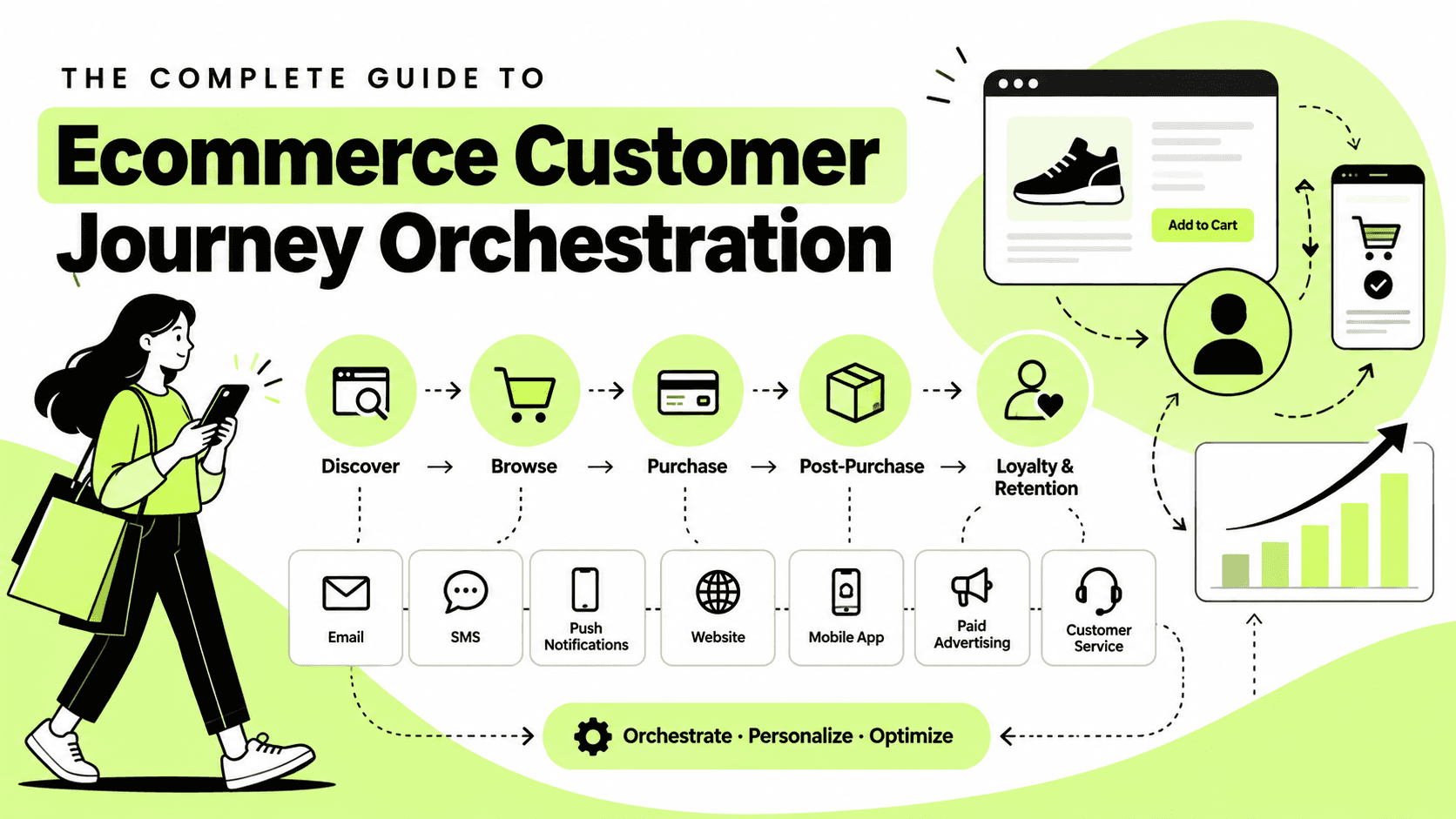
Customer Journey Orchestration in eCommerce: Definition, Implementation Strategies, Examples, Best Practices, & More (Full Guide)
Sirazum Monir Osmani
eCommerce customer journey orchestration basically refers to coordinating customer interactions across channels based on each shopper’s behavior, context, and journey stage.
eCommerce brands utilize customer journey orchestration to make marketing more relevant, improve customer experience, increase conversions, and prevent disconnected messages from competing with one another. Journey orchestration connects email, SMS, WhatsApp, push notifications, AI voice call, and website (digital storefront) experience around the customer.
The main components of customer journey orchestration in eCommerce include unified customer data, behavioral events, customer profiles, segmentation, AI and predictive analytics, next-best-action decisioning, personalization, automation, omnichannel activation, and journey analytics.
Implementation strategies generally start with defining business objectives and identifying important journeys. From there, eCommerce brands need to audit customer data, establish behavioral events and decision rules, connect marketing channels, build adaptive journeys, test different approaches, measure performance, and continuously optimize them.
Customer journey orchestration platforms make all this coordination considerably easier from one system.
What Is Customer Journey Orchestration in eCommerce?
Customer journey orchestration in eCommerce is the process of dynamically coordinating customer interactions across channels based on unified data, real-time behavior, customer context, and journey objectives.
eCommerce businesses use orchestration because online shopper journeys rarely follow a simple predefined sequence. A shopper might discover a product through an advertisement, browse it on mobile, return through email, abandon a cart, purchase through desktop, and later contact customer service.
For an eCommerce CRM manager, this helps determine the next best interaction for each customer.
How Does Customer Journey Orchestration Work in eCommerce?
The steps of how customer journey orchestration works are listed below.
Collect Customer Signals: The system captures important behavioral signals such as product views, searches, cart additions, purchases, email clicks, customer service interactions, and other events.
Unify Customer Data: Data from different touchpoints is combined so the business can understand the customer as one person instead of several disconnected channel identities.
Understand Customer Context: The orchestration system evaluates information such as purchase history, engagement, preferences, intent, journey stage, and recent customer behavior.
Apply Decisioning: Business rules, segmentation, predictive models, or AI determine which potential actions are appropriate for the customer.
Select the Next-Best Action: The system chooses the most relevant interaction, such as sending an email, showing a recommendation, suppressing a promotion, or waiting for another signal.
Deliver the Interaction: The selected experience is activated through the most appropriate channel or customer touchpoint.
Measure the Response: The system observes whether the customer viewed, clicked, purchased, ignored the interaction, or performed another behavioral event.
Adapt the Journey: New signals are fed back into the journey so future decisions can change according to the customer’s latest behavior.
What Does Real-Time Customer Journey Orchestration Mean in eCommerce?
Real-time customer journey orchestration in eCommerce means detecting a shopper’s behavioral event, evaluating current customer context, making a decision, and activating the appropriate interaction immediately or at the appropriate next moment.
Real-time does not always mean “send immediately.” Sometimes the best real-time decision is to delay, suppress, or choose a different channel.
For example, a customer may receive a cart reminder but purchase before the next scheduled touchpoint. Real-time decisioning recognizes the purchase behavioral event and immediately changes the adaptive journey, potentially suppressing the reminder and triggering a post-purchase experience instead.
What is the Difference Among Customer Journey Orchestration, Journey Mapping, and Automation in eCommerce?
In eCommerce, the difference among customer journey orchestration, journey mapping, and marketing automation is that mapping visualizes journeys, automation executes predefined actions, while orchestration dynamically coordinates what happens next.
Journey mapping helps teams visualize the customer journey, including important stages, touchpoints, expectations, pain points, and potential opportunities.
Marketing automation executes predefined actions based on configured triggers or schedules. For example, a standard automation might send three emails at fixed intervals after someone abandons a cart.
Customer journey orchestration sits above these activities and dynamically determines which experience should occur based on customer context. Instead of assuming everyone should remain inside the same automation, orchestration can change the path when customer behavior changes.
Journey analytics is another major component because marketers need visibility into how customers move through journeys and where performance improves or declines.
In practice, mapping, marketing automation, personalization, analytics, and orchestration work together. Orchestration is the coordination layer that connects them around the customer.
What are the Key Components of Customer Journey Orchestration in eCommerce?
The key components of customer journey orchestration in eCommerce include unified customer data, customer identity, behavioral events, decisioning, AI, personalization, omnichannel activation, analytics, and communication controls.
Let’s get to know the details about them.
Unified Customer Data
Unified customer data combines information from eCommerce platforms, websites, apps, communication channels, customer service systems, advertising platforms, and other relevant sources. This creates the shared data foundation required for journey decisions.
Without unified data, separate systems may make decisions using incomplete versions of the same customer.
Customer Profiles and Identity
Customer profiles bring together behavioral, transactional, demographic, engagement, and preference data around an identifiable customer. Identity resolution helps connect interactions that may otherwise appear as separate profiles.
Accurate identity becomes particularly important when shoppers interact across multiple devices or channels.
Behavioral Events and Real-Time Triggers
Behavioral events represent actions such as viewing a product, starting checkout, making a purchase, clicking a campaign, or becoming inactive. Real-time triggers allow journeys to respond when those actions occur.
For retail lifecycle marketers, the closer the trigger is to meaningful customer behavior, the more contextual the resulting interaction can become.
Segmentation and Decision Engines
Segmentation organizes customers according to attributes or behavior, while decision engines determine which action should receive priority. The decision engine can evaluate several possible journeys before selecting the most appropriate path.
This helps move segmentation beyond static audience lists toward continuously changing customer states.
AI & Predictive Analytics
AI and predictive analytics can identify patterns that simple rules may miss, such as purchase propensity, churn likelihood, expected replenishment periods, predicted customer value, or product affinities.
AI is most useful when it improves a meaningful journey decision rather than being introduced simply because automation is available.
Next-Best-Action Decisioning
Next-best-action decisioning determines which action is most appropriate for a customer at a specific moment. The right decision may be an offer, recommendation, educational message, service interaction, different channel, or even no message at all.
That final possibility matters: good orchestration should know when not to communicate.
Personalization and Automation
Personalization adapts the experience to customer context, while automation makes the interaction scalable. Together, they allow brands to deliver relevant experiences without manually managing each shopper.
Effective personalization should influence the journey itself, not only the copy inside a message.
Omnichannel Activation
Omnichannel activation allows the orchestration system to trigger interactions through channels such as email, SMS, push notifications, website experiences, apps, and advertising.
The objective is not to activate every channel. It is to activate the channel that makes sense for the current customer context.
Journey Analytics
Journey analytics shows how customers progress through different paths, where they convert, where they disengage, and which interactions influence outcomes.
These insights help marketers identify journey bottlenecks and determine where orchestration logic should be improved.
Frequency Capping & Suppression
Frequency capping controls how often customers can receive messages within a given period. Suppression rules prevent communications when another interaction or customer state makes them inappropriate.
Together, these controls help prevent an orchestration program from becoming an over-messaging engine.
How to Implement Customer Journey Orchestration?
Implementing customer journey orchestration involves defining objectives, prioritizing journeys, preparing customer data, establishing events and decision rules, connecting channels, building adaptive journeys, testing, measuring, and optimizing.
Below is a step-by-step strategy for eCommerce businesses to orchestrate customer journeys:
Step 1 – Define Business Objectives
Defining business objectives means establishing the measurable outcomes your orchestration program should improve. Objectives should connect the customer experience to business outcomes such as conversion, retention, customer lifetime value (CLV), and churn reduction.
A clear objective also keeps teams from automating journeys simply because the technology allows them to.
Step 2 – Identify Priority Journeys
Identifying priority journeys means selecting the customer journeys where improved coordination could create the greatest business impact. Start with high-value journeys such as onboarding, cart recovery, post-purchase, repeat purchase, replenishment, or churn prevention rather than trying to orchestrate everything simultaneously.
For an eCommerce or CRM manager, prioritization also makes implementation easier to measure and manage.
Step 3 – Audit Customer Data
Auditing customer data means reviewing your available data sources, data quality, identity processes, and gaps across the customer profile. Look specifically for data silos, duplicate identities, delayed information, and missing signals that could affect decisioning.
The quality of orchestration ultimately depends on the quality and availability of the context behind each decision.
Step 4 – Define Behavioral Events
Defining behavioral events means identifying the customer behaviors and triggers that should activate or modify a journey. Relevant events might include product views, category browsing, search activity, cart additions, checkout starts, purchases, cancellations, message interactions, or periods of inactivity.
Events should represent meaningful changes in customer behavior rather than every action your technology can technically capture.
Step 5 – Establish Decision Rules
Establishing decision rules means determining eligibility, triggers, priorities, suppression rules, and exit conditions for each journey. These rules decide which customers can enter a journey, which journey wins when several compete, and when communication should stop.
Strong decision rules are essential for avoiding overlapping automation.
Step 6 – Connect Channels
Connecting channels means integrating the touchpoints required for omnichannel activation. Channel integrations may include email, SMS, web push, app push, websites, apps, advertising platforms, and service systems.
You do not necessarily need every possible channel. Start with the channels that already play meaningful roles in your customers’ journeys.
Step 7 – Build Adaptive Journeys
Building adaptive journeys means applying journey logic and dynamic decisioning so each path can change according to customer behavior. Personalization should affect which action happens next, not simply which product or name appears inside the same fixed sequence.
This is where orchestration begins to differ materially from traditional linear campaign automation.
Step 8 – Test
Testing means running experimentation and journey testing before scaling an orchestration program. Test journey variations, timing, channel sequences, offers, suppression policies, and decision logic to understand which approach produces better outcomes.
Testing should also verify that customers exit or switch journeys correctly when their behavior changes.
Step 9 – Measure
Measuring means tracking KPIs such as conversion, engagement, revenue, retention, and operational performance. Measurement should happen at the overall journey level as well as individual interaction level.
A high email click-through rate, for example, matters less if the complete journey fails to improve the intended business outcome.
Step 10 – Optimize
Optimizing means using the feedback loop generated by customer responses to continuously refine journeys. Journey optimization should be a process of continuous improvement where real-time results influence future decision rules, prioritization, personalization, and channel strategies.
As customer behavior changes, the orchestration program should change with it.
What are the main channels for Customer Journey Orchestration in eCommerce?
The main channels for customer journey orchestration in eCommerce are:
Email: Email can support onboarding, recommendations, cart recovery, post-purchase communication, replenishment, retention, and other lifecycle journeys.
SMS: SMS can provide timely communications when urgency or short-form messaging makes the channel appropriate.
WhatsApp: WhatsApp can grab customer attention in the moment when it matters the most.
Push Notifications: Web and app push notifications can bring customers back to products, carts, promotions, content, or other journey experiences.
AI Voice Call: AI voice calls can provide the right assistance to the right customer regarding pre-purchase and post-purchase support.
Website (digital storefront): Websites can personalize product recommendations, banners, offers, content, navigation, and other experiences according to customer context.
Mobile App: Apps can adapt notifications, recommendations, content, and other interactions based on logged-in customer behavior.
Paid Advertising: Paid advertising audiences and messaging can change based on customer stage, purchase behavior, suppression requirements, or other journey signals.
Chatbot: Chatbots can provide valuable context about customer problems, intent, satisfaction, and purchase status that should influence marketing journeys.
Cross-Channel Coordination: Cross-channel coordination connects all CJO channels so one interaction can influence what happens through another.
How Does eCommerce CJO Coordinate Multiple Channels?
Customer journey orchestration coordinates multiple channels by treating the customer as one journey rather than a collection of separate email, SMS, WhatsApp, push, AI voice call, and others.
For example, if a shopper clicks an email and completes a purchase, orchestration can suppress a pending SMS reminder and remove that customer from cart-retargeting audiences.
This prevents channel conflict and helps prevent over-messaging while maintaining a consistent experience.
How Does Customer Journey Orchestration Prevent Over-Messaging?
Customer journey orchestration prevents over-messaging by managing competing journeys centrally and determining which communication deserves priority.
A customer action can interrupt, change, or suppress other campaigns. For example, if someone purchases during a browse-abandonment journey, the purchase event should immediately remove them from unnecessary browse and cart reminders.
That distinction is important because frequency management should happen at the customer level, not only the campaign level.
What are the Examples of Customer Journey Orchestration in eCommerce?
Welcome and Onboarding Journeys
Welcome and onboarding journeys adapt early communications according to how new customers interact with your store. Someone who immediately purchases may leave the introductory sequence and move into a post-purchase journey, while a non-purchaser may continue receiving educational or discovery content.
Following best practices, onboarding should reflect customer progress rather than forcing everyone through the same sequence.
Browse Abandonment Journeys
Browse abandonment journeys respond when customers show interest in products without adding them to a cart. The journey may use product affinity, repeated views, price, prior purchases, and engagement to determine whether an email, retargeting message, recommendation, or no action is appropriate.
Higher-intent browsing behavior can therefore receive different treatment from casual exploration.
Cart Abandonment Journeys
Cart abandonment journeys coordinate recovery attempts around current purchase intent. Email might initiate the journey, while SMS, push, paid advertising, or another channel can be introduced depending on customer response and consent.
Once a purchase occurs, the customer should immediately exit recovery communications.
Post-Purchase Journeys
Post-purchase journeys coordinate order-related communication with education, product usage guidance, review requests, recommendations, and future purchase opportunities.
Cross-sell and upsell opportunities should appear when they make sense within the customer relationship rather than immediately pushing another sale after every order.
Replenishment Journeys
Replenishment journeys estimate when customers may need to repurchase a consumable or frequently reordered product. Purchase history, average usage periods, order frequency, and customer behavior can determine when and where reminders appear.
The journey can adapt if the customer repurchases earlier than expected.
Loyalty Journeys
Loyalty journeys recognize repeat purchasers, high-value customers, VIP segments, loyalty milestones, and changing engagement patterns. Orchestration can coordinate rewards, early access, recommendations, content, and recognition across multiple channels.
This helps loyalty become an ongoing customer experience rather than simply a points notification.
Churn Prevention Journeys
Churn prevention journeys detect signals that a previously engaged customer may be becoming inactive. Declining purchase frequency, reduced engagement, missed replenishment cycles, or other behavioral changes can trigger an appropriate retention action.
Different churn risks may require different interventions, which makes dynamic decisioning more useful than sending the same win-back discount to everyone.
What are the Best Practices for Customer Journey Orchestration in eCommerce?
Customer journey orchestration best practices include prioritizing valuable journeys, using behavioral signals, maintaining unified customer context, coordinating channels, controlling frequency, applying suppression, and continuously measuring performance.
Below are the best practices eCommerce businesses should follow:
Start with High-Value Journeys
Begin with journeys tied to meaningful commercial or customer outcomes. Cart abandonment, onboarding, post-purchase, replenishment, and churn prevention are often easier to prioritize than attempting complete orchestration across the entire lifecycle immediately.
Use Real Behavioral Signals
Behavioral signals provide stronger journey context than static segments alone. Product views, searches, cart activity, purchases, engagement, and inactivity can indicate what customers currently need.
Maintain Unified Customer Context
Unified customer context allows every journey to understand what has already happened. Without that shared context, separate systems can easily produce contradictory decisions.
Coordinate Channels
An omnichannel strategy should coordinate channels rather than simply use many of them. Let actions within one channel influence eligibility, timing, and messaging elsewhere.
Set Frequency Caps
Frequency caps protect customers from receiving excessive communications. Ideally, frequency policies should consider total communication volume across channels.
Use Suppression Rules
Suppression is just as important as activation. Customers should stop receiving messages when they purchase, become ineligible, enter a higher-priority journey, or meet another defined condition.
Prioritize Next-Best Actions
Next-best-action decisioning helps resolve competition between different possible experiences. Instead of asking which campaign is scheduled next, ask which action is most useful for this customer now.
Apply AI Where It Improves Decisioning
AI can help identify intent, propensity, affinities, churn risk, timing, and other patterns. Use AI where it materially improves decisions instead of adding complexity without a clear journey benefit.
Define Exit Conditions
Every journey should have clear exit criteria. Purchase completion, inactivity, opt-out, journey completion, or entry into another lifecycle state can all justify an exit.
Measure and Optimize Continuously
Journey optimization requires continuous measuring rather than one-time campaign reporting. Evaluate both individual interactions and the complete journey outcome.
Avoid Unnecessary Automation
Not every customer behavior requires a response. Excessive automation can create noise, increase message fatigue, and make journey management unnecessarily complex.
Treat the Customer as One Cross-Channel Identity
Customers do not think of themselves as separate “email customers,” “SMS customers,” and “website visitors.” Your orchestration architecture should reflect the same unified identity across touchpoints.
How to Measure Customer Journey Orchestration in eCommerce?
Engagement Metrics
Engagement metrics include opens, clicks, sessions, product interactions, message responses, and other signs that customers are interacting with the journey. These metrics help diagnose individual touchpoints but should not be treated as the only measure of success.
Conversion Metrics
Conversion metrics measure whether journeys generate desired customer actions such as purchases, completed checkouts, registrations, or repeat orders. They help determine whether orchestration is influencing actual business behavior.
Revenue Metrics
Revenue metrics can include journey-attributed revenue, revenue per customer, average order value, incremental revenue, and customer lifetime value. Where possible, teams should distinguish correlation from incremental impact through appropriate experimentation.
Retention Metrics
Retention metrics include repeat purchase rates, churn rates, reorder intervals, customer lifetime value, and cohort retention. These metrics are especially useful when CJO platforms are being used to orchestrate post-purchase and retention journeys.
Customer Experience Metrics
Customer experience metrics can include satisfaction, opt-out rates, complaint rates, support interactions, and indicators of communication fatigue. Strong orchestration should improve commercial outcomes without degrading the customer experience.
Operational Metrics
Operational metrics measure how efficiently journeys are being executed. Teams can track journey completion, suppression rates, conflicting triggers, automation failures, decision latency, and the proportion of interactions being handled automatically.
Why Is Customer Journey Orchestration Important for eCommerce?
Customer journey orchestration is important for eCommerce because it helps brands turn fragmented customer data and channel activities into coordinated, personalized experiences that respond to how customers actually behave.
When online stores orchestrate customer journeys in the right manner, they also:
Improve Personalization
Customer journey orchestration helps improve personalization because messaging can reflect a shopper’s current behavior, preferences, purchase history, and journey stage. Instead of personalizing only a name or product block, businesses can personalize what should happen next.
For example, a first-time browser, repeat purchaser, loyal VIP, and customer showing churn signals should not receive identical communications even when they appear in the same promotional campaign.
Create a Better Omnichannel Experience
An omnichannel experience requires more than simply operating multiple marketing channels. Those channels need to understand what has already happened elsewhere in the customer journey.
Journey orchestration helps email, SMS, website experiences, paid advertising, push notifications, and service interactions work as parts of one experience rather than independent campaigns.
Increase Customer Engagement
Customer engagement generally improves when communications arrive with stronger relevance and context. A timely replenishment reminder based on expected product usage, for example, is more useful than an unrelated scheduled promotion.
Greater relevance gives customers more reason to interact while allowing marketers to focus communications on moments where engagement actually matters.
Increase Conversion Rates
Customer journey orchestration can increase conversion rates by detecting purchase intent and responding with an appropriate next action. High-intent shoppers can therefore receive different treatment from low-intent browsers.
For eCommerce marketers, this can be especially useful around browse abandonment, cart abandonment, checkout behavior, product recommendations, and other conversion-sensitive journeys.
Improve Customer Experience
A strong customer experience should reflect what the customer has already done. Someone who just completed an order should not continue receiving cart-recovery messages about the same products.
Orchestration uses updated customer context to reduce those disconnected experiences and make journeys feel more coherent.
Increase Retention
Customer journey orchestration can increase retention by identifying signals related to declining engagement, replenishment opportunities, repeat-purchase timing, and churn risk. Brands can then intervene before the relationship becomes inactive.
Retention journeys become even stronger when businesses combine purchase behavior with engagement and customer lifecycle data rather than relying on a single scheduled win-back campaign.
Reduce Message Fatigue
More channels can easily create more messaging rather than better messaging. When email, SMS, push, and advertising systems all act independently, the same customer can receive several overlapping promotions.
Orchestration can reduce message fatigue through frequency caps, suppression logic, channel priorities, and centralized decisioning.
Improve Cross-Channel Coordination
Cross-channel coordination ensures one channel can respond to what happens in another. For example, completing a purchase on the website could immediately stop an SMS cart reminder and change the next email into a post-purchase message.
That coordination makes the overall customer journey more consistent and reduces channel conflict.
Improve Marketing Efficiency
Marketing efficiency improves when marketers spend less time manually reconciling campaigns across separate systems. Decision rules and automation can determine which journey deserves priority and when another interaction should be suppressed.
This becomes increasingly valuable for larger eCommerce teams managing hundreds of audience segments, triggers, and lifecycle campaigns simultaneously.
Unify Customer Data
Customer journey orchestration depends on the ability to unify customer data across sources. Unified data creates the context required to understand what customers have done and determine what should happen next.
Without that context, personalization and automation remain limited by data silos.
Is a Platform Necessary for eCommerce Customer Journey Orchestration?
Yes, customer journey orchestration platforms for eCommerce are necessary because meaningful orchestration requires customer data, real-time signals, decisioning, cross-channel activation, and journey controls to work together consistently at scale.
Very small stores can approximate parts of orchestration by connecting separate automation tools manually. As the number of customers, behavioral triggers, campaigns, audiences, and channels grows, however, coordinating them becomes increasingly difficult.
A dedicated platform provides a central system for collecting signals, maintaining customer context, determining the next-best action, activating interactions, applying suppression rules, and measuring journey outcomes.
That centralized coordination is what separates true orchestration from simply operating several marketing tools at once.
How Does Markopolo AI Orchestrate Customer Journey in eCommerce?
Markopolo AI orchestrates customer journey orchestration for eCommerce brands by unifying online shopper data, applying AI decisioning to behavioral triggers, and coordinating next-best actions across email, SMS, WhatsApp, push, and AI voice call channels through automation designed to improve customer engagement.
For eCommerce marketers building their own customer journey orchestration program, Markopolo AI provides a way to connect behavioral customer data with journey activation rather than managing every channel independently.
How Does Customer Journey Orchestration Improve Customer Engagement for eCommerce?
Customer journey orchestration improves customer engagement in eCommerce by coordinating unified, real-time customer experiences across channels according to each shopper’s behavior, context, preferences, and journey stage.
For eCommerce brands, CJO platforms use real-time behavioral data to continuously evaluate what online shoppers are doing and adapt interactions accordingly.
Technologies such as artificial intelligence, predictive analytics, behavioral data processing, and real-time decision-making make that personalization more scalable. A platform might recognize that one customer has high purchase intent while another requires more education, even though both originally entered the same audience.
That understanding can influence messaging across all the channels
By following best practices, eCommerce teams can move beyond disconnected campaigns and toward a customer journey that changes as the customer changes. That is ultimately the purpose of customer journey orchestration: making every next interaction more aware of everything that happened before it.