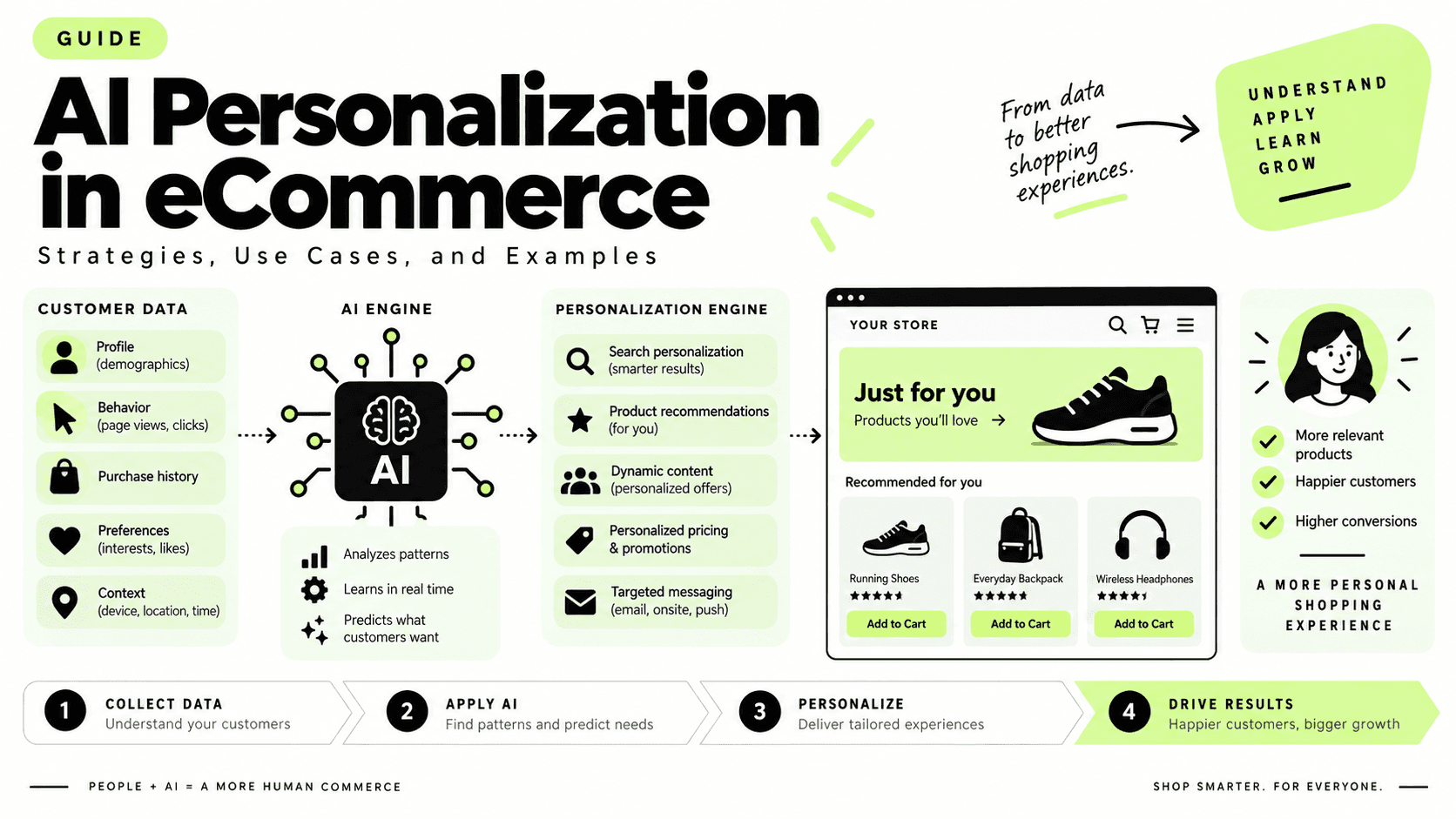
AI Personalization in eCommerce: Definition, Strategies, Use Cases, and Examples
Sirazum Monir Osmani
AI personalization in eCommerce basically refers to using AI to tailor each shopper’s experience based on their behavior, preferences, and intent.
Artificial intelligence and machine learning make this possible by continuously analyzing customer data and behavioral signals as shoppers move through the buying journey. Instead of showing every visitor the same products, promotions, search results, and messages, an eCommerce business can adapt those experiences according to what each customer is most likely to need or do next.
That adaptation can happen across product recommendations, search results, website content, offers, email, SMS, customer support, and post-purchase communication. Throughout this guide, we will break down how AI personalization works, the most important strategies, the data behind it, practical use cases, examples, benefits, measurement methods, and what to consider when choosing an AI personalization platform.
What Is AI Personalization in eCommerce?
AI personalization in eCommerce is the use of artificial intelligence and machine learning to create individualized shopping experiences based on real-time customer behavior, preferences, context, and predicted intent.
Traditional personalization often depends on predefined rules. A retailer might decide that every customer who purchases Product A should automatically see Product B, or that everyone within a particular segment should receive the same offer.
AI personalization goes further because decisions do not have to remain static.
A personalization engine can evaluate behavioral data, contextual data, purchase history, customer preferences, and other behavioral signals before deciding which experience is most relevant for an individual shopper at that particular moment.
That ability to adapt makes real-time decisioning one of the major differences between AI-driven and traditional personalization.
The overall process can be understood through the following flow:
Data Collection → Customer Profiling → AI/ML Analysis → Prediction → Personalization Decision → Experience Delivery → Feedback Loop
Data collection provides information about what the customer has done. Customer profiling organizes that information into a usable understanding of the shopper. AI and machine learning models then analyze those signals through predictive analytics to estimate customer intent, product affinity, purchase probability, churn risk, or another relevant outcome.
Those predictions are passed to a recommendation engine or personalization engine, which decides what product, message, offer, or experience should be delivered.
Experience delivery creates the actual customer interaction. The customer's subsequent actions then become part of the feedback loop, allowing the system to improve future decisions.
For eCommerce teams, this feedback loop is particularly important. A good strategy does not simply personalize once. It continuously learns from what customers view, ignore, purchase, abandon, search for, and respond to.
What Are the Important AI Personalization Strategies for eCommerce?
The important AI personalization strategies for eCommerce include real-time behavioral personalization, predictive recommendations, personalized search, behavioral campaigns, personalized offers, AI assistants, post-purchase personalization, and continuous optimization.
The important AI personalization strategies for eCommerce are listed below.
Personalize Based on Real-Time Behavior
Use AI-Driven Predictive Recommendations
Personalize Search and Product Discovery
Automate AI-Triggered Behavioral Campaigns
Personalize Pricing and Offers
Deploy AI Shopping Assistants
Personalize the Post-Purchase Journey
Continuously Test and Optimize with AI
1. Personalize Based on Real-Time Behavior
Personalizing based on real-time behavior means adapting products, content, offers, and messages according to what a shopper is actively doing during their current browsing session.
Real-time personalization focuses heavily on session behavior rather than depending exclusively on what a customer did days or months ago.
Suppose a shopper arrives at an online fashion store and immediately searches for running shoes, views three men's running products, applies a specific size filter, and repeatedly returns to one particular product.
Those actions reveal current intent.
Instead of continuing to show the shopper generic products, an AI personalization system can use those signals to adjust recommendations, search results, homepage modules, promotions, and subsequent communication.
For an eCommerce marketer or CRM manager, this matters because customer intent can change quickly. Someone who previously purchased formal clothing may currently be shopping for running equipment. Historical information remains useful, but real-time behavior helps you understand what matters to the customer now.
2. Use AI-Driven Predictive Recommendations
Using AI-driven predictive recommendations means ranking products according to each shopper's predicted purchase propensity and product affinity rather than depending on simple predefined recommendation rules.
Basic recommendation systems often rely on logic such as "customers also bought" or "similar products."
Predictive recommendations add another layer.
Through predictive analytics, an AI model can consider previous purchases, browsing patterns, product characteristics, customer similarities, price preferences, recent session behavior, and other signals before estimating which products have the strongest likelihood of generating interest or purchase.
That prediction then influences recommendation ranking.
For example, two customers visiting the same product page may receive completely different recommended products because their individual purchase propensity differs.
For retailers with large catalogs, this can be particularly valuable. Instead of asking merchandising teams to manually define every possible product relationship, AI can continuously rank products based on evolving customer and product data.
3. Personalize Search and Product Discovery
Personalizing search and product discovery means using AI to interpret search intent and rank products differently for individual shoppers according to their behavior, preferences, and likely needs.
Search is one of the strongest signals of intent available to an eCommerce business.
A customer typing "black running shoes" is explicitly communicating what they want. Yet two people using the same search phrase may still value very different products.
One shopper may consistently purchase premium products. Another may normally shop during sales. A third may prefer a particular brand or product style.
AI-powered search can combine the query itself with those customer signals to produce a personalized ranking.
The result is a more relevant product discovery experience.
This approach can also help when queries are less precise. AI search systems can interpret natural language, semantic relationships, attributes, and contextual information to understand the underlying search intent rather than relying entirely on exact keyword matches.
4. Automate AI-Triggered Behavioral Campaigns
Automating AI-triggered behavioral campaigns means detecting important customer events or predicted behaviors and automatically delivering personalized communication based on the customer's situation and likely next action.
A behavioral trigger may be something obvious, such as a customer abandoning a shopping cart.
However, AI makes triggers more sophisticated.
Instead of treating every cart abandonment identically, a model can consider cart value, purchase history, product affinity, engagement history, likelihood to purchase, and potentially the customer's sensitivity to incentives.
Browse abandonment can be approached similarly.
AI can also support churn prediction, helping eCommerce businesses identify customers whose purchasing frequency or engagement pattern suggests that they may be becoming inactive.
The resulting campaign can then adapt the message, product recommendations, communication channel, timing, or offer to the individual customer.
For lifecycle marketers, that turns automation from a sequence of fixed workflows into a more responsive customer journey.
5. Personalize Pricing and Offers
Personalizing pricing and offers means using AI to determine which promotions or incentives are relevant according to customer value, loyalty, purchasing behavior, and price sensitivity.
Offering the same discount to every customer is easy, but it may not always be economically efficient.
Some customers may purchase without an incentive. Others may respond strongly to free shipping. Some may care more about loyalty rewards, bundles, or early access than percentage discounts.
AI can analyze these differences to support personalized offers.
Depending on the retailer's strategy and market, AI may also contribute to dynamic pricing, where pricing decisions respond to variables such as demand, inventory, competition, or customer context.
For customer-level promotions, price sensitivity becomes particularly important. Understanding how likely a shopper is to respond to a certain incentive can help businesses avoid unnecessary discounting while still presenting relevant offers.
Any pricing personalization should, however, be implemented transparently and in accordance with applicable privacy, consumer protection, and pricing regulations.
6. Deploy AI Shopping Assistants
Deploying AI shopping assistants means using conversational AI to help customers discover products, compare alternatives, answer questions, and receive personalized recommendations through natural-language conversations.
AI assistants bring personalization into conversational commerce.
Instead of requiring shoppers to navigate filters manually, an AI chatbot can allow someone to explain what they need naturally.
A shopper might ask:
"I need a waterproof backpack for short business trips that fits a 16-inch laptop."
A generative AI shopping assistant can interpret those requirements, retrieve relevant products, explain differences, and refine the recommendation based on follow-up questions.
This form of generative AI can be especially valuable when purchases involve multiple attributes or require customer education.
The assistant also creates additional behavioral information. Every question helps reveal customer preferences and intent, which can further improve personalization during the session.
7. Personalize the Post-Purchase Journey
Personalizing the post-purchase journey means using AI to determine relevant replenishment reminders, complementary products, loyalty rewards, and follow-up communication based on a customer's previous purchases.
Personalization should not end at checkout.
For many eCommerce businesses, the period after purchase is where retention, repeat revenue, and customer lifetime value begin to develop.
A customer who buys a consumable product may need a replenishment reminder after a predictable period. Someone purchasing a camera may benefit from recommendations for lenses, storage, or accessories. A loyal customer may respond better to a reward than another immediate promotion.
This is where post-purchase personalization connects acquisition with retention.
AI can analyze what someone purchased, expected repurchase cycles, complementary product relationships, engagement patterns, and loyalty behavior before deciding what should happen next.
For lifecycle marketers, that creates a more continuous customer journey rather than a series of disconnected campaigns.
8. Continuously Test and Optimize With AI
Continuously testing and optimizing with AI means using experiments and customer response data to improve personalization models and decisions over time instead of relying on one-time configurations.
AI personalization should continuously learn.
Customer behavior changes. Product catalogs change. Seasonal demand changes. Promotional strategies change. A personalization model therefore needs fresh data to remain useful.
A/B testing can help compare personalized experiences with alternatives, while incrementality measurement helps determine whether personalization actually caused additional business outcomes rather than simply receiving credit for purchases that would have happened anyway.
Continuous optimization brings those insights back into the system.
Instead of asking whether personalization "works" in general, eCommerce teams can determine which personalization strategies work, for whom, in which situations, and across which stages of the customer journey.
What Data Does AI Use for eCommerce Personalization?
The types of data AI uses for eCommerce personalization are listed below.
Behavioral Data: Behavioral data includes product views, clicks, browsing paths, cart activity, engagement, and other actions that reveal what a shopper is currently interested in.
Transactional Data: Transactional data includes orders, purchase frequency, order values, returned products, product combinations, and previous transactions that help AI understand buying patterns.
Search Data: Search data includes keywords, queries, filters, sorting behavior, and search interactions that reveal explicit customer intent.
Product Data: Product data includes categories, attributes, pricing, inventory, descriptions, images, compatibility, and other information needed to understand relationships between products.
Customer Data: Customer data can include customer profiles, loyalty status, preferences, lifecycle stage, engagement history, and other information collected with appropriate consent.
Contextual Data: Contextual data considers factors such as device, session context, traffic source, time, location where appropriate, and other circumstances surrounding an interaction.
First-Party Data: First-party data is information collected directly through a business's own customer interactions, including website activity, transactions, subscriptions, and communication engagement.
Different use cases require different combinations of data.
A product recommendation model may depend heavily on behavioral, transactional, and product data. A churn prediction model may place greater weight on purchasing frequency and engagement patterns. Search personalization may combine search data, behavioral information, and customer preferences.
For eCommerce businesses evaluating AI personalization, data availability is therefore one of the first things to assess.
You do not necessarily need every possible customer attribute. You need reliable data that helps the system understand intent and make useful decisions.
What Are the AI Personalization Use Cases in eCommerce?
The AI personalization use cases in eCommerce are listed below.
Product Discovery: AI can rank and recommend products according to individual browsing behavior, preferences, previous purchases, and predicted interests.
Cross-Selling: AI can identify complementary items that are relevant to what a customer is currently viewing, purchasing, or has purchased previously.
Upselling: AI can recommend higher-value alternatives when customer behavior and preferences indicate that the alternative may provide greater relevance.
Search Personalization: AI can modify search rankings according to search intent, customer behavior, product affinity, and contextual signals.
Homepage Personalization: AI can adapt homepage products, categories, promotions, banners, and content according to the individual visitor.
Personalized Promotions: AI can determine which customers may need an incentive and which type of promotion is more likely to influence their purchasing decision.
Email Personalization: AI can personalize email content, product recommendations, timing, subject matter, and triggered communication according to customer behavior.
Customer Support: AI assistants can respond to customer questions while using relevant customer and product context to make interactions more useful.
Retention: AI can identify repeat-purchase opportunities, churn signals, replenishment timing, and relevant loyalty actions.
Merchandising: AI can help determine which products should receive greater visibility according to customer demand, affinity, inventory, and commercial objectives.
These use cases can operate independently, but their value increases when they share the same understanding of the customer.
A shopper's website behavior, for instance, can inform a later email recommendation. Their email interaction can then influence the next website experience.
That connection is what eventually turns isolated personalization tactics into an integrated personalization strategy.
What Are the AI Personalization Examples in eCommerce?
The examples of AI personalization in eCommerce are listed below.
Personalized Product Recommendations Example
Personalized product recommendations use AI to determine which products are most relevant to an individual shopper based on behavioral, transactional, contextual, and product-level signals.
Consider an online sports retailer.
Customer signal: A returning customer searches for trail-running shoes, views several waterproof models, filters for a particular shoe size, and spends significant time examining one brand.
AI analysis: The personalization engine combines this session behavior with previous purchases, product attributes, customer preferences, and patterns from similar shopping journeys.
Prediction: The model predicts that the customer has high purchase propensity for waterproof trail-running shoes within a particular price range.
Personalized action: The retailer changes recommendation rankings and highlights products matching those preferences. If the shopper leaves without purchasing, the same context can inform subsequent email, SMS, or another eligible channel.
Outcome: The customer receives fewer irrelevant recommendations and can discover suitable products more quickly, while the retailer has a stronger opportunity to increase conversion.
This illustrates how real-time personalization can eventually develop into omnichannel personalization when customer context follows the shopper across relevant touchpoints.
Dynamic Homepage Experience Example
Dynamic homepage personalization uses AI to change homepage content according to the interests, behavior, and predicted intent of each visitor.
Imagine two customers arriving at the same electronics retailer.
The first shopper has recently viewed gaming laptops and graphics cards. The second has repeatedly browsed smartphones and wireless accessories.
Rather than presenting both shoppers with an identical homepage, AI can rank categories, products, recommendations, and promotional content differently.
The first visitor may see gaming products prominently displayed, while the second receives smartphone-related recommendations.
As those customers continue browsing, their homepage experience can continue evolving based on fresh behavioral signals.
Personalized Offers Example
Personalized offers use AI to determine which promotion, incentive, or reward may be most relevant to a particular customer and purchasing situation.
Consider a customer who has added several products to their cart but has not completed checkout.
A traditional automation might immediately send a 10% discount.
AI can make the decision more selectively.
The system may determine that one shopper has a high probability of purchasing without any discount and simply needs a reminder. Another shopper may historically respond to free shipping. A highly loyal customer may value additional loyalty points more than a price reduction.
The resulting offer therefore reflects expected customer behavior rather than applying the same incentive to everyone.
For retailers, this can help balance customer relevance with promotional efficiency.
AI Shopping Assistant Example
An AI shopping assistant uses conversational AI to understand customer requirements and recommend suitable products through natural-language interaction.
Suppose a customer enters an online skincare store and asks:
"I need a lightweight moisturizer for oily skin that I can use under sunscreen."
The assistant can interpret the product requirements, search the catalog, compare relevant attributes, and recommend suitable products.
If the customer then says that they prefer fragrance-free products below a certain price, the assistant can refine the recommendation immediately.
Each interaction reveals additional preference information.
That information can make the shopping experience progressively more relevant while reducing the amount of manual searching the customer needs to perform.
What Are the Benefits of AI Personalization in eCommerce?
The benefits of AI personalization in eCommerce include better customer experiences, stronger engagement and conversion, higher average order value, improved retention, and more efficient marketing investment.
The benefits of AI personalization in eCommerce are listed below.
Better Customer Experience
Higher Engagement and Conversions
Higher Average Order Value
Customer Retention and Loyalty
Better Marketing ROI
Better Customer Experience
AI personalization creates a better customer experience by improving relevance, simplifying product discovery, reducing unnecessary friction, and adapting different parts of the shopping journey to individual customer needs.
Relevance is particularly important as product catalogs grow.
Customers generally do not want to inspect every available product. They want to find the products most appropriate for them.
Personalization helps narrow that gap.
When search results, recommendations, messaging, and content reflect actual customer preferences, customers can move through the buying journey with less effort.
Higher Engagement and Conversions
AI personalization drives higher engagement and conversions by showing shoppers more relevant products, messages, and experiences that better reflect their current interests and purchase intent.
Better relevance can influence metrics such as click-through rate, product engagement, add-to-cart rate, and eventual conversion.
However, personalization should not be evaluated based on engagement alone.
A higher click-through rate may look positive, but the more meaningful question is whether personalized experiences increase genuine purchase intent and generate incremental conversions.
That distinction becomes important when measuring ROI.
Higher Average Order Value
AI personalization increases average order value by identifying relevant cross-selling, upselling, bundling, and product recommendation opportunities according to each customer's preferences and current purchasing context.
Cross-selling becomes more useful when complementary products genuinely fit what the customer is buying.
Upselling follows the same principle.
Rather than simply promoting the most expensive alternative, AI can estimate which higher-value option aligns with the shopper's requirements and likely willingness to purchase.
As a result, increasing average order value can occur alongside improving relevance rather than working against it.
Customer Retention and Loyalty
AI personalization improves customer retention and loyalty by making post-purchase communication, repeat-purchase recommendations, replenishment reminders, and loyalty experiences more relevant to individual customers over time.
Retention depends on maintaining relevance beyond the initial transaction.
AI can identify when customers are likely to need a product again, which categories they may explore next, or when changes in behavior suggest declining engagement.
Those insights can support more timely lifecycle communication.
Over repeated purchases, more relevant engagement can contribute to stronger relationships and higher customer lifetime value.
Better Marketing ROI
AI personalization improves marketing ROI by making customer segmentation, campaign targeting, recommendations, and messaging more precise while helping marketers focus spending on interactions capable of generating incremental revenue.
Traditional customer segmentation remains useful, but AI can make decisions at a more granular level.
Two customers inside the same segment may still have different intent, product affinity, purchasing probability, and communication preferences.
AI can account for those differences.
For marketers, the goal should therefore be more than generating additional attributed revenue. The goal is determining whether personalization produces incremental revenue that would not otherwise have occurred.
Are There Any Challenges of AI Personalization in eCommerce?
Yes, there are some challenges of AI personalization in eCommerce such as data privacy, customer consent, algorithmic bias, poor data quality, integration complexity, and maintaining accurate real-time personalization.
Customer data privacy is one of the most important considerations.
Personalization depends on customer information and behavioral signals, which means businesses need appropriate consent processes, data controls, retention policies, and privacy practices.
Data quality creates another challenge.
AI models cannot consistently make useful personalization decisions when product information is incomplete, customer profiles are fragmented, event tracking is inaccurate, or behavioral signals are delayed.
Integration can make the problem harder. Customer information may exist separately across an eCommerce platform, CRM, analytics tools, loyalty system, customer service software, and marketing channels.
Connecting those environments often determines how effectively personalization can work.
Algorithmic bias also requires attention. Models trained on incomplete or unrepresentative data can create patterns that unfairly favor or disadvantage certain customer groups or produce consistently poor recommendations for particular users.
Another challenge is maintaining real-time accuracy.
A personalization system that reacts to outdated behavior may create the opposite of personalization. Someone who already purchased a product, for example, should not continue seeing acquisition messages for the same item simply because systems failed to update quickly enough.
The customer experience itself also needs consideration.
Overly personalized recommendations or messaging can feel intrusive when customers do not understand why certain information is being used or when a brand appears to know more than the customer expected.
To reduce these challenges, businesses should establish clear governance, maintain high-quality first-party data, collect appropriate consent, monitor model performance, integrate customer systems carefully, and regularly assess personalization metrics and customer feedback.
Personalization should make shopping easier, not make customers uncomfortable.
How to Measure eCommerce AI Personalization ROI?
Measuring eCommerce AI personalization ROI involves comparing personalized experiences against appropriate baselines and tracking whether they generate incremental improvements in conversion, revenue, engagement, order value, and retention.
The ways to measure AI personalization ROI are listed below.
Conversion: Measure whether personalized experiences improve conversion rates compared with non-personalized or alternative experiences.
Revenue: Track revenue influenced by personalized experiences while distinguishing attributed revenue from genuinely incremental revenue where possible.
Engagement: Monitor click-through rate, product views, interaction rates, add-to-cart behavior, and other engagement indicators connected to personalized experiences.
Average Order Value: Compare whether personalized recommendations, cross-selling, or upselling increase average order value.
Retention: Measure repeat-purchase rate, churn, purchase frequency, and customer lifetime value among customers exposed to relevant personalization strategies.
Incremental Impact: Determine how much additional revenue or conversion occurred because of personalization rather than giving the personalization system credit for outcomes that would have occurred anyway.
Experimentation: Use controlled experiments, holdout groups, and A/B testing to compare different personalization decisions and isolate their effects.
Measurement matters when comparing personalization platforms as well.
A platform that reports large amounts of attributed revenue may look impressive, but attribution alone does not prove impact.
For CEOs, CMOs, and eCommerce directors, incremental performance is a stronger decision-making metric.
For CRM managers and lifecycle marketers, experimentation also reveals which strategies work at specific stages of the customer lifecycle.
How to Choose an an AI-Powered eCommerce Personalization Platform?
Choosing an an AI-Powered eCommerce personalization platform involves evaluating its recommendation technology, search, real-time decisioning, data integrations, measurement capabilities, scalability, governance, privacy controls, and total cost.
The factors to consider when choosing an AI eCommerce personalization platform are listed below.
Recommendation Capabilities: Evaluate whether the platform can generate individualized product recommendations using behavioral, transactional, contextual, and product information rather than basic rule-based logic alone.
AI Search: Determine whether the platform can interpret search intent and personalize product rankings according to individual customer signals.
Real-Time Personalization: Assess how quickly the system can respond to new product views, searches, cart activity, purchases, and other behavioral events.
Data Integration: Check whether the platform can connect with your eCommerce store, CRM, customer data, analytics stack, product catalog, and marketing channels.
Analytics: Look for reporting that explains how personalization affects conversion, revenue, engagement, retention, and other commercial metrics.
Experimentation: Prioritize platforms that support A/B testing, control groups, incrementality measurement, and structured experimentation.
Scalability: Make sure the platform can handle your current traffic, customer volume, product catalog, channels, and expected growth.
Privacy: Evaluate consent management, customer data controls, security practices, and the platform's ability to support your privacy requirements.
Governance: Determine how marketers can control recommendations, business rules, exclusions, campaign logic, model behavior, and customer experiences.
Cost: Compare platform fees with implementation requirements, operational resources, expected incremental value, and the number of personalization use cases you can realistically deploy.
Platforms like Markopolo AI can be considered alongside other personalization platforms according to these criteria.
The important point is not simply whether a vendor says it "uses AI."
Your team should understand what decisions the AI actually makes, which customer signals it uses, how quickly it responds, where personalized experiences can be delivered, and how the resulting business impact will be measured.
How Does Markopolo AI Help With AI Personalization in eCommerce?
Markopolo AI helps with AI personalization in eCommerce by unifying first-party customer data, interpreting customer behavior, and using machine learning to predict intent, product affinity, and relevant next actions.
Those predictions can be used to make customer engagement more contextual throughout the lifecycle.
Instead of relying only on broad customer segments, Markopolo AI utilizes first-party behavioral information to understand what individual shoppers are doing and respond according to their current context.
That can include personalized product recommendations, relevant offers, abandoned cart and checkout recovery, lifecycle campaigns, and behavioral follow-ups.
eCommerce personalization can also extend across channels including email, SMS, WhatsApp, web push, app push, and AI voice calls, allowing customer context to inform communication beyond the website itself.
For eCommerce marketers and CRM teams, the underlying objective is to connect data, customer intent, and engagement so that personalization can respond to what a customer is doing rather than simply placing them into a predefined campaign.
Is AI Personalization Worth Investing In for eCommerce Businesses?
Yes, AI personalization is worth investing in for eCommerce businesses because it can improve conversion rate, average order value, retention, and customer lifetime value while continuously adapting to changing customer behavior.
The value, however, depends heavily on implementation.
Simply adding an AI recommendation widget does not automatically create a personalization strategy.
Successful eCommerce AI personalization strategies usually connect customer data with specific commercial objectives. Those objectives may include improving product discovery, reducing abandonment, increasing repeat purchases, strengthening retention, or increasing the relevance of lifecycle marketing.
Choosing the proper use cases therefore matters.
A smaller retailer may initially gain more from product recommendations and behavioral campaigns than from building highly complex dynamic pricing models. A larger retailer with millions of customers and an extensive catalog may need personalized search, merchandising, recommendations, and lifecycle decisioning operating together.
The right platforms should support those priorities rather than forcing your business to adopt personalization features that do not solve an actual customer or commercial problem.
Moreover, the broader benefits of hyper-personalization in eCommerce also depend on how customers experience it.
When AI helps customers find products faster, receive more relevant communication, avoid irrelevant promotions, and move through the buying journey with less friction, personalization provides genuine customer value.
That customer value should remain the foundation.
For eCommerce CEOs, CMOs, marketers, CRM managers, lifecycle teams, and store owners evaluating AI personalization, the most useful question is therefore not simply, "Should we use AI?"
A better question is:
Where in our customer journey can AI make the next interaction more relevant, measurable, and valuable for both the customer and the business?
Once that question is clear, AI personalization becomes much easier to approach as a practical eCommerce strategy rather than another layer of technology.