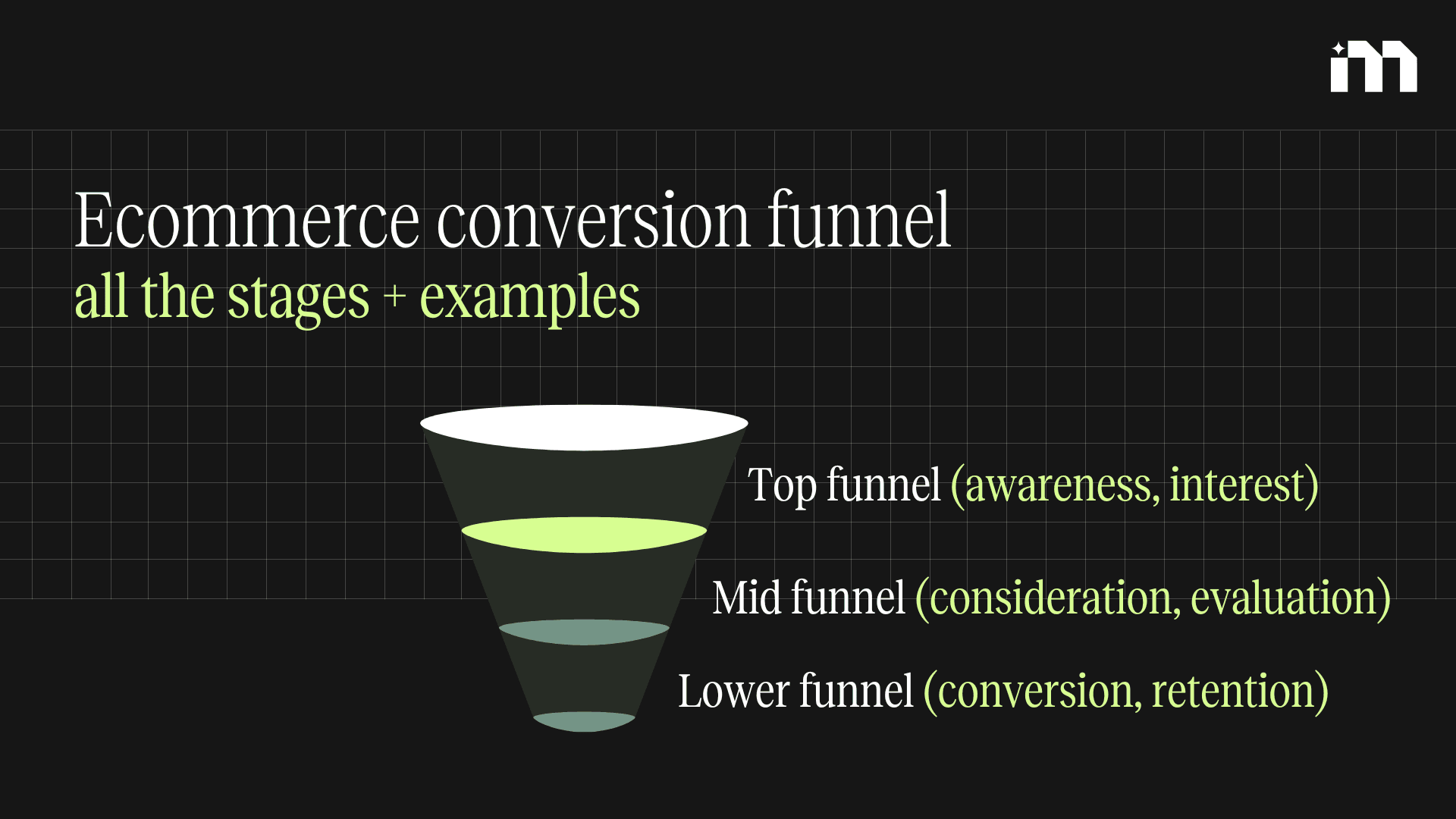
All stages of the ecommerce conversion funnel (with examples)
Sirazum Monir Osmani
Most ecommerce stores obsess over getting more traffic. The real problem is what happens after visitors arrive. A well-structured conversion funnel turns casual browsers into loyal buyers by meeting them at the right stage with the right message. Without it, stores bleed revenue at every step.
Here is the reality: global ecommerce conversion rates hover between just 2% and 4%, according to 2025 data from Speed Commerce and IRP Commerce. That means for every 100 visitors, 96 or more leave without buying. A VWO benchmark study found that 96% of first-time visitors are not ready to make a purchase at all. The gap between traffic and revenue is where your funnel either works or fails.
This guide breaks down every stage of the ecommerce conversion funnel, from the moment someone discovers your brand to the point they become a repeat buyer, with real examples and actionable insights at each step.
Important: not all stages need to happen independently. For many customers, awareness and interest can occur at the same time, while for others the bottom of the funnel might be their first touchpoint and they can convert right away. |
|---|
Top-of-the-funnel
The top of the funnel (TOFU) represents the widest entry point in ecommerce. It covers the first two stages of the buyer journey: awareness and interest. At this level, shoppers are not yet customers. They are people who have either stumbled upon your brand or are beginning to explore a product category. The intent is low, the audience is broad, and most visitors will not return unless something captures their attention early.
Ecommerce brands that neglect the top of the funnel often overspend on bottom-funnel tactics like retargeting or discount codes, only to wonder why their customer acquisition cost keeps climbing. The cost of acquiring a new customer has increased by 222% over the past eight years, according to data cited in Markopolo's own research on revenue recovery. Investing in TOFU is not about immediate sales. It is about building a pipeline of future buyers who already recognize and trust your brand when they reach the decision stage.
Giving attention to TOFU also expands your addressable audience. When a brand only targets high-intent shoppers, it competes in a small, expensive pool. By educating and engaging consumers early, stores create a warmer audience that converts more efficiently later. Think of it as planting seeds. The harvest comes downstream, but it cannot happen without the effort here.
Stage 1: awareness
Example: a user just discovered your site
Awareness is the moment a potential customer encounters your brand for the first time. Maybe they saw a TikTok ad for your product, clicked on a blog post that ranked on Google, or noticed a friend's Instagram story featuring your packaging. At this stage, the shopper has no relationship with your brand. They may not even know they have a need your product solves.
The goal here is not to sell. It is to register in the shopper's mind. Tactics that drive awareness include content marketing, social media presence, influencer partnerships, and paid campaigns optimized for reach rather than conversions. For example, the eco-conscious apparel brand tentree scaled its influencer marketing program from 20 to 80 creators in 2024 using the GRIN platform, generating over 800 conversions and achieving a 13x return on investment. The key was choosing creators who genuinely aligned with the brand's mission, turning awareness into an authentic introduction rather than a cold pitch.
For an ecommerce site, awareness-stage content might include educational blog posts about the product category, short-form video explaining a common problem, or a well-targeted Meta ad that introduces the brand story. The shopper who sees your ad for sustainable sneakers while scrolling at lunch is an awareness-stage visitor. They may not buy today, but they now know you exist.
Stage 2: interest
Example: users finding their desired product
Interest is the stage where passive awareness becomes active curiosity. The shopper is no longer just scrolling. They are searching. They might type "best noise-cancelling headphones under $200" into Google, browse a product category on your site, or click through multiple pages to explore your catalog. The difference between awareness and interest is intent. At this stage, the shopper has recognized a need or desire and is beginning to explore options.
For ecommerce brands, capturing interest means making your product discoverable and compelling at the point of search. This involves strong SEO for product and category pages, engaging product photography, and clear value propositions above the fold. The Sill, an online plant retailer, achieved a 45% organic traffic boost by investing in long-tail SEO and site speed optimization, which ensured that shoppers searching for specific plant varieties could find and explore their catalog quickly.
Interest-stage shoppers are also prime candidates for email capture. When someone signs up for a newsletter or creates a wishlist, they are signaling that your product has caught their attention. The challenge is to keep that attention alive. Personalized product recommendations, timely follow-up emails, and engaging category pages all serve to deepen interest and move the shopper toward the next stage of the funnel.
Middle-of-the-funnel
The middle of the funnel (MOFU) is where ecommerce separates window shoppers from serious buyers. This stage covers consideration and evaluation, the phases where a shopper has identified a product and is now actively deciding whether it is the right purchase. The shopper is comparing options, reading reviews, checking specifications, and weighing your offer against competitors.
MOFU plays a disproportionately important role in ecommerce because online shoppers lack the physical touchpoints of a brick-and-mortar store. They cannot hold the product, test the fabric, or ask a salesperson a quick question. Instead, they rely on product detail pages, customer reviews, comparison content, and trust signals to build confidence. A 2025 PowerReviews study found that 93% of consumers consult product reviews when shopping online, and 85% say they are less likely to buy a product with no ratings or reviews at all. This means the middle of the funnel is not just a stage in the journey. It is the stage where most purchase decisions are actually made or abandoned.
Real-world ecommerce brands have seen measurable results from investing here. Huckberry, a men's apparel and outdoor gear retailer, integrated Algolia's AI-driven personalization engine to surface relevant products during the consideration phase, resulting in a 9.4% increase in revenue from personalized user profiles. Similarly, YETI redesigned its mobile experience with a mobile-first UX approach and saw a 63% year-over-year increase in mobile conversion rates. These outcomes were not driven by more traffic or bigger ad budgets. They came from reducing friction and building trust at the exact moment when shoppers were evaluating whether to buy.
Stage 3: consideration
Example: users investigating a product they need
Consideration is the research phase. The shopper has moved beyond browsing and is now actively investigating a specific product. They are reading the product description closely, examining photos from multiple angles, checking size guides, and looking for answers to practical questions like "Will this fit my space?" or "Does this work with my existing setup?"
At this stage, the quality of your product detail page (PDP) is everything. Amazon's approach to conversion rate optimization illustrates this well. The company continuously A/B tests individual elements on product pages, from image types to description formats, changing one variable at a time to isolate what drives purchase decisions. A study published in the International Journal of Research Publication and Reviews in 2025 highlighted how this method of isolating single changes, such as showing a product in use versus on a white background, led to measurable conversion improvements.
For ecommerce brands without Amazon's testing infrastructure, the principles still apply. High-quality lifestyle images, clear benefit-driven copy, transparent shipping and return information, and easy access to customer Q&A sections all reduce the uncertainty that causes shoppers to leave during consideration. Brands like Charlotte Bio saw success by adding urgency elements, such as a countdown timer paired with a discount code, directly on the product page to nudge consideration-stage shoppers toward action.
Stage 4: evaluation
Example: users reading reviews or comparing products
Evaluation is the final filter before a purchase decision. At this stage, the shopper is no longer asking "Is this the right kind of product?" but rather "Is this the right specific product from this specific brand?" They are reading customer reviews, comparing prices with competitors, checking third-party review sites, and looking for social proof that validates their choice.
Reviews are the single most influential factor at this stage. A 2025 PowerReviews survey of over 19,000 consumers found that 90% regularly consider how recently a review was written, and 76% of consumers say they are scrutinizing and researching products more carefully due to economic uncertainty. Younger consumers are even more review-dependent, with 84% of Gen Z spending more time researching products before committing. This makes review volume, recency, and authenticity a direct driver of conversion.
Comparison behavior also defines the evaluation stage. Shoppers open multiple tabs, check competitor pricing, and look for differentiators like free shipping, better return policies, or bundle offers. Brands that make this comparison easy, rather than trying to prevent it, tend to convert better. Providing comparison tables on your own site, showcasing "why us" content, and highlighting trust signals like money-back guarantees all reduce the friction of evaluation. The outdoor retailers Millets and Blacks implemented personalized product recommendations during this stage and saw conversion rate increases of 332% and 277% respectively when a visitor selected a recommended product, with personalized recommendations accounting for nearly one-fifth of total site revenue.
Bottom-of-the-funnel
The bottom of the funnel (BOFU) is where revenue is realized. It covers conversion and retention, the stages where a shopper completes a purchase and, ideally, comes back to buy again. For ecommerce, this is the most measurable part of the funnel, and also the most expensive to lose. The average global cart abandonment rate sits near 70%, meaning seven out of ten shoppers who add a product to their cart still walk away without completing checkout.
Loyalty safeguards future revenue in a way that acquisition alone cannot. The Pareto Principle, commonly known as the 80/20 rule, consistently plays out in ecommerce: roughly 80% of revenue comes from just 20% of customers, typically the repeat buyers. The revenue efficiency of that top 20% is roughly 4x compared to one-time purchasers, whose contribution flips to 20% of revenue from 80% of the customer base. Sephora's Beauty Insider loyalty program demonstrates this clearly. The program grew to over 34 million members, and those members contributed to 80% of the company's total sales, along with a 13–51% increase in upsell revenue. When brands invest in retaining their best customers instead of constantly chasing new ones, they build a more predictable and profitable business.
Stage 5: conversion
Example: added to cart and checked out
Conversion is the moment of transaction: the shopper adds a product to their cart and completes checkout. It sounds straightforward, but this stage is where most ecommerce revenue is lost. The reasons for cart abandonment are well-documented: unexpected shipping costs, complicated checkout flows, lack of payment options, and insufficient trust signals.
Reducing checkout friction is the single highest-leverage action an ecommerce brand can take at this stage. Benchmark data from 2025 shows that the average add-to-cart rate across ecommerce is about 7.5%, but the final purchase conversion rate drops to just 2–3%. The gap between adding to cart and completing the purchase represents a massive opportunity. Simplifying checkout to three steps or fewer, enabling guest checkout, offering multiple payment methods including buy-now-pay-later options, and displaying trust badges at the payment stage all directly reduce abandonment.
For shoppers who do abandon their carts, recovery strategies matter enormously. The industry standard for cart recovery using traditional email sequences is around 10–15%. Markopolo's AI-driven approach, which assigns each visitor an individual AI agent to orchestrate personalized recovery across email, SMS, WhatsApp, and voice calls, recovers 30–40% of abandoned revenue. The difference comes from treating each shopper as an individual rather than a segment. A price-sensitive researcher who browses at lunch needs a fundamentally different follow-up than an impulse buyer ready to purchase premium products immediately. One-size-fits-all email sequences cannot accommodate that nuance, but behavioral intelligence can.
Stage 6: retention
Example: users buys again or comes back
Retention is where short-term revenue becomes long-term business health. A retained customer is not just someone who bought once and was satisfied. They are someone who actively chooses your brand over alternatives on subsequent purchases. In ecommerce, the average retention rate sits around 20–30%, meaning only about 3 in 10 customers return to buy again. Brands that push this above 35% enter strong territory, and those exceeding 50% have built something exceptional.
The economics of retention are compelling. It costs 5 to 20 times more to acquire a new customer than to earn a repeat purchase from an existing one. A 5% increase in customer retention can lift revenues by 25–95%, according to widely cited research from Bain & Company. Chewy, the pet supply brand, built its retention strategy around customer-centric gestures like pet portraits and handwritten cards, achieving a retention rate of approximately 91% and over $500 in net sales per active customer.
Retention strategies for ecommerce include loyalty programs, subscription models, personalized post-purchase communication, and proactive re-engagement campaigns. The key is maintaining relevance after the first purchase. Personalized product recommendations based on past orders, timely replenishment reminders for consumable products, and exclusive early access for returning customers all give people a reason to come back. Brands that treat the post-purchase experience as part of the funnel, rather than an afterthought, build the kind of customer relationships that compound over time.
Conclusion
The ecommerce conversion funnel is not a linear slide from awareness to purchase. It is a system of interconnected stages, each with its own consumer psychology, its own friction points, and its own optimization opportunities. The brands that win are not the ones spending the most at any single stage. They are the ones that build a coherent experience across every stage, from the first Instagram ad a shopper sees to the personalized follow-up they receive after their third order.
Understanding where your shoppers drop off is the first step. The second is building systems that respond to individual behavior rather than relying on broad segments and generic playbooks. Whether it is investing in content to build awareness, optimizing product pages for the consideration phase, streamlining checkout to reduce abandonment, or deploying AI-powered retention strategies, each improvement at each stage compounds into measurable revenue growth.
The funnel is not just a marketing framework. It is a revenue framework. Treat it that way, and the results follow.