The Best eCommerce Personalization Software Platforms with Pros, Cons, Price (and How to Choose the Right One)
Sirazum Monir Osmani
The best eCommerce personalization platforms include Markopolo AI, Kimonix, Nosto, Dynamic Yield, Bloomreach, Insider One, Klaviyo, Algolia, Rebuy, and Klevu. All of these platforms can help create more relevant shopping experiences, but they approach personalization from different directions, including behavioral personalization, product recommendations, search and discovery, customer engagement, lifecycle marketing, and conversion optimization.
Below is a comparison table that contains the main features, plans, prices, and best use cases.
eCommerce Personalization Software | Main Personalization Feature | Public Pricing | Best For |
|---|---|---|---|
Markopolo AI | Context-aware, omnichannel 1:1 hyper-personalization | Free: $0; Standard: $10.99/month; Pro: $39.99/month; Enterprise: Custom | eCommerce brands wanting AI-driven behavioral personalization across the customer journey |
Kimonix | AI merchandising, personalized product recommendations, search, and A/B testing | Merchandising from $19/month + usage; Agentic Search from $5.90/month + usage; Custom plan available | Shopify and Shopify Plus brands focused on AI-powered merchandising, product discovery, and conversion optimization |
Nosto | Onsite personalization, search, merchandising, and recommendations | Custom modular pricing | Mid-market and enterprise retailers focused on onsite experiences |
Dynamic Yield | Experience optimization, recommendations, experimentation, and targeting | Custom pricing | Enterprises with sophisticated personalization and experimentation programs |
Bloomreach | Search, marketing automation, recommendations, and conversational shopping | Custom annual pricing | Larger retailers needing multiple commerce personalization capabilities |
Insider One | Omnichannel journey orchestration and customer engagement | Custom pricing | Mid-market and enterprise brands needing cross-channel personalization |
Klaviyo | Email, mobile messaging, CRM, and lifecycle personalization | Free: $0; paid pricing scales with profiles and usage | SMB and mid-market eCommerce lifecycle teams |
Algolia | Search, product discovery, personalized ranking, and recommendations | Free; Grow and Grow Plus usage-based; Elevate custom | Stores with large catalogs and advanced search requirements |
Rebuy | Shopify upselling, cart personalization, search, and post-purchase optimization | Free option; packages from $25/month; Platform One from $534/month at the displayed order tier | Shopify stores focused on conversion and AOV |
Klevu | AI search, recommendations, and merchandising | Growth, Premium, Premium+, and Enterprise: Custom pricing | Retailers prioritizing onsite search and discovery |
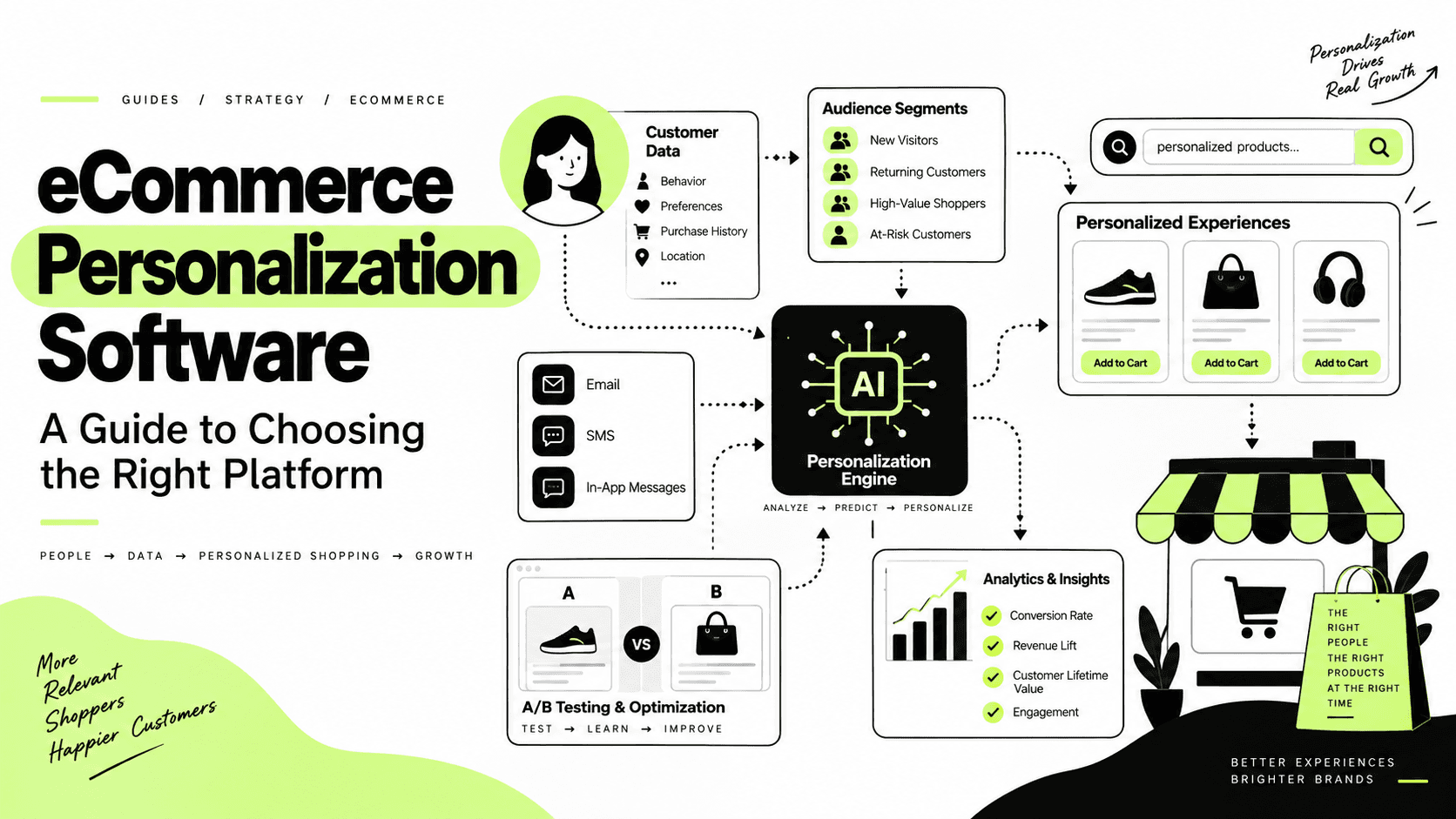
An eCommerce personalization platform generally refers to software that uses customer, behavioral, transactional, and product data to tailor what individual shoppers see and experience. Depending on the platform, that personalization can affect product recommendations, search results, website content, offers, emails, SMS messages, push notifications, and other customer touchpoints.
Choosing the right software for eCommerce personalization therefore starts with your use case. If your main problem is product discovery, a search-focused platform may make sense. If your priority is lifecycle engagement, you may need something capable of using customer behavior across email, SMS, web, push, and other channels. Meanwhile, retailers wanting broader website optimization may prefer an onsite experience platform.
A strong platform should support real-time behavioral data, AI-driven recommendations, segmentation, experimentation, first-party data, analytics, and measurable attribution. Pricing varies considerably as well because some eCommerce personalization softwares use self-service subscriptions while others sell modular or enterprise contracts.
What Is an eCommerce Personalization Platform?
An eCommerce personalization platform is software that uses shopper data, behavioral signals, product information, and AI or rules to tailor individual shopping experiences across one or more customer touchpoints.
The platform typically starts by collecting or receiving signals such as products viewed, searches made, purchases completed, categories browsed, messages engaged with, and other customer interactions. Those signals can then influence what happens next, whether that means changing product recommendations, reordering search results, showing different website content, adjusting an offer, or triggering personalized communication.
This approach matters increasingly because personalization is moving away from isolated demographic segments toward real-time individual context. At the same time, first-party and zero-party data have become increasingly important foundations for building relevant customer experiences.
Some tools specialize in what shoppers experience inside your storefront. Others concentrate on search and product discovery, while another group connects personalization with email, SMS, push, WhatsApp, customer lifecycle marketing, and other channels.
That distinction becomes important when comparing the leading options.
What Are the 10 Best eCommerce Personalization Platforms?
The 10 best eCommerce personalization platforms are:
Markopolo AI
Kimonix
Nosto
Dynamic Yield
Bloomreach
Insider One
Klaviyo
Algolia
Rebuy
Klevu
Markopolo AI
Markopolo AI is an AI-powered customer engagement and personalization platform for eCommerce that uses behavioral intelligence to understand individual shoppers and personalize decisions across the customer journey.
Markopolo AI hyper-personalizes the eCommerce experience for each shopper in a 1:1 manner. It uses email, SMS, WhatsApp, push notifications, and AI voice calls .Markopolo AI’s behavioral intelligence layer can use granular shopper interactions to build richer behavioral context around intent, preferences, friction, and likely next actions.
That behavioral foundation makes the platform particularly relevant when your personalization strategy goes beyond displaying conventional “customers also bought” recommendations. The objective is to use what a shopper is doing now, together with broader behavioral context, to determine which action or engagement is most relevant next.
Price
Markopolo AI currently offers the following publicly listed pricing options:
Free: $0/month — 500 emails per month, 250 contacts, 1:1 hyper-personalization, AI content generation, and an agentic workflow builder.
Standard: $10.99/month on annual billing — includes 6,000 emails per month, 500 contacts, 1:1 hyper-personalization, and 10 minutes of AI voice calling.
Pro: $39.99/month on annual billing — includes 25,000 emails per month, 2,500 contacts, and 60 minutes of AI voice calling.
Enterprise: Custom pricing — designed for broader omnichannel requirements, including email, SMS, WhatsApp, push notifications, and AI voice calls.
Pros
Real-time behavioral personalization.
AI-powered customer decisioning.
First-party behavioral intelligence.
Cross-journey personalization capabilities.
Supports customer engagement and lifecycle use cases.
Designed for contextual one-to-one experiences.
Cons
Free plan has more limited channel usage than paid configurations.
Best for: eCommerce brands looking to connect behavioral intelligence, AI decisioning, lifecycle engagement, and personalized customer experiences rather than operating personalization as an isolated website feature.
When choosing the right platform, this type of behavioral approach is particularly relevant for eCommerce businesses that want personalization decisions to continue across different stages and channels of the shopper journey.
Kimonix
Kimonix is an AI-powered eCommerce merchandising and personalization platform for Shopify that combines automated collection sorting, personalized product recommendations, A/B testing, and AI-powered search.
The platform uses shopper behavior alongside real-time merchandising signals such as inventory, product performance, profitability, and returns to determine which products should be surfaced. Its personalized recommendation engine can tailor products to individual visitors across home, collection, product, and cart pages, while first-time shoppers can receive recommendations based on signals such as best sellers or frequently bought-together products.
Kimonix also includes Kim, an AI merchandising agent that analyzes store data, identifies merchandising opportunities, and can apply approved changes. Its broader toolkit covers smart collections, cross-selling, personalized email recommendations, collection A/B testing, and agentic product search.
Price
Kimonix uses a pay-as-you-go pricing model with separate pricing for merchandising and search:
Merchandising & Product Recommendations: $19/month base fee plus usage. Collection views and recommendation impressions are charged on a tiered basis, beginning at 1.2¢ per view/impression for the first 10,000, with rates decreasing at higher volumes.
Agentic Search: $5.90/month base fee plus $0.10 per AI agent answer and $0.01 per search.
Custom Plan: Custom pricing for requirements such as enterprise catalogs, hourly collection re-sorting, headless commerce, multiple stores, white labeling, customized features, and advanced support.
Free trials: 14 days for Merchandising & Product Recommendations and 7 days for Agentic Search.
Pros
1:1 personalized product recommendations.
AI-powered collection merchandising and automated product sorting.
Uses 100+ merchandising and behavioral signals.
Personalized recommendations across home, collection, product, and cart pages.
Collection A/B testing for measuring conversion impact.
Personalized product recommendations for email campaigns.
AI-powered natural-language and agentic search.
Shopify and Shopify Plus focused.
Kim AI merchandising agent is included in Kimonix plans.
Cons
Primarily designed for Shopify and Shopify Plus businesses rather than retailers operating on a wide range of commerce platforms.
Usage-based pricing means costs can increase as collection views, recommendation impressions, and search activity scale.
Best for: Shopify and Shopify Plus brands that want to combine AI-powered merchandising, personalized product recommendations, search, A/B testing, and conversion-focused product discovery within one platform.
Nosto
Nosto is an AI-powered commerce experience platform focused on onsite personalization, personalized search, product recommendations, merchandising, and content experiences for eCommerce retailers.
Its strength lies in connecting several storefront experiences. Search behavior, for example, can contribute to recommendations, merchandising, and other onsite personalization instead of remaining isolated inside the search box.
Price
Nosto does not use rigid publicly priced tiers. Instead, businesses build a modular package according to the products they require.
Its available product suites include capabilities within:
Product Experience Cloud: Personalized Search, Category Merchandising, Product Recommendations, Post-Purchase Upsell, Dynamic Bundles, and Personalized Emails.
Content Experience Cloud: A/B Testing & Optimization, Content Personalization, Pop-ups, and Shoppable UGC.
Professional and Enterprise configurations: Higher support and scalability requirements are handled through tailored packages.
Pricing is custom and is influenced by GMV/turnover, traffic, selected modules, support, and scalability requirements. Nosto describes the pricing structure as a base platform fee plus a fee based on store volume.
Pros
Strong onsite personalization.
Personalized search and recommendations.
AI-powered product discovery.
Category merchandising tools.
Real-time behavioral signals.
Built specifically around commerce experiences.
Cons
Broader deployments may involve several separate modules.
Final pricing requires a tailored quote.
Best for: mid-market and enterprise eCommerce businesses that want to personalize search, recommendations, merchandising, and onsite discovery through a commerce experience platform.
Dynamic Yield
Dynamic Yield is an experience optimization and personalization platform that helps eCommerce businesses tailor products, content, recommendations, and digital experiences to individual users.
Its technology supports targeting, recommendations, segmentation, optimization, journey orchestration, and affinity-based personalization. Dynamic Yield can also build affinity profiles from interactions such as product views and purchases to personalize recommendations and promotions around user preferences.
Price
Dynamic Yield does not publish standardized self-service pricing for Experience OS.
Experience OS / enterprise deployment: Custom pricing / contact sales
Additional applications and capabilities, including search, recommendations, targeting, optimization, journey orchestration, web, mobile-app, API, and email experiences, are incorporated according to the deployment requirements.
Businesses therefore need to contact Dynamic Yield for a commercial proposal based on the capabilities, scale, and implementation they require.
Pros
Advanced recommendation algorithms.
Strong experimentation capabilities.
Affinity-based personalization.
Audience segmentation.
Personalization across multiple digital experiences.
Suitable for complex enterprise programs.
Cons
Advanced capabilities can create a steeper learning curve.
Public self-service pricing is unavailable.
Best for: larger eCommerce companies and enterprises that need advanced experimentation, recommendations, segmentation, and experience optimization.
Bloomreach
Bloomreach is a commerce experience platform combining AI-powered product discovery, recommendations, personalization, customer engagement, search, and conversational shopping capabilities for eCommerce businesses.
Its breadth can be useful for larger retailers trying to reduce fragmentation between discovery and customer engagement.
Price
Bloomreach currently lists three principal commercial products, all using annual custom pricing:
Autonomous Marketing: Request pricing.
Autonomous Search: Request pricing.
Conversational Shopping: Request pricing.
Pricing is based on factors including the number of customers, catalog size, selected modules, and communication or platform usage. Bloomreach states that subscriptions consist of a module fee plus usage-based pricing, while its Loomi AI capabilities are included with its products.
Pros
Strong search and product discovery.
Personalized product recommendations.
Cross-channel capabilities.
Website and app personalization.
Commerce-focused AI functionality.
Suitable for complex catalogs.
Cons
Implementation can be complex for smaller teams.
Total cost can increase as more modules are introduced.
Best for: mid-market and enterprise retailers that want a broader commerce experience ecosystem spanning discovery, recommendations, customer engagement, and AI-driven shopping experiences.
Insider One
Insider One is an AI-native customer experience and engagement platform that combines customer data, personalization, journey orchestration, and cross-channel activation.
The platform can personalize website and mobile experiences alongside communication through channels including email, SMS, WhatsApp, push notifications, and other customer touchpoints. Insider also supports product recommendations, segmentation, predictive characteristics, and omnichannel journey orchestration.
Price
Insider does not publicly list fixed self-service prices or standardized dollar-priced plans.
Insider One: Custom pricing / contact sales.
Pricing is configured according to the channels, capabilities, customer scale, data requirements, and deployment scope required by the business.
Because Insider positions the product primarily toward midsized and enterprise businesses, buyers generally need to request a tailored commercial proposal.
Pros
Broad cross-channel personalization.
Customer data unification.
Journey orchestration.
AI-powered segmentation.
Website and app personalization.
Personalized product recommendations.
Cons
Its breadth may be unnecessary for brands needing only onsite recommendations.
Pricing cannot be compared directly without obtaining a quote.
Best for: mid-market and enterprise businesses looking for customer data, personalization, and omnichannel journey orchestration in one environment.
Klaviyo
Klaviyo is a B2C CRM and customer engagement platform widely used by eCommerce businesses to personalize marketing based on customer profiles, behavioral data, events, and purchase history.
Personalization is particularly strong across customer communication. Brands can use profiles, event information, first-party data, and customer behavior to personalize email, mobile messaging, and other lifecycle experiences.
Price
Klaviyo pricing varies according to active profiles, sending volume, products, and messaging usage.
Current publicly visible options include:
Free: $0/month for up to 250 active profiles and 500 emails per month. The current free plan also includes a limited monthly mobile-messaging allowance.
Email / Marketing: Pricing scales with active profiles. Klaviyo currently displays an example of $45/month for email with 1,500 active profiles.
Mobile Messaging: Charged according to usage, with SMS, MMS, WhatsApp, or RCS rates varying by channel and market.
Data + Analytics: Separate products and usage-based configurations are available.
Enterprise: Contact sales for enterprise requirements.
For CRM managers and lifecycle marketers, this model makes Klaviyo particularly relevant when personalization is primarily about who receives which communication, through which channel, and when.
Pros
Strong email personalization.
Mobile and lifecycle marketing.
Extensive eCommerce integrations.
Customer profile and event data.
Segmentation and automation.
Accessible to growing eCommerce teams.
Cons
Less specialized than dedicated discovery platforms for advanced onsite search.
Costs can rise as profiles and messaging usage grow.
Best for: SMB and mid-market eCommerce businesses prioritizing CRM, retention, lifecycle marketing, and personalized customer communication.
Algolia
Algolia is an AI-powered search and discovery platform that helps eCommerce businesses personalize search results, recommendations, browsing experiences, and product discovery.
For retailers with extensive catalogs, that search-first approach can be valuable because customers often communicate strong purchase intent through the products and terms they actively search for.
Price
Algolia currently offers the following publicly listed plans:
Free: $0 — includes 10,000 search requests per month, 50,000 records, 5,000 recommendation requests, and 5,000 crawls.
Grow: Starts free with 10,000 search requests per month and 100,000 records included. Additional usage is $0.50 per 1,000 search requests and $0.40 per additional 1,000 records.
Grow Plus: Starts free with 10,000 search requests and 100,000 records included. Additional usage is $1.75 per 1,000 search requests and $0.40 per additional 1,000 records. It includes additional AI ranking and advanced personalization capabilities.
Elevate: Custom enterprise pricing with volume-based discounts and features such as NeuralSearch, AI Collections, Smart Groups, real-time personalization, enhanced SLAs, and enterprise support.
Pros
Powerful search infrastructure.
AI-enhanced personalization.
Semantic and AI-assisted search.
Personalized ranking.
Recommendations.
Strong API and developer flexibility.
Cons
More technical implementations may require developer resources.
It is primarily a discovery platform rather than a complete lifecycle engagement suite.
Best for: eCommerce businesses with substantial catalogs that want to improve search relevance, discovery, recommendations, and personalized ranking.
Rebuy
Rebuy is an eCommerce personalization platform built primarily for Shopify brands, with tools for AI recommendations, merchandising, cart experiences, upselling, cross-selling, search, and post-purchase personalization.
Its personalization capabilities stretch across product pages, carts, checkout, post-purchase experiences, search, collections, merchandising, and testing.
Price
Rebuy currently uses package-based pricing tied largely to monthly Shopify order volume.
Its publicly listed options include:
Rebuy Monetize: Free.
Build Your Own Plan: From $25/month for one package, depending on monthly order volume.
Available packages include:
Cart & Merchandising
Checkout & Post-Purchase
Search & Collections
Flows & A/B Testing
Platform One: The pricing page currently displays $534/month at its shown order-volume selection, with the actual price changing according to monthly orders.
Premium Support: Optional add-on listed at $499/month.
Enterprise configurations are also available through sales, with pricing determined according to requirements and order volume.
Pros
Built specifically around Shopify.
Strong upsell and cross-sell capabilities.
Smart cart personalization.
Product recommendations.
Checkout and post-purchase optimization.
A/B testing functionality.
Cons
Primarily relevant to Shopify merchants.
Full-suite pricing is considerably higher than buying a single package.
Best for: Shopify brands focused on increasing conversion, cart value, upsells, cross-sells, and post-purchase revenue.
Klevu
Klevu is an AI-powered eCommerce search and discovery solution that personalizes search, product recommendations, merchandising, and product visibility using shopper behavior and machine learning.
Klevu can interpret previous searches and product interactions to identify shopper interests, while collaborative filtering can help provide relevant experiences based on similar customer behavior.
Price
Klevu's publicly referenced plan structure includes:
Growth: Custom pricing / request quote.
Premium: Custom pricing / request quote.
Premium+: Custom pricing / request quote.
Enterprise: Custom pricing / request quote.
Klevu does not publicly display standardized dollar prices for these plans. Certain personalization features require Premium+ or Enterprise, while other functionality is available across lower plans or through additional personalization add-ons.
Pros
AI-powered onsite search.
Behavioral personalization.
Product recommendations.
Collaborative filtering.
Shopify, BigCommerce, and Magento support.
Merchandising functionality.
Cons
Some personalization functionality requires higher plans or add-ons.
Fixed public pricing is unavailable.
Best for: eCommerce retailers that need better onsite search, recommendations, and personalized product discovery without purchasing a broader lifecycle engagement suite.
How to Choose the Right Platform for eCommerce Personalization?
To choose the right platform for eCommerce personalization, first identify which part of the customer journey needs personalization, then evaluate whether the platform's data, AI, integrations, experimentation, and measurement capabilities support that objective.
Starting with the objective prevents your team from comparing platforms simply by feature count.
For example, a CRM manager trying to improve repeat purchases has a very different requirement from a merchandising team trying to improve search conversion. Similarly, an eCommerce director managing 200,000 SKUs needs different technology from an SMB Shopify merchant trying to increase cart value.
1. Identify Your Primary Personalization Use Case
Start by asking where personalization could produce the greatest commercial impact.
Your priority may be:
Onsite product recommendations
Personalized search
Product discovery
Website content personalization
Email and SMS personalization
Cart and checkout optimization
Customer lifecycle marketing
Cross-channel journey orchestration
This distinction helps separate the different platform types before deeper comparison begins.
2. Evaluate Your Data and Technical Requirements
Next, determine what information the platform needs.
A strong personalization system may depend on product catalog information, browsing activity, purchase data, customer profiles, search behavior, campaign engagement, or real-time behavioral signals.
For an enterprise retailer, the ability to process significant event volumes and complex product catalogs can be essential. For an SMB, implementation speed and existing integrations with Shopify or another commerce platform may matter more.
3. Examine the Depth of AI Personalization
AI appears on almost every personalization software website today, but not every implementation does the same thing.
Some systems use AI primarily for product recommendations. Others apply it to search ranking, behavioral prediction, audience creation, next-best-action decisioning, offer selection, journey orchestration, or several of these areas together.
You should therefore evaluate what the AI actually decides, which data informs those decisions, and how quickly those decisions respond to changing shopper behavior.
4. Check Your Existing eCommerce Stack
Your chosen platform needs to work with the systems you already depend on.
Check integrations with your:
Commerce platform
CRM
Customer data platform
Product catalog
Analytics tools
Email and SMS infrastructure
Loyalty platform
Mobile app
Data warehouse
An impressive personalization engine creates little value if your team cannot reliably feed it the customer and product information required to make decisions.
5. Run a Pilot Before Making a Long-Term Commitment
Finally, test the platform against real business outcomes.
Instead of relying only on demos, run a controlled pilot, holdout, or A/B test wherever practical. Compare personalized experiences against an appropriate control and measure whether conversion rate, AOV, revenue per visitor, engagement, or another relevant KPI improves.
The result tells you something a feature checklist cannot: whether the technology works for your customers, catalog, traffic, and business model.
What Types of eCommerce Personalization Platforms Are There?
eCommerce personalization platforms fall into several categories based on where and how they personalize the shopping journey.
The main types are listed below.
Onsite Experience Platforms
Onsite experience platforms personalize what shoppers encounter directly within the website or app.
Their features can include product recommendations, personalized banners, dynamic content, merchandising, audience-specific experiences, and experimentation.
Customer Engagement and Lifecycle Platforms
Customer engagement and lifecycle platforms personalize communication beyond an individual website session.
They can use behavior, customer profiles, lifecycle stages, and purchase history to personalize email, SMS, WhatsApp, push notifications, and other channels, helping CRM and lifecycle teams maintain relevance between visits.
Search and Product Discovery Platforms
Search and product discovery platforms specialize in helping shoppers find the most relevant products.
Typical features include semantic search, personalized ranking, recommendations, autocomplete, filters, merchandising, category optimization, and AI-based interpretation of shopper intent.
Conversion and Upsell Engines
Conversion and upsell engines personalize experiences closer to the purchasing decision.
These platforms typically focus on bundles, complementary products, cart recommendations, checkout offers, post-purchase upsells, and other experiences designed to improve conversion and average order value.
Understanding these categories matters because two products described as eCommerce personalization software can ultimately solve very different business problems.
What Should an eCommerce Personalization Platform Include?
An eCommerce personalization platform should include the data, decisioning, activation, experimentation, and measurement capabilities required to turn individual shopper signals into relevant experiences.
The most important elements to look for include:
Real-Time Behavioral Data
Personalization becomes considerably more useful when the system can react to what a shopper is doing now rather than relying solely on historical segments.
Real-time behavioral data can include browsing, searches, clicks, cart activity, product comparisons, purchases, and other interactions.
AI-Driven Product Recommendations
AI-driven recommendations help identify products that are likely to be relevant to a particular visitor.
More advanced systems can incorporate current-session behavior, historical purchases, product relationships, contextual signals, and patterns from similar shoppers.
Personalized Search and Merchandising
Search personalization adjusts results based on individual intent, preferences, and behavior.
Merchandising capabilities should complement that automation by allowing your team to promote, demote, pin, filter, or prioritize products when commercial objectives require human control.
Customer Segmentation
Personalization does not always need to operate at a strict one-to-one level.
Dynamic segmentation gives marketers a practical way to personalize campaigns according to behavior, affinities, lifecycle stages, purchase history, customer value, and engagement.
Omnichannel or Cross-Channel Personalization
A shopper should ideally not become a completely different person every time they move to another channel.
Cross-channel personalization helps carry customer context from websites and apps into email, SMS, push, WhatsApp, and other supported touchpoints.
A/B Testing and Experimentation
Personalization should be tested rather than assumed to work.
A/B testing allows you to compare personalized and control experiences, helping determine whether a recommendation algorithm, offer, message, ranking strategy, or experience actually creates incremental value.
First-Party and Zero-Party Data Support
As brands focus increasingly on direct customer relationships, first-party and voluntarily supplied zero-party information provide a stronger foundation for personalization.
Your platform should therefore be able to activate information collected through purchases, browsing, preferences, profiles, subscriptions, and other owned interactions.
Analytics and Attribution Reporting
Finally, personalization needs measurement.
Your platform should show how personalized experiences influence engagement, conversion, average order value, customer value, and revenue rather than providing only impression or click counts.
How Is the Performance for eCommerce Personalization Measured?
eCommerce personalization performance is measured using engagement, conversion, order value, visitor revenue, attributed revenue, and long-term customer-value metrics compared against an appropriate baseline or control group.
The key metrics include:
Recommendation Click-Through Rate
Recommendation click-through rate shows how frequently shoppers engage with personalized product suggestions.
A rising CTR can indicate stronger relevance, although clicks should ultimately be connected with conversion and revenue rather than treated as the final objective.
Conversion Rate Lift
Conversion rate lift compares purchasing behavior between shoppers receiving personalized experiences and an appropriate baseline.
For many eCommerce teams, this is one of the clearest signals of whether personalization is actually reducing friction and helping shoppers make decisions.
Average Order Value Lift
Average order value, or AOV, measures the average amount customers spend per order.
Personalized complementary products, bundles, upsells, and recommendations can increase AOV when they introduce relevant additional products rather than simply showing more offers.
Revenue per Visitor
Revenue per visitor combines traffic and monetization into one useful metric.
Because personalization may affect both conversion probability and basket size, revenue per visitor can provide a more complete view of commercial impact.
Personalization-Attributed Revenue
Personalization-attributed revenue estimates how much revenue can be connected with personalized recommendations, journeys, messages, or experiences.
When possible, use incrementality testing alongside attribution so your team can distinguish revenue influenced by personalization from purchases that likely would have occurred anyway.
Customer Lifetime Value
Customer lifetime value moves measurement beyond individual sessions.
For eCommerce marketers especially, the question is not simply whether personalization generated another click today but whether more relevant experiences increase repeat purchases, retention, purchase frequency, and total customer value over time.
How Much Does an eCommerce Personalization Platform Cost?
The cost of an eCommerce personalization platform can range from free self-service software to custom enterprise contracts costing substantially more, depending on the platform type and scale of deployment.
Some tools publish comparatively straightforward plans. Markopolo AI, for example, currently has a free plan alongside paid plans starting at $10.99 per month, while Algolia combines free allowances with usage-based search pricing. Rebuy offers individual packages starting from $25 per month at its lowest displayed order tier.
Other vendors, including Nosto, Bloomreach, Dynamic Yield, Insider, Klevu, and Constructor, rely heavily or entirely on custom pricing.
The final amount can depend on:
Catalog or SKU size
Monthly website traffic
Search volume
Number of customer profiles
Event volume
Monthly orders
Number of channels
Email or mobile messaging usage
AI capabilities
Recommendation volume
Additional modules
Implementation requirements
Support and SLA requirements
Pricing models therefore vary considerably. Some eCommerce personalization software uses flat subscriptions, while others charge according to traffic, searches, profiles, orders, communications, or selected modules.
For that reason, eCommerce decision-makers should compare total cost of ownership against the incremental value the platform can create, rather than comparing only the advertised monthly price.
How Important Is AI in eCommerce Personalization Platforms?
AI support in eCommerce personalization platforms is very important because modern retailers need to make relevant personalization decisions across thousands or millions of shopper interactions faster than marketers can configure them manually.
Traditional personalization often depended on fixed rules such as “if customer belongs to segment A, show product B.”
AI can make that decision much more dynamic.
Machine-learning models can analyze product information, browsing behavior, transactions, search activity, contextual data, and other signals to estimate which product, content, message, offer, channel, or experience is most relevant for an individual customer.
That role becomes particularly powerful at scale.
A retailer with hundreds of thousands of SKUs cannot manually determine the ideal product order for every shopper. Similarly, a lifecycle marketing team cannot manually select the ideal communication, timing, and channel for every individual customer.
AI can help automate those decisions.
Search platforms increasingly use semantic understanding, personalized ranking, behavioral learning, and recommendation models to improve discovery. Customer engagement platforms can apply AI to behavioral prediction, segmentation, next-best-action decisioning, send-time optimization, channel selection, and journey orchestration.
As a result, AI is shifting from an additional eCommerce personalization feature into part of the underlying decision-making infrastructure.
Still, more AI does not automatically mean better personalization.
When you evaluate a platform, look at what information its AI understands, what decisions it can make, where those decisions can be activated, how quickly it adapts, and whether its impact can be measured.
Those questions matter more than the AI label itself.
How Does Markopolo AI Use AI for eCommerce Personalization?
Markopolo AI uses artificial intelligence for eCommerce personalization by turning granular shopper interactions into behavioral intelligence that can inform what experience, product, message, channel, timing, or action should come next.
At the foundation of this approach is MarkTag, Markopolo AI's compostable CDP and behavioral intelligence layer. MarkTag can capture detailed customer interactions and translate behavioral activity into richer representations of shopper intent and preferences rather than treating every interaction simply as an isolated pageview or click.
Those behavioral profiles can then provide context for Athena, Markopolo AI's AI layer, to help determine appropriate next actions for individual customers.
For an eCommerce marketer, this distinction matters.
A shopper who views a product and leaves may look like a standard abandonment event inside conventional analytics. Behavioral intelligence can provide additional context around that interaction, helping AI determine whether the next experience should focus on the same product, another recommendation, reassurance, an offer, a different message, or another engagement path.
Once the next action is determined, Markopolo AI can carry that personalization across email, SMS, WhatsApp, web push notifications, mobile app push notifications, and AI voice calls. Rather than treating these channels as disconnected tools, the AI can use behavioral context to help determine the right channel, message, and timing for an individual shopper. Markopolo AI's public product materials currently describe email, SMS, WhatsApp, push notifications, and AI voice calling as its core engagement channels, while its push functionality supports both browser-based web push and mobile app push.
That intelligence can consequently support personalization across the broader customer journey rather than limiting personalization to a single recommendation widget or isolated campaign.
In practice, the objective is to make recommendations, customer communication, lifecycle experiences, and other personalization decisions respond more closely to how each shopper actually behaves.
Other eCommerce personalization platforms may specialize primarily in search, merchandising, recommendations, email, onsite experiences, or another specific part of the journey. Markopolo AI's approach instead places behavioral understanding and cross-channel decisioning at the center of personalization.
For businesses choosing the right platform, that creates an important final distinction: personalization software should not only know who a customer is. Increasingly, it should understand what that customer is trying to do and use that understanding to determine what should happen next.