Revenue teams using AI-powered intelligence platforms are 3.7 times more likely to meet their quota than those who do not, according to Gartner’s survey. Let’s down the top 10 platforms transforming how RevOps teams forecast, coach, and close deals.
Top 10 AI-Powered Revenue Intelligence Tools for RevOps Teams in 2026 (Quick Comparison)
Tool | Best For | Key AI Feature | Starting Price |
|---|---|---|---|
Markopolo | Ecommerce revenue recovery | Behavioral vectorization & multi-channel orchestration | $49/month |
Gong | Conversation intelligence | Multi-meeting insights & deal risk detection | Custom enterprise pricing |
Clari | Revenue forecasting | Predictive pipeline analytics | Custom pricing |
Salesloft | Sales engagement | AI-powered cadence optimization | Custom pricing |
Chorus (ZoomInfo) | Call analytics | Emotional signal detection | Part of ZoomInfo bundle |
People.ai | Activity capture | Automated relationship mapping | Custom pricing |
6sense | Account intelligence | Buyer intent signals | Custom pricing |
Outreach | Workflow automation | Generative AI for emails | $100/user/month |
Revenue.io | Real-time guidance | Live conversation prompts | Custom pricing |
Salesken | Sales coaching | Real-time call assistance | Custom pricing |
What Are Revenue Intelligence Tools (And Why AI Changes Everything)
Revenue intelligence tools analyze customer interactions, deal progression, and market signals to help teams make data-driven decisions. Traditional CRM systems store data, whereas revenue intelligence platforms actively interpret it.
Companies with AI-led processes achieve 2.5x higher revenue growth than peers using legacy approaches, according to Accenture's 2024 research on enterprise operations maturity.
Modern revenue intelligence platforms use three types of AI:
Predictive AI for forecasting outcomes.
Generative for creating personalized content at scale. A research by Boston Consulting Group found out that 74%of sales professionals expect GenAI to improve key business metrics.
Agentic AI for autonomously executing tasks. By 2028, at least 15% of day-to-day work decisions will be made autonomously through agentic AI.
10 Best Revenue Intelligence Tools: Complete Platform Analysis with Key Features, Pros, and Cons
Markopolo AI
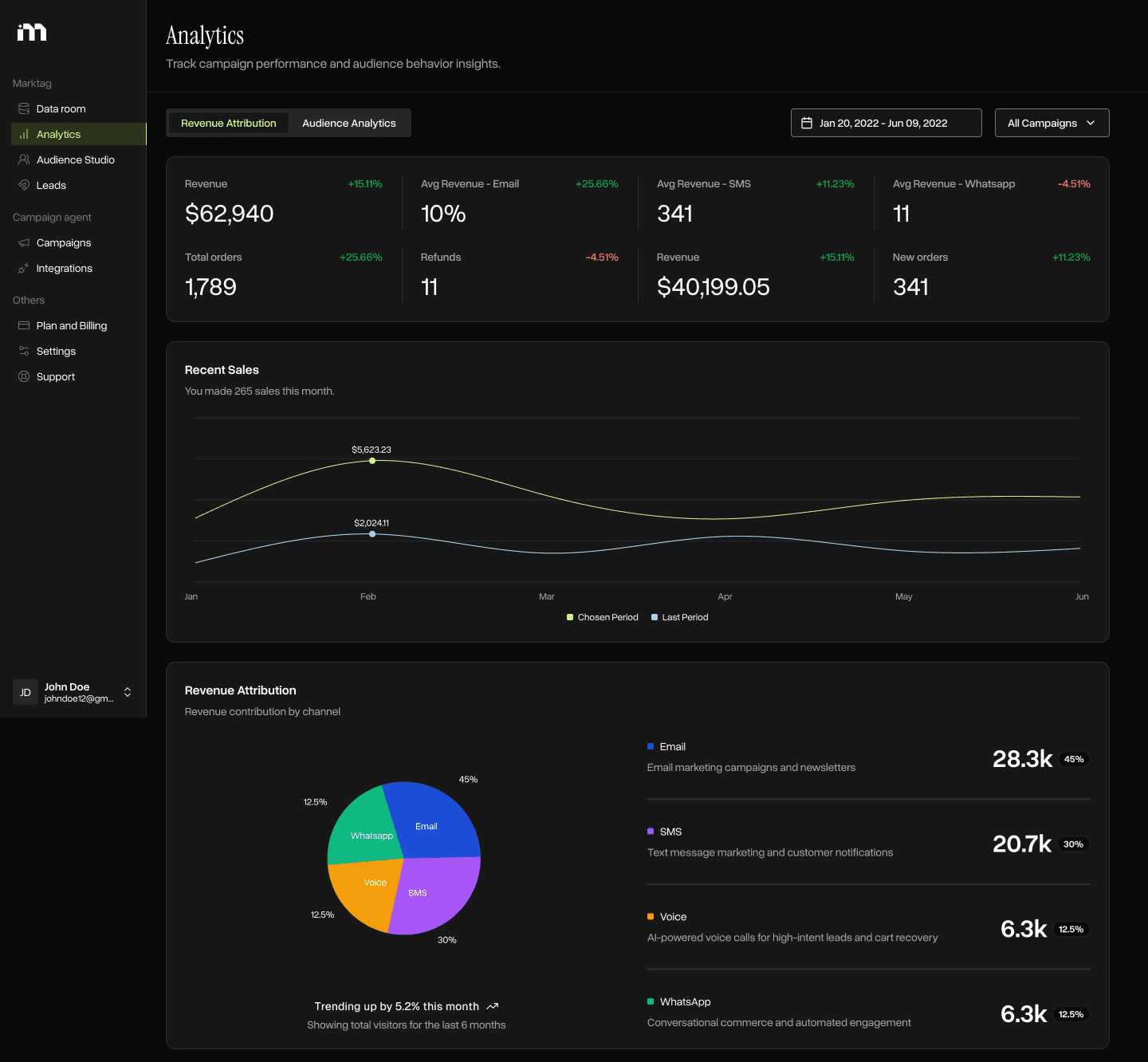
Markopolo interface.
Markopolo is the most comprehensive AI-driven revenue intelligence platform that helps ecommerce businesses recover lost revenue. While B2B-focused tools analyze sales conversations, Markopolo addresses the complete customer journey from first touch to conversion. It's a tool that unify sales, customer success, and RevOps updates via revenue recovery in real-time.
The platform's core innovation is MarkTag, which transforms every customer interaction into a 384-dimensional behavioral vector representing intent, context, and purchase probability.
When someone abandons their cart, Markopolo's AI analyzes behavioral vectors to determine whether they're price-sensitive researchers needing social proof via WhatsApp at 7 PM, or impulse buyers responding to limited stock SMS within minutes.
This individuation at scale drives 30-40% cart recovery rates versus the industry standard of 10-15%. The platform integrates Shopify, email, SMS, WhatsApp, push notifications, and AI voice calls into a unified intelligence layer with value-based pricing starting at $49/month with 30 days of free trial.
Best for: Ecommerce businesses, D2C brands, online retail stores, merchants of Shopify, WooCommerce, WordPress, etc.
Key Features
384-dimensional behavioral vectorization creating complete customer intent profiles
MarkTag intelligence system tracking micro-interactions and hesitation patterns
AI Orchestration Engine generating unique recovery strategies per individual
Multi-channel campaign execution across email, SMS, WhatsApp, voice, and push
Audience Studio with self-updating cohorts based on real-time behavior
Predictive abandonment detection 3+ pages before it occurs
Real-time decision making in under 50ms per user
Lifetime attribution model mapping complete customer journeys
Pros
Achieves 30-40% cart recovery vs 10-15% industry standard
Value-based pricing aligns platform success with merchant revenue
Purpose-built for ecommerce customer behavior patterns
Unified data layer across all customer touchpoints
No manual workflow creation required
Cons
Newer features compared to long-established enterprise platforms
Performs best when integrated with existing e-commerce systems
Teams see optimal results after the AI accumulates enough behavioral data
Value-based pricing aligns costs with revenue recovery outcomes
Initial setup requires implementing behavioral tracking
Continuous product innovation means new capabilities are always being added
Gong
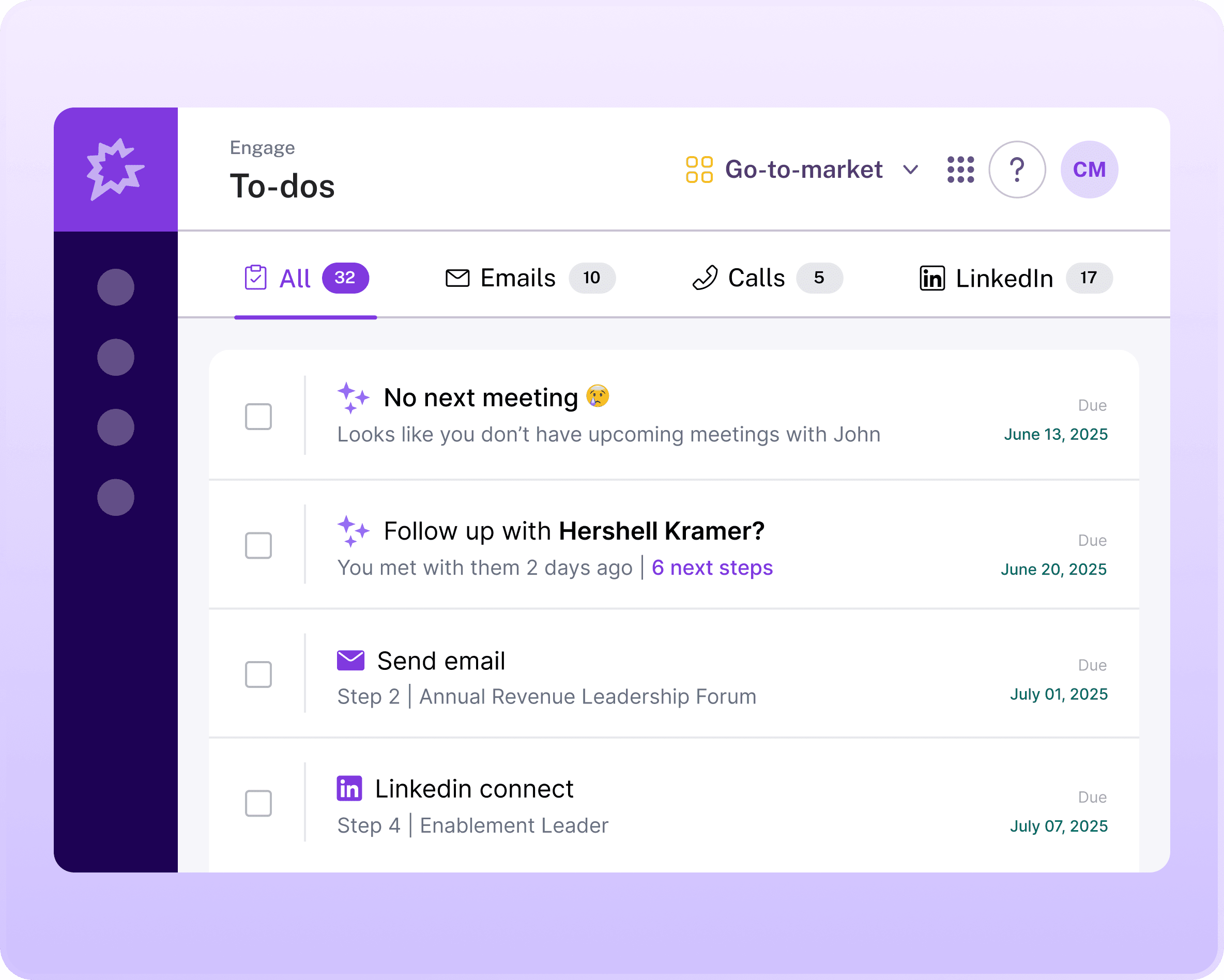
Gong interface. (Image source: Gong)
Gong dominates B2B conversation intelligence with its comprehensive revenue AI platform capturing customer interactions across calls, emails, and meetings. The system applies natural language processing to identify deal risks, competitive mentions, and buying signals while connecting conversations over time to show relationship development.
Its predictive analytics help teams spot pipeline risks weeks before they become critical, providing sales operations teams with visibility into forecast accuracy by rep, region, and segment.
Gong's multi-meeting insights represent a significant advancement over point solutions, enabling revenue leaders to understand how deals progress through complex B2B sales cycles. The platform's AI coaching analyzes top performers to create replicable models across the entire team, while real-time alerts notify managers when deal velocity slows or champions stop engaging.
Best for: B2B sales teams, enterprise sales organizations, SaaS companies
Key Features
Multi-meeting conversation analysis connecting interactions over time
Deal risk identification weeks before issues become critical
Competitive mention tracking and analysis
Buying signal detection through NLP
Market intelligence gathering from customer conversations
Predictive pipeline analytics
Automated CRM data capture
Revenue team performance benchmarking
Pros
Industry-leading conversation intelligence accuracy
Comprehensive view of entire customer relationship
Strong predictive analytics for forecasting
Extensive integration ecosystem
Proven ROI with enterprise clients
Cons
Enterprise pricing significantly higher than mid-market alternatives
Built for long B2B sales cycles, not transactional models
Requires substantial conversation volume for effective AI training
Implementation complexity with 2-3 month deployment timeline
Limited transactional commerce and cart recovery capabilities
Clari
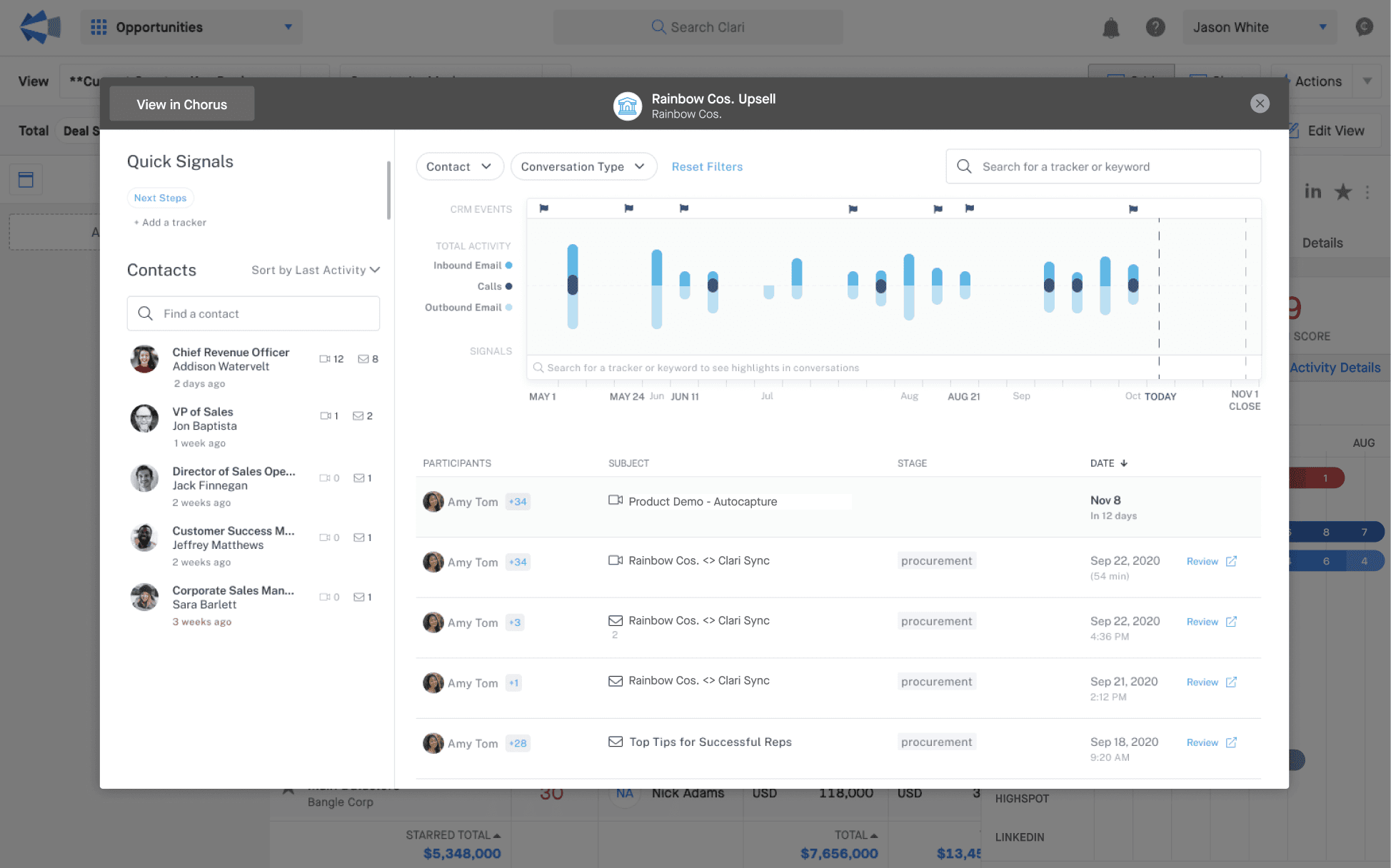
Clari interface. (Image source: Clari)
Clari provides sophisticated forecasting capabilities by aggregating signals from CRM data, email, calendar, and opportunity changes to generate dynamic forecasts updating in real-time.
The platform's AI identifies which deals are truly at risk versus those simply marked as stuck in static CRM fields, giving sales operations teams the visibility needed to course-correct before quarter end.
Clari's forecasting approach represents a significant evolution from manual spreadsheet-based methods, using machine learning to analyze patterns across thousands of deals. The platform provides forecast accuracy visibility by rep, region, and segment, enabling revenue leaders to make confident resource allocation and hiring decisions.
Best for: Enterprise B2B sales teams, sales operations leaders, SaaS companies with complex pipelines
Key Features
Real-time dynamic forecast updates
Deal risk scoring and identification
Pipeline inspection and analysis
Multi-dimensional forecast views by rep, region, segment
Opportunity change tracking
Email and calendar signal integration
Revenue leak detection
Time-series forecasting models
Pros
Best-in-class forecasting accuracy
Strong pipeline visibility features
Enterprise-grade reliability
Comprehensive deal inspection tools
Reduces forecast preparation time significantly
Cons
Lacks behavioral intelligence for individual customer tracking
Pipeline management focus without autonomous agent capabilities
Premium pricing tier for full feature access
Dependent on high-quality CRM data for accuracy
Steeper learning curve for non-technical users
Salesloft
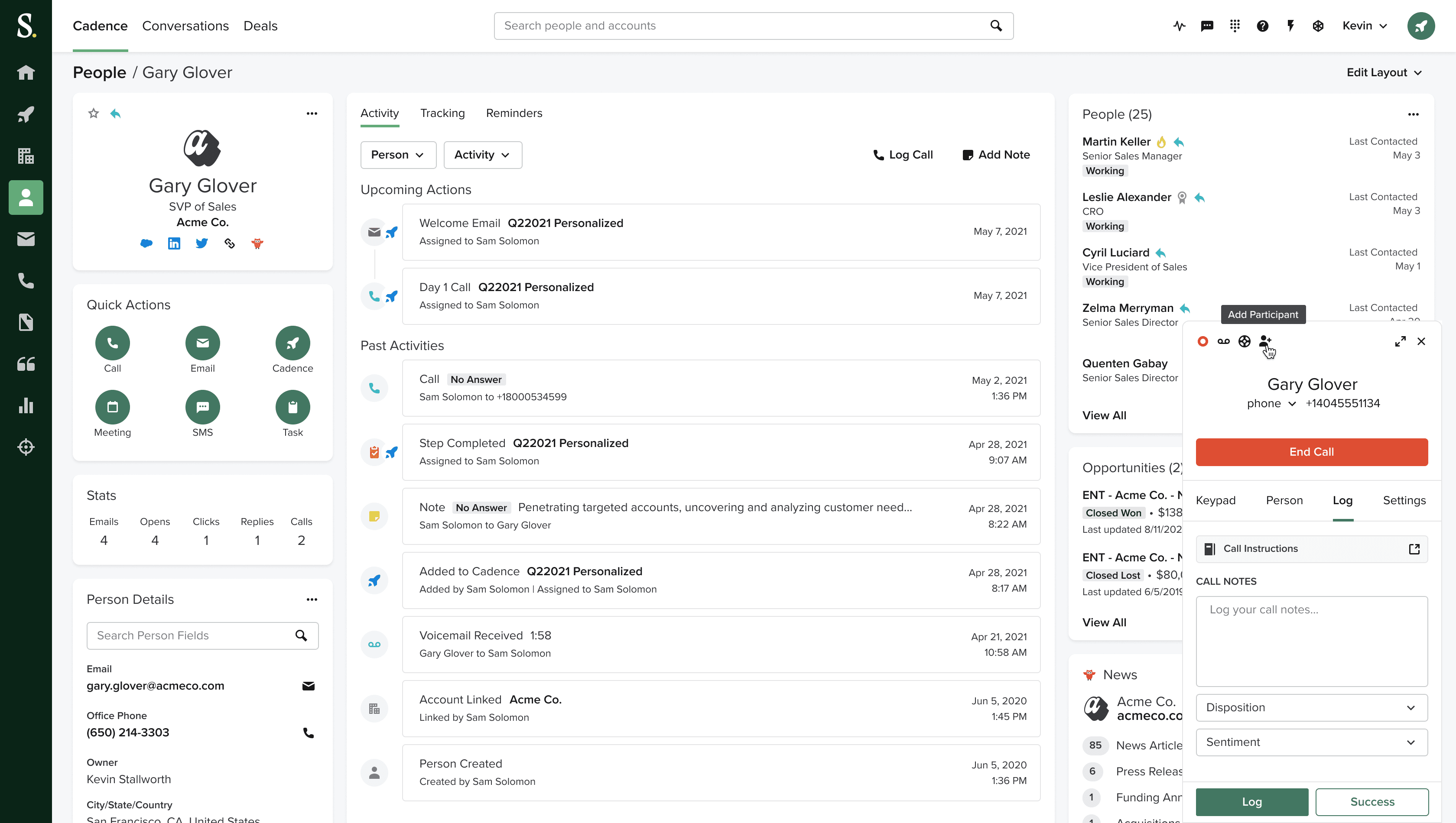
Salesloft interface. (Image via Contentstack)
Salesloft combines cadence management with AI-powered recommendations for optimal outreach timing and messaging. Its generative AI helps reps create personalized emails at scale, addressing the challenge that 79% of sales teams face with executing personalization efficiently.
Workflow automation handles sequence enrollment and follow-up tasks, allowing sellers to focus on actual conversations rather than administrative work.
It also excels at multi-channel engagement orchestration, coordinating touchpoints across email, phone, and social channels while providing analytics on what messaging resonates with different prospect segments.
Best for: B2B sales development teams, account executives, inside sales teams
Key Features
AI-powered cadence optimization
Generative AI for email personalization
Multi-channel sequence management
Call recording and analysis
Meeting scheduling automation
Email tracking and analytics
Integration with major CRM platforms
Sales coaching and training features
Pros
Strong email engagement features
User-friendly interface
Good integration ecosystem
Effective for SDR teams
Comprehensive training resources
Cons
Lacks behavioral vectorization and predictive intelligence
Requires manual sequence building and optimization
No autonomous revenue agent capabilities
Traditional subscription model not tied to performance outcomes
Limited predictive analytics compared to AI-first platforms
Chorus (ZoomInfo)
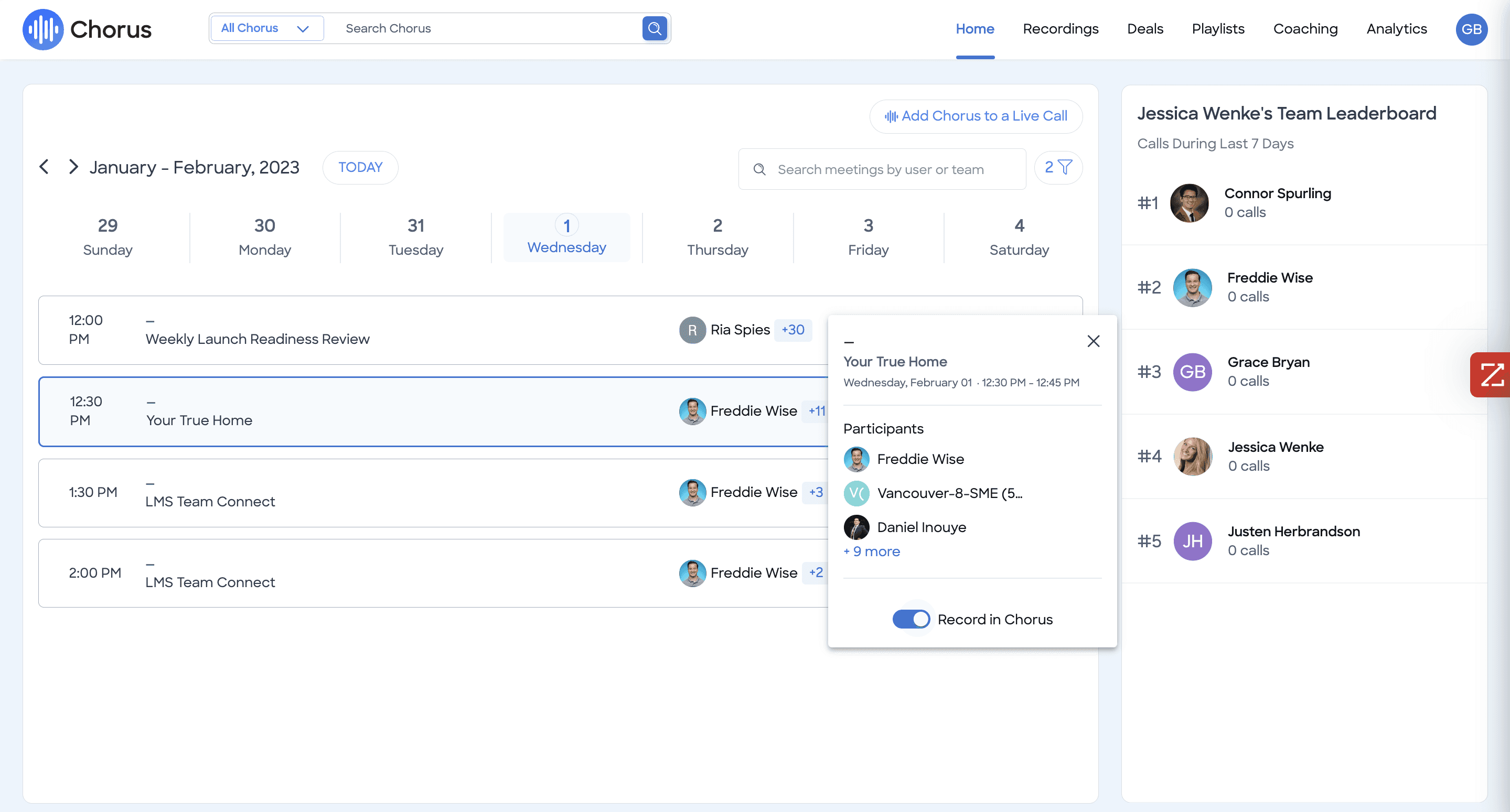
Chorus interface. (Image source: Zoominfo)
Chorus is great for reading emotional signals within sales conversations and automatically connecting them to CRM systems, eliminating manual note-taking. Its AI coaching analyzes top performers to create replicable models for the entire team, making it particularly valuable for organizations focused on sales methodology consistency.
As part of ZoomInfo's broader platform, Chorus benefits from integration with comprehensive B2B contact data and intent signals, creating a unified view of account intelligence and conversation insights.
Best for: B2B sales teams, organizations with ZoomInfo subscriptions, sales coaching-focused companies
Key Features
Emotional signal detection in conversations
Automatic CRM conversation logging
Top performer analysis and modeling
Integration with ZoomInfo's B2B data
Call recording and transcription
Deal intelligence extraction
Competitive intelligence tracking
Coaching workflow automation
Pros
Strong emotional intelligence capabilities
Seamless ZoomInfo integration
Eliminates manual note-taking
Good coaching features
Part of larger intelligence ecosystem
Cons
Requires ZoomInfo bundle purchase, limiting standalone flexibility
Conversation-focused without journey-level orchestration
No behavioral vectorization or predictive abandonment features
Combined platform costs can be substantial
Optimized for scheduled calls rather than digital-first interactions
People.ai
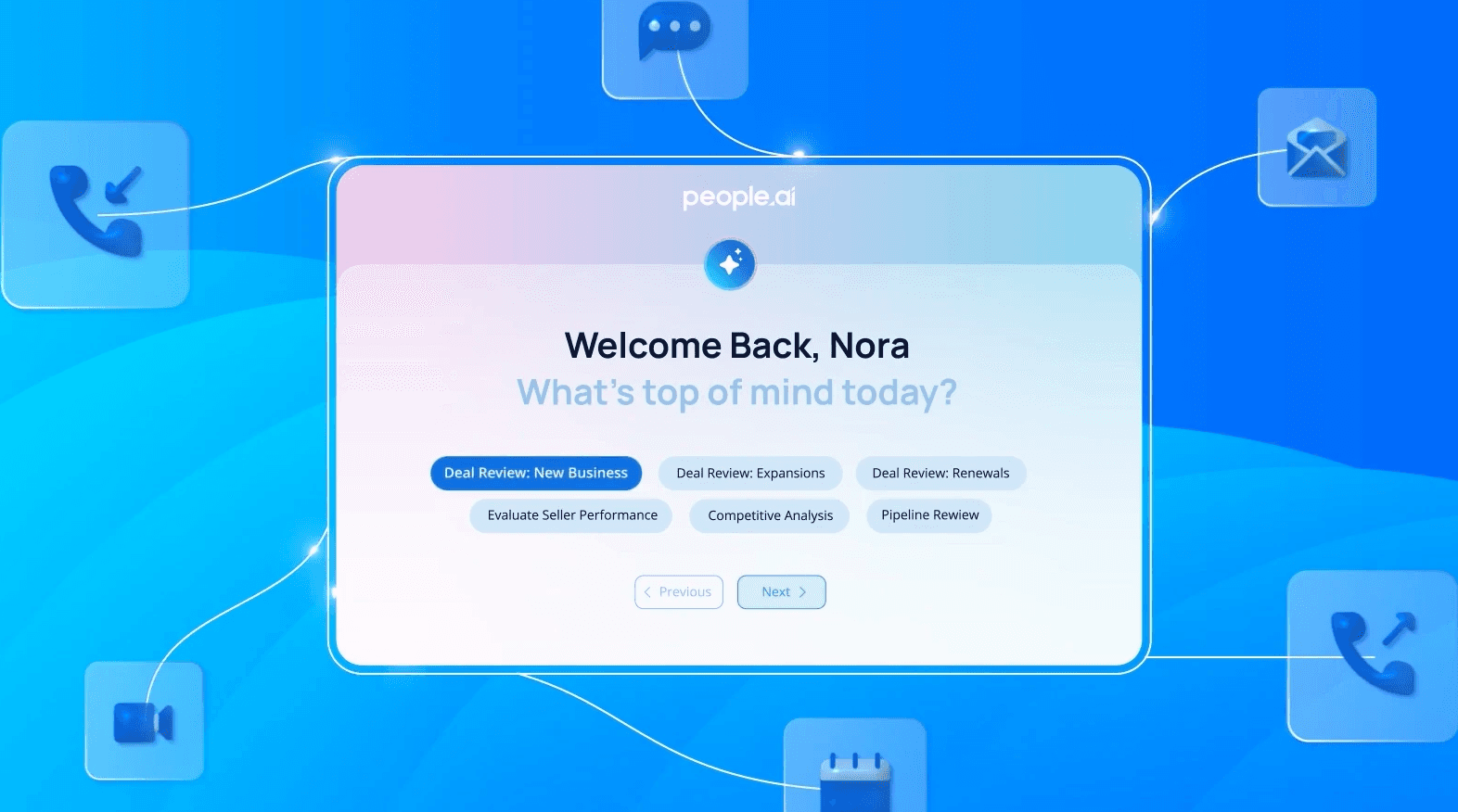
People.ai interface. (Image source: People.ai)
People.ai takes a unique approach by focusing on automated activity capture and relationship intelligence. The platform automatically logs every customer interaction, maps buying committee relationships, and scores engagement levels, eliminating data entry while providing clearer visibility into who actually influences deals.
The relationship mapping capabilities help sales teams understand complex B2B buying dynamics by showing connection strength, engagement frequency, and influence patterns across stakeholder networks.
Best for: Enterprise B2B sales teams, account-based sales organizations, relationship-driven sales models
Key Features
Automated activity capture across email, calendar, calls
Relationship intelligence and mapping
Buying committee identification
Engagement scoring
Opportunity health scoring
Revenue analytics
Forecasting based on activity data
Integration with major CRM and communication platforms
Pros
Eliminates manual data entry completely
Strong relationship mapping features
Good data quality improvement
Comprehensive activity tracking
Useful for complex B2B sales
Cons
Relationship mapping focus without individual customer intelligence
No autonomous revenue recovery or cart abandonment features
Requires extensive email and calendar data access permissions
Enterprise-tier pricing structure
Less effective for high-velocity transactional sales models
6sense
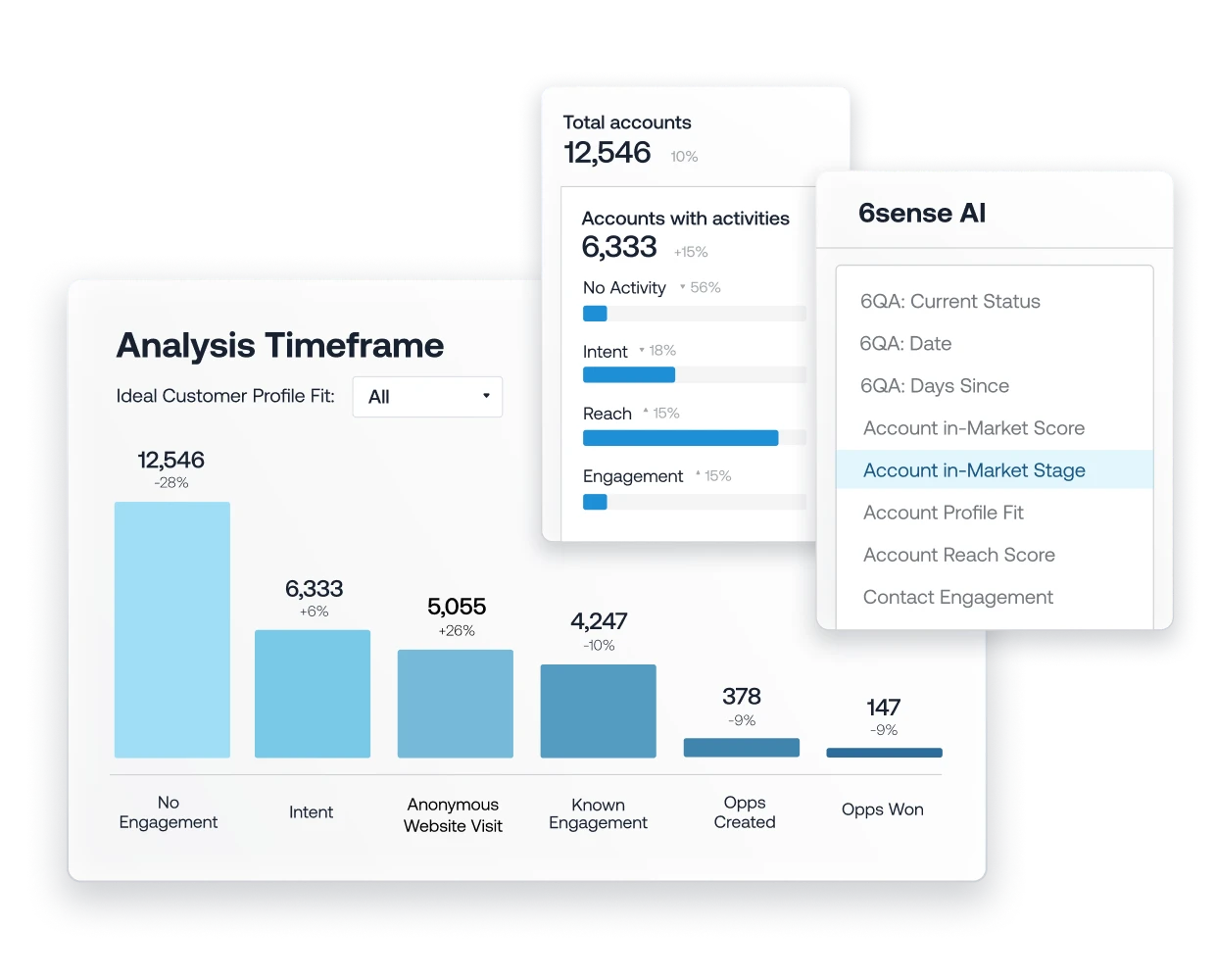
6sense interface. (Image source: 6sense)
6sense specializes in predictive account identification and intent monitoring, aggregating signals across first-party website behavior, second-party platforms like G2 and LinkedIn, and third-party research networks. This allows teams to prioritize accounts showing genuine buying behavior, achieving 76% higher ROI compared to generic outreach according to B2B marketing benchmarks.
The platform's intent data combines multiple signals to predict which accounts are in-market and which stakeholders are involved in the buying process, enabling more strategic account-based marketing and sales approaches.
Best for: Enterprise B2B companies, account-based marketing teams, complex B2B sales cycles
Key Features
Multi-source intent data aggregation
Predictive account identification
Buying stage detection
Stakeholder involvement mapping
Anonymous visitor identification
Campaign orchestration across channels
Account engagement scoring
Integration with advertising platforms
Pros
Comprehensive intent signal coverage
Strong predictive account scoring
Good for account-based strategies
Helps prioritize sales efforts
Integrates with advertising platforms
Cons
Account-level focus without individual customer behavior tracking
No cart abandonment or purchase journey optimization
Premium pricing makes it expensive for mid-market segments
Significant configuration and setup requirements
Less effective for high-volume individual transaction businesses
Outreach
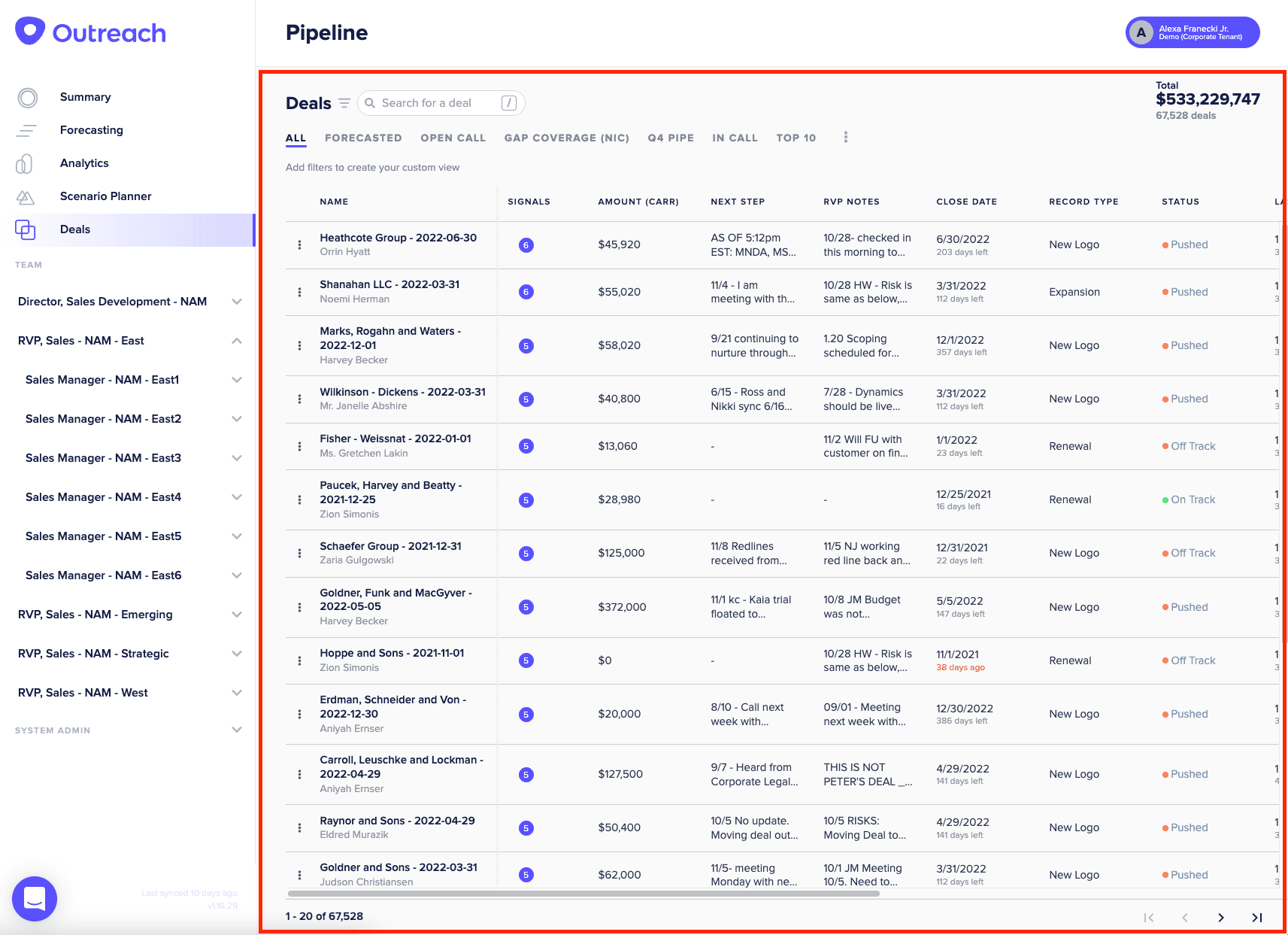
Outreach interface. (Image source: Outreach)
Outreach provides engagement orchestration with particularly strong email intelligence, analyzing which subject lines, content, and sending times drive responses. The platform's generative AI creates drafts based on prospect research, saving hours of manual work while maintaining personalization quality through automated optimization.
The workflow automation capabilities coordinate multi-touch sequences across channels while providing detailed analytics on what messaging resonates with different segments.
Best for: B2B sales teams, SDR organizations, sales engagement-focused teams
Key Features
Email intelligence and optimization
Generative AI content creation
Multi-channel sequence orchestration
A/B testing for messaging
Meeting scheduling automation
Call recording and analysis
Sales analytics and reporting
CRM integration and sync
Pros
Excellent email optimization features
Strong content generation capabilities
Good analytics and reporting
Established platform with large user base
Comprehensive training and support
Cons
Static sequence model without behavioral vectorization
Lacks real-time adaptive journey capabilities
No predictive purchase behavior optimization
Per-user pricing model rather than performance-based
Requires manual optimization and testing of messaging sequences
Revenue.io
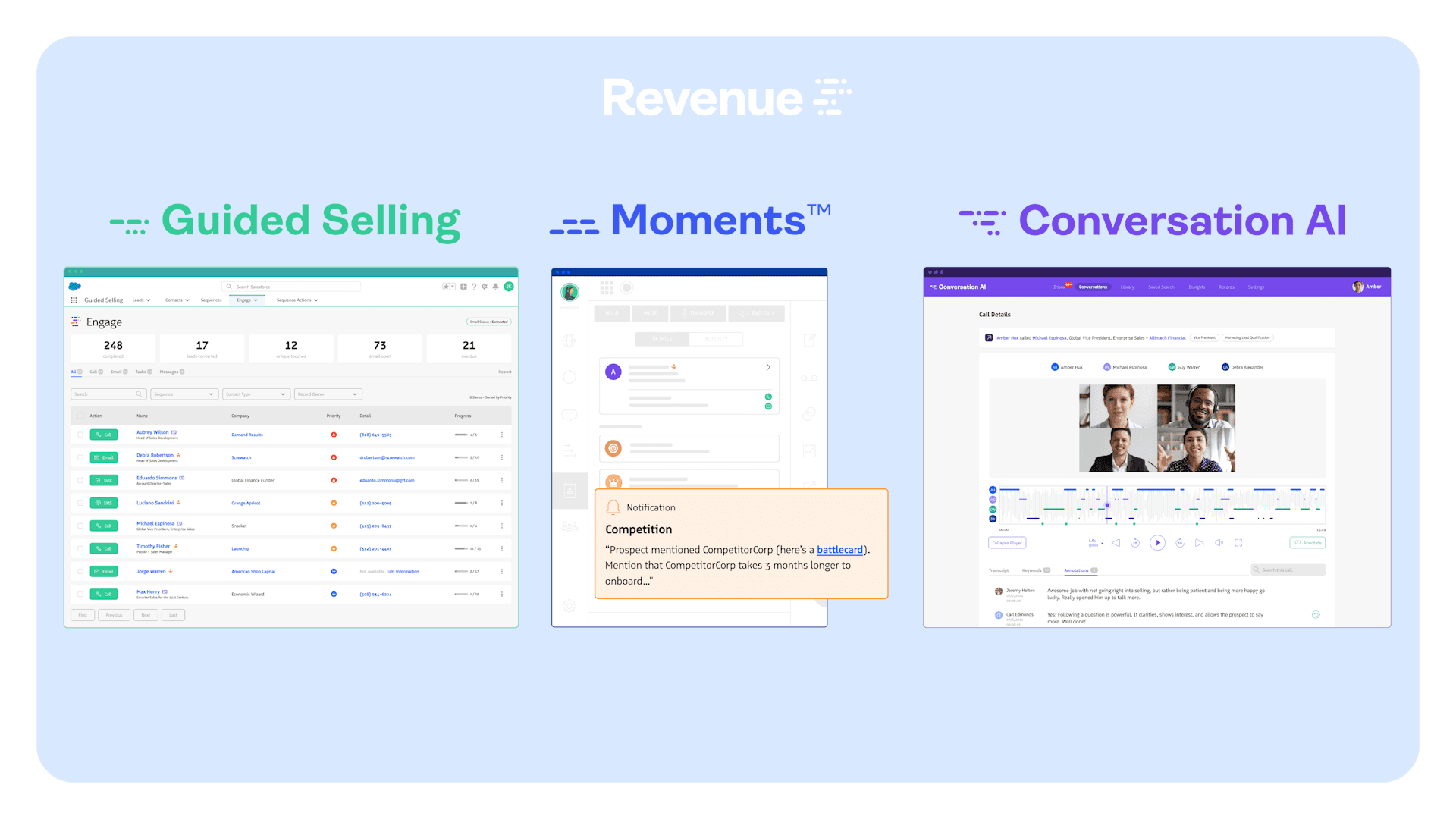
Revenue.io interface. (Image source: Revenue.io)
Revenue.io delivers real-time battlecards and talking points during live sales conversations, listening to calls and surfacing relevant competitive intelligence, objection responses, and next-best questions exactly when reps need them. This just-in-time coaching approach helps even junior representatives handle difficult conversations confidently.
The platform's real-time guidance represents a shift from post-call coaching to in-the-moment support, reducing the time between learning opportunities and application.
Best for: B2B sales teams, organizations with complex products, competitive sales environments
Key Features
Real-time conversation guidance
Dynamic battlecard surfacing
Competitive intelligence prompts
Objection response recommendations
Call recording and analysis
Post-call coaching insights
Integration with CRM systems
Performance analytics
Pros
Unique real-time guidance capabilities
Helps reps in critical moments
Good for complex product sales
Reduces ramp time for new reps
Actionable coaching insights
Cons
Single-channel focus limited to live phone conversations
No digital customer interaction or journey tracking
Lacks behavioral prediction and abandonment prevention
Premium pricing for real-time AI guidance features
Limited effectiveness in digital-first or asynchronous sales models
Salesken
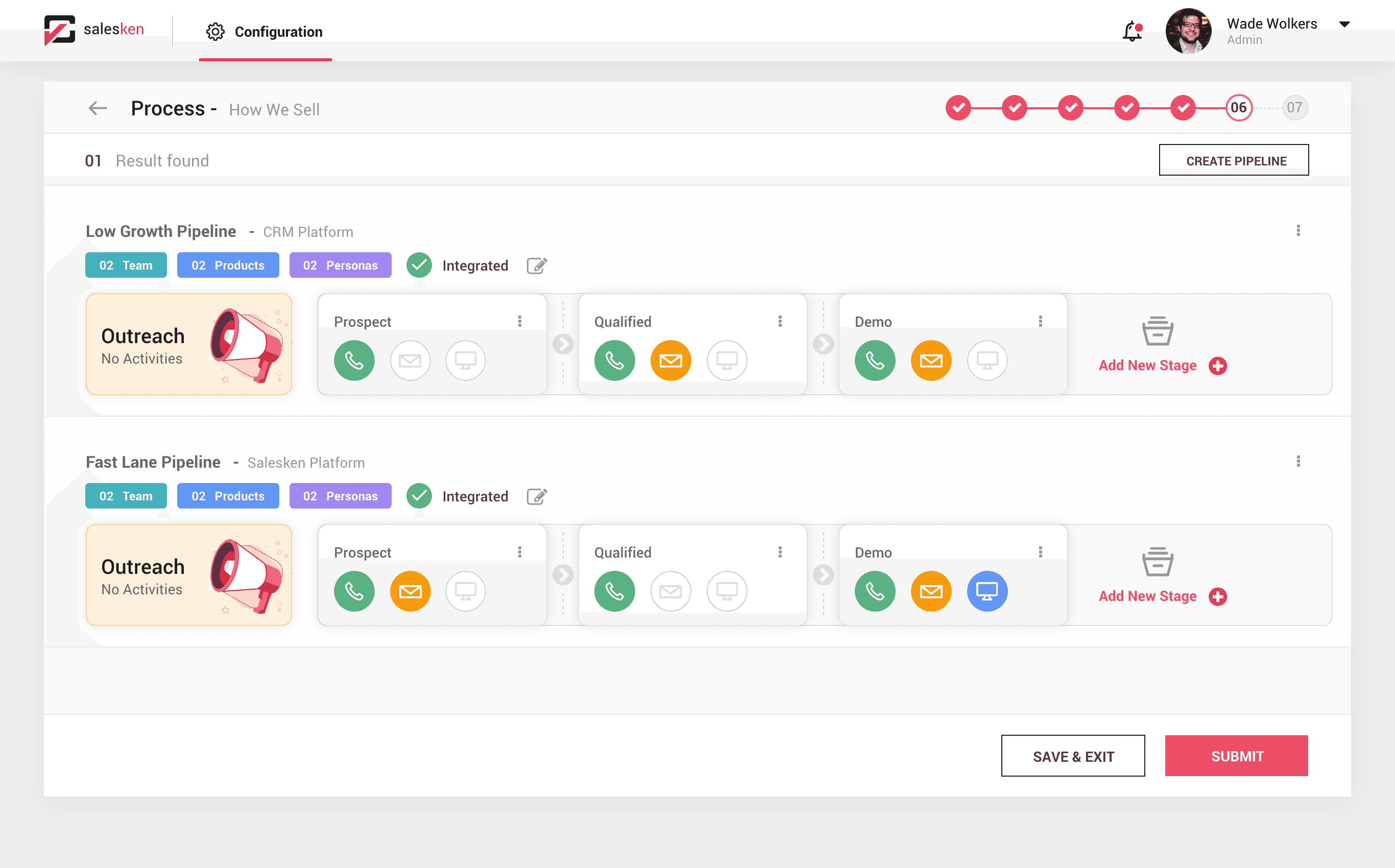
Salesken interface. (Image via TrustRadius)
Salesken provides real-time call assistance with conversation scoring and prompts when reps miss key questions or fail to address buyer concerns. The platform scores conversations in real-time and sends alerts during calls, while post-call analytics identify specific skill gaps for targeted coaching.
The implementation success in complex sales environments demonstrates Salesken's ability to handle sophisticated product discussions and objection handling scenarios.
Best for: B2B sales teams, call-center operations, sales coaching-focused organizations
Key Features
Real-time conversation scoring
Live prompts during calls
Skill gap identification
Coaching workflow automation
Call recording and transcription
Performance benchmarking
CRM integration
Custom coaching playbooks
Pros
Strong real-time coaching features
Good skill development tools
Effective for call-based sales
Detailed performance analytics
Customizable coaching playbooks
Cons
Voice-only channel without multi-channel orchestration capabilities
Requires synchronous phone-based sales interactions
No digital customer behavior tracking or journey optimization
Single-channel approach versus integrated multi-touch strategies
Limited to coaching rather than autonomous revenue generation
Must-Have Features in AI-Powered Revenue Intelligence Tools
Behavioral Vectorization and Intent Analysis
Modern revenue intelligence should turn raw customer actions into data that AI can easily understand. Look for tools that build rich behavioral profiles capturing hesitation, comparisons, and how quickly someone moves toward a decision.
The most advanced systems go far beyond basic event tracking to model intent, timing patterns, emotional signals, and likelihood to buy. They allow you to see not just what customers do, but why they do it.
Real-Time Predictive Analytics
AI in revenue cycle management can predict risks before they happen, not just report past activity. Look for systems that flag churn or abandonment risk early in a customer journey, assign deal or customer risk scores you can track over time, and suggest which retention or recovery actions are most likely to work.
The strongest platforms tie these predictions to real outcomes like reduced churn, higher conversion rates, and better customer lifetime value.
Autonomous Agent Architecture
Revenue intelligence tools should function as autonomous agents rather than workflow executors. This means generating unique strategies for each individual rather than applying pre-defined templates, orchestrating multi-channel engagement without manual sequence building, and continuously learning from outcomes to improve future interactions.
Systems with autonomous capabilities process millions of events per second and generate thousands of unique journeys simultaneously.
Lifetime Attribution Modeling
Traditional attribution (last-click, first-touch, linear) fails to capture customer journey complexity. Advanced platforms create detailed maps of cause-and-effect links in user behavior, not just simple connections.
They track how behaviors speed up or slow down over time, keep full details of the user's surroundings for each action, and predict future interactions. This creates true understanding of what drives purchase decisions.
Multi-Channel Orchestration at Scale
Look for platforms that coordinate engagement across six or more channels: email, SMS, WhatsApp, push notifications, voice calls, and in-app messaging. It also needs perfect context preservation. The system picks the best channel and timing for each person based on their unique likelihood to respond.
Automated Data Capture and Intelligence Extraction
AI should eliminate manual data entry by automatically logging all customer interactions. It should also extract intelligence from unstructured communications, and enriching profiles in real-time. A case study by CaptivateIQ found out that a telecommunications company named AFL achieved 100% data accuracy within six months with AI.
So, your preferred revenue intelligence tools should be able to capture micro-interactions like mouse movements, scroll patterns, and dwell time—not just major events like purchases.
Self-Updating Audience Intelligence
Static segments quickly go out of date. Smart platforms create audiences that update live with behavior shifts, spot tiny patterns in big groups, and predict customer segment changes ahead of time.
The system should recognize when someone's intent shifts from browsing to comparison shopping to purchase readiness and adjust engagement accordingly.
Performance-Based Success Metrics
HubSpot’s 2024 AI in Sales report shows AI adoption in sales jumped from 24% to 43%, with a primary use case being personalizing outreach and accelerating deal cycles (AI-assisted email and messaging).
AI RevOps tools should measure impact, not just activity. Look for tools that show 20–30% better forecast accuracy and link accurate forecasts with higher quota attainment. The strongest platforms prove revenue gains through recovered revenue, higher conversion rates, and increased customer lifetime value.
How Revenue Intelligence Tools Drive ROI for RevOps Teams
Forecasting Accuracy
AI-powered tools improve 20-30% of predictions compared to manual approaches. Gartner research shows 67% of sales operations leaders find forecasting harder today than three years ago, making this improvement critical for pipeline planning and resource allocation.
Time Savings
Automated data entry alone reclaim 5-10 hours per rep per week. Organizations using AI coaching see 20% more engagement with professional development and shortened sales cycles.
Revenue lift
This measures the ultimate success. Organizations currently using AI report 29% higher revenue growth compared to peers without AI adoption, based on Gong's research across 600+ revenue leaders.
For ecommerce, traditional cart abandonment campaigns recover 10-15% of lost revenue. AI-powered platforms like Markopolo achieve 30-40% recovery through individualized journeys. On a monthly abandoned cart value of $100,000, this represents an additional $20,000-25,000 recovered—far exceeding platform costs.
Choosing the Right Revenue Intelligence Tool for Your Team
Team size determines platform needs. Small teams under 20 reps benefit from integrated platforms like Salesloft. Mid-market teams of 20-100 need specialized forecasting (Clari) or conversation intelligence (Gong). Enterprises above 100 reps typically deploy multiple complementary tools.
Ecommerce businesses need platforms understanding digital customer behavior, integrating with Shopify, and orchestrating across email, SMS, and other channels—where Markopolo specifically addresses requirements that B2B tools miss.
Integration requirements can't be overlooked. Prioritize native connectors to your CRM, communication tools, and meeting platforms.
Budget planning should account for both subscription costs ($50,000-500,000+ annually for enterprise platforms) and 2-3 month implementation timelines. Value-based pricing models reduce upfront risk by aligning vendor success with your outcomes.
Integration & Tech Stack Requirements
CRM compatibility is non-negotiable. Your platform must integrate deeply with Salesforce, HubSpot, or your CRM choice through bidirectional sync.
Data requirements determine AI capability. Most platforms need 6-12 months of historical data to train predictive models. Conversation intelligence requires recorded calls and email access. Audit data quality before implementation—clean data foundations make AI effective.
API capabilities enable custom workflows and integrations. Evaluate rate limits, documentation quality, and webhook support for building dashboards or integrating proprietary systems.
Security and compliance vary by industry. Ensure platforms meet standards for data encryption, access controls, and regulations (GDPR, CCPA, HIPAA). Conversation intelligence tools need clear consent workflows and retention policies.
The goal is creating a unified intelligence layer where data flows seamlessly between systems. When your revenue intelligence platform, CRM, marketing automation, and customer success tools share common data foundations, you gain the complete customer view necessary for true RevOps alignment.
Use Markopolo as Your Revenue Intelligence Tool in 2026
Revenue intelligence tools powered by AI fundamentally change how teams forecast, coach, and close deals. Organizations adopting these platforms today build competitive advantages that compound as their AI models learn and improve.
Whether recovering ecommerce revenue or analyzing B2B conversations, the key is moving from reactive reporting to proactive intelligence that drives action.