10 Best Shopify Apps to Increase Sales: How to Choose and What Mistakes to Avoid
Sirazum Monir Osmani
Shopify apps that increase sales are Markopolo AI, Klaviyo, Upsell.com, UpCart, Loox, Tidio, Bundler, PageFly, Searchanise, and Smile.io.
Which apps can increase sales on your Shopify store?
Markopolo AI
Markopolo AI is a Shopify app that increases sales through 1:1 hyper-personalized customer engagement across email, SMS, WhatsApp, push notifications, and AI voice calls.
The app also increases customer retention and average order value by engaging the right customer at the right time through the right channel.
Markopolo AI allows Shopify merchants to create lifecycle marketing automation flows, such as welcome, browse abandonment, cart and checkout abandonment, retention, loyalty, etc.
Markopolo AI also allows Shopify stores to track revenue from each campaign through its revenue attribution feature. This gives Shopify brands a clear view of how much sales growth each marketing channel is driving.
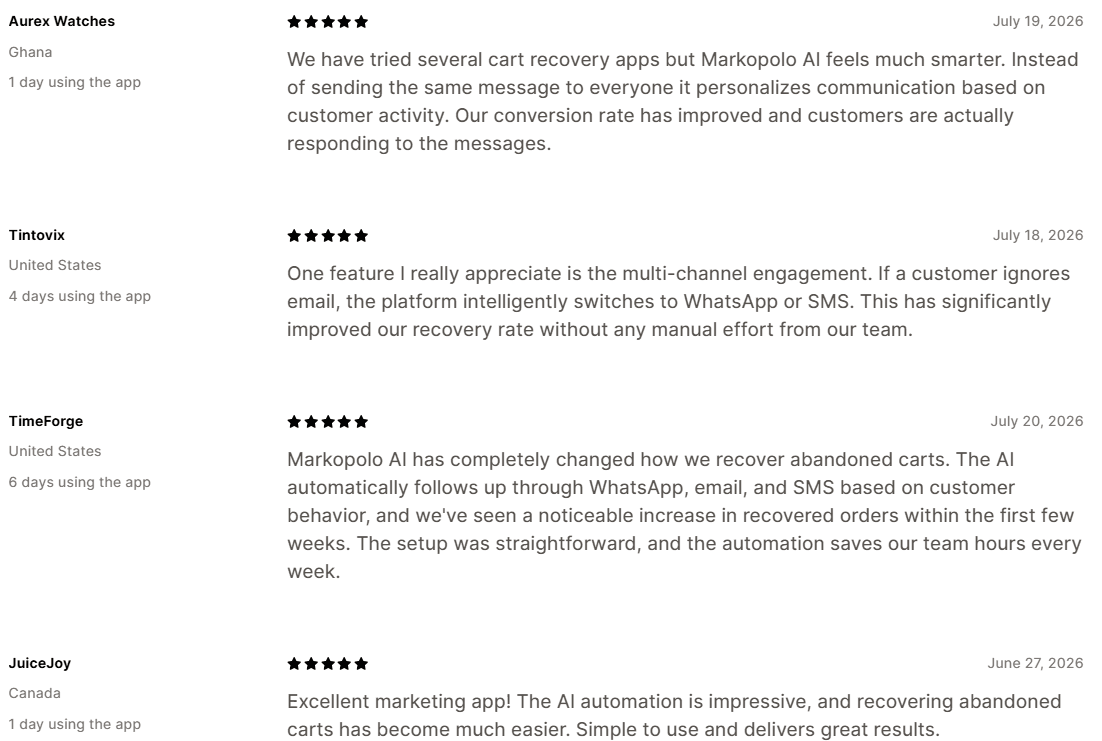
On the Shopify App Store, Markopolo AI has a 5/5 rating, with merchant reviews highlighting improved Shopify sales and revenue growth, including: “Our conversion rate has improved,” “This has significantly improved our recovery rate without any manual effort,” and “We’ve seen a noticeable increase in recovered orders”, etc.
Use Markopolo AI to increase sales on Shopify
Markopolo AI helps you get more sales through email, SMS, WhatsApp, push notifications, and AI voice calls
No credit card required.

Klaviyo
Klaviyo is a Shopify marketing automation app built around email, SMS, WhatsApp, customer data, segmentation, and personalized ecommerce campaigns. It syncs Shopify store and customer activity with marketing workflows, allowing merchants to create automated flows for abandoned carts, product browsing, post-purchase engagement, win-backs, and other stages of the customer lifecycle.
For Shopify stores, Klaviyo’s main sales use case is turning behavioral and purchase data into more relevant marketing messages. Merchants can segment customers based on shopping activity and automate campaigns designed to convert browsers, recover lost sales, and generate repeat purchases. Klaviyo currently has a 4.7/5 rating on the Shopify App Store.
Upsell.com
Upsell.com (formerly ReConvert) focuses on generating more revenue from shoppers who are already close to purchasing. Shopify merchants can create product-page offers, cart upsells, frequently bought together recommendations, checkout offers, and one-click post-purchase upsells instead of relying only on acquiring additional traffic.
The app currently has a 4.8/5 Shopify App Store rating. In Upsell, post-purchase funnels are particularly useful because customers can accept additional offers after placing an order without restarting the original checkout process.
Its strongest use case is increasing Shopify average order value by presenting relevant cross-sells and upsells throughout the buying journey.
UpCart
UpCart turns the standard Shopify cart into a customizable slide cart designed to generate more value before checkout. UpCart currently has a 4.7/5 rating on the Shopify App Store.
Merchants can place product recommendations, cross-sells, add-ons, free gifts, discounts, reward bars, and free-shipping goals directly inside the cart while keeping shoppers on the storefront.
This makes UpCart particularly relevant for stores trying to increase average order value while reducing cart friction. Rather than introducing another step between product selection and checkout, merchants can encourage customers to add complementary products or spend enough to unlock an incentive within the cart itself.
Loox
Loox is a social-proof and product-review app on Shopify. Loox lets shopify brands to sell more products through social proof. The product reviews app helps stores automatically collect customer reviews, including photo and video UGC, and display ratings, testimonials, review galleries, and other trust signals across product pages and the storefront.
For shoppers who are interested in a product but uncertain about buying, seeing experiences from previous customers can reduce purchase hesitation. Loox also offers AI-powered review sorting, highlights, translations, referrals, and review syndication across channels such as Google, Meta, TikTok Shop, and the Shop app. Loox has a 4.9/5 Shopify App Store rating.
Tidio
Tidio is a Shopify live chat and AI chatbot app . Tidio helps Shopify merchants increase sales that brings customer support and conversational selling into the shopping experience. Store visitors can ask questions while browsing, while merchants can use live chat, automated flows, and Tidio’s Lyro AI agent to respond to common inquiries and guide shoppers toward relevant products.
Tidio currently holds a 4.8/5 rating on the Shopify App Store.
The sales opportunity with Tidio is different from email or upselling apps: Tidio targets shoppers who may abandon a purchase because they still have unanswered questions. Its Shopify features can surface customer carts, previous orders, browsing activity, personalized product recommendations, and discount codes during conversations.
Bundler
Bundler gives Shopify merchants a way to sell products together rather than relying exclusively on individual product purchases. Stores can create classic product bundles, mix-and-match bundles, quantity breaks, volume discounts, tiered offers, frequently bought together deals, and Buy X Get Y promotions.
This makes Bundler particularly useful for increasing units per transaction and average order value. A skincare store, for example, can package complementary products into a routine, while a consumables brand can offer quantity discounts for customers buying multiple units. Bundler currently has a 4.9/5 rating on the Shopify App Store.
PageFly
PageFly targets a different Shopify sales bottleneck: the storefront itself. It allows merchants to build and optimize product pages, landing pages, homepages, collection pages, and other conversion-focused store experiences without relying entirely on Shopify theme templates or custom development.
PageFly currently has a 4.9/5 Shopify App Store rating.
Its CRO tools extend beyond page design. PageFly includes A/B testing, click heatmaps, funnel analytics, AI page audits, and hundreds of page templates, giving merchants ways to identify where shoppers drop off and test changes to copy, layouts, offers, and calls to action.
Searchanise
Searchanise helps Shopify stores increase sales by making products easier to find. Its search and discovery tools include predictive instant search, autocomplete, AI personalization, voice search, synonyms, custom filters, product recommendations, merchandising controls, and search analytics.
This becomes especially important for Shopify stores with larger catalogs, where shoppers may know what they want but struggle to locate the right product or variant. Better search results and collection filtering shorten the path between product intent and purchase. Searchanise currently has a 4.8/5 Shopify App Store rating, with one recent merchant review reporting that sales and orders were “noticeably up” after using the app.
Smile.io
Smile.io gets more sales on Shopify by focusing on getting more revenue from customers after their first Shopify order. Merchants can create loyalty programs with points, rewards, referrals, VIP tiers, exclusive perks, special pricing, and promotional campaigns such as double-points events.
Instead of treating every completed order as the end of the customer journey, Smile gives shoppers incentives to purchase again and engage with the brand over time. That makes it particularly relevant for Shopify stores trying to improve repeat purchase rate, customer retention, referral sales, and customer lifetime value. Smile currently has a 4.9/5 rating on the Shopify App Store.
How to choose the best Shopify app to increase your store’s sales?
To choose the best Shopify app to increase sales, determine a Shopify app that directly solves your store’s biggest sales bottleneck, such as low conversion, abandoned carts, weak retention, or low average order value. Prioritize apps with the right features, reliable integrations, transparent pricing, strong support, and measurable revenue impact.
Store symptom | Revenue problem | Best app type | Shopify app examples | Measure next |
|---|---|---|---|---|
Traffic reaches product pages, but few shoppers buy | Low conversion rate | Reviews, search, live chat, page optimization, CRO | Loox, Searchanise, Tidio, PageFly, Markopolo AI | Conversion rate, product-page exits, search-to-purchase rate |
Customers usually buy only one item | Low average order value | Upsells, cross-sells, bundles, cart incentives | Upsell.com, UpCart, Bundler, Markopolo AI | AOV, units per order, upsell acceptance rate |
Shoppers add items but leave before buying | Lost purchase intent | Email, SMS, WhatsApp, push, cart recovery automation | Markopolo AI, Klaviyo | Cart recovery rate, recovered revenue, checkout completion |
First-time buyers rarely come back | Low repeat purchase rate | Loyalty, lifecycle email, referrals, win-back flows | Smile.io, Markopolo AI, Klaviyo | Repeat purchase rate, retention, customer lifetime value |
Products are bought repeatedly or replenished | Low purchase frequency | Subscriptions, replenishment reminders, lifecycle automation | Subscription apps, Markopolo AI, Klaviyo | Reorder rate, subscription revenue, purchase interval |
What mistakes should you avoid when choosing or installing a Shopify app that increases sales?
Don’t install more than two apps at once
Recommend starting with no more than one or two sales-focused apps at a time. Installing several apps simultaneously makes it harder to determine which one actually improved conversion rate, AOV, or repeat purchases, while also increasing the risk of overlapping features, higher subscription costs, and unnecessary complexity.
Avoid choosing multiple apps that solve essentially the same problem. For example, Klaviyo and Markopolo both offer customer messaging and automation capabilities, including email/SMS and cart-recovery use cases, so most merchants would normally evaluate them as alternatives rather than install both for the same function.
Don’t choose apps without identifying the sales problem
The app should match a measurable bottleneck. If you’re figuring out how to increase sales on Shopify, start by identifying where your store is currently losing revenue rather than simply adding more apps. A store struggling with low conversion may need reviews or better product discovery, while a store with healthy conversions but small baskets may benefit more from upsells or bundles. Choosing based on popularity alone can add cost without addressing the actual reason sales are being lost.
Avoid apps with overlapping features
Check the existing Shopify stack before adding another tool. Many sales apps now combine functions such as email automation, abandoned-cart recovery, product recommendations, loyalty features, or upselling. Paying for two apps that perform the same core task can create duplicate workflows, conflicting customer messages, and more difficult attribution.
Don’t ignore how an app affects your store
Before installation, check whether the app works properly with the store’s theme, checkout configuration, subscriptions, existing marketing tools, and other important integrations. Merchants should also monitor storefront performance after installation rather than assuming every app has zero technical impact.
Don’t overlook long-term costs
An app may seem affordable at first but become significantly more expensive as your orders, contacts, or usage increase. Check the full pricing structure before installing, including higher-tier plans, usage limits, transaction fees, and paid add-ons, so the app remains cost-effective as your Shopify store grows.
Don’t install apps without tracking results
Establish a relevant KPI before activating the app. Depending on its purpose, that could be conversion rate, average order value, recovered-cart revenue, repeat purchase rate, or revenue per recipient. Compare performance before and after implementation so the decision to keep or remove the app is based on measurable sales impact rather than impressions.