
10 best abandoned cart recovery apps for Shopify: key features, comparison, pros, and cons
Nearly 70% of online shoppers abandon their carts before completing a purchase. For Shopify store owners, this translates to significant revenue left on the table. The right abandoned cart recovery app can reclaim 20-40% of those lost sales by reaching customers at the right moment with the right message.
This guide covers the best abandoned cart recovery solutions for Shopify stores. It explains how these apps work, compares their features, and helps you choose the one that fits your business needs.
How do abandoned cart recovery apps bring customers back to complete their purchases?
Abandoned cart recovery apps use data, automation, and strategic communication to re-engage shoppers who left without buying. They work by tracking visitor behavior, identifying abandonment triggers, and delivering personalized messages that address the specific reasons customers hesitated.
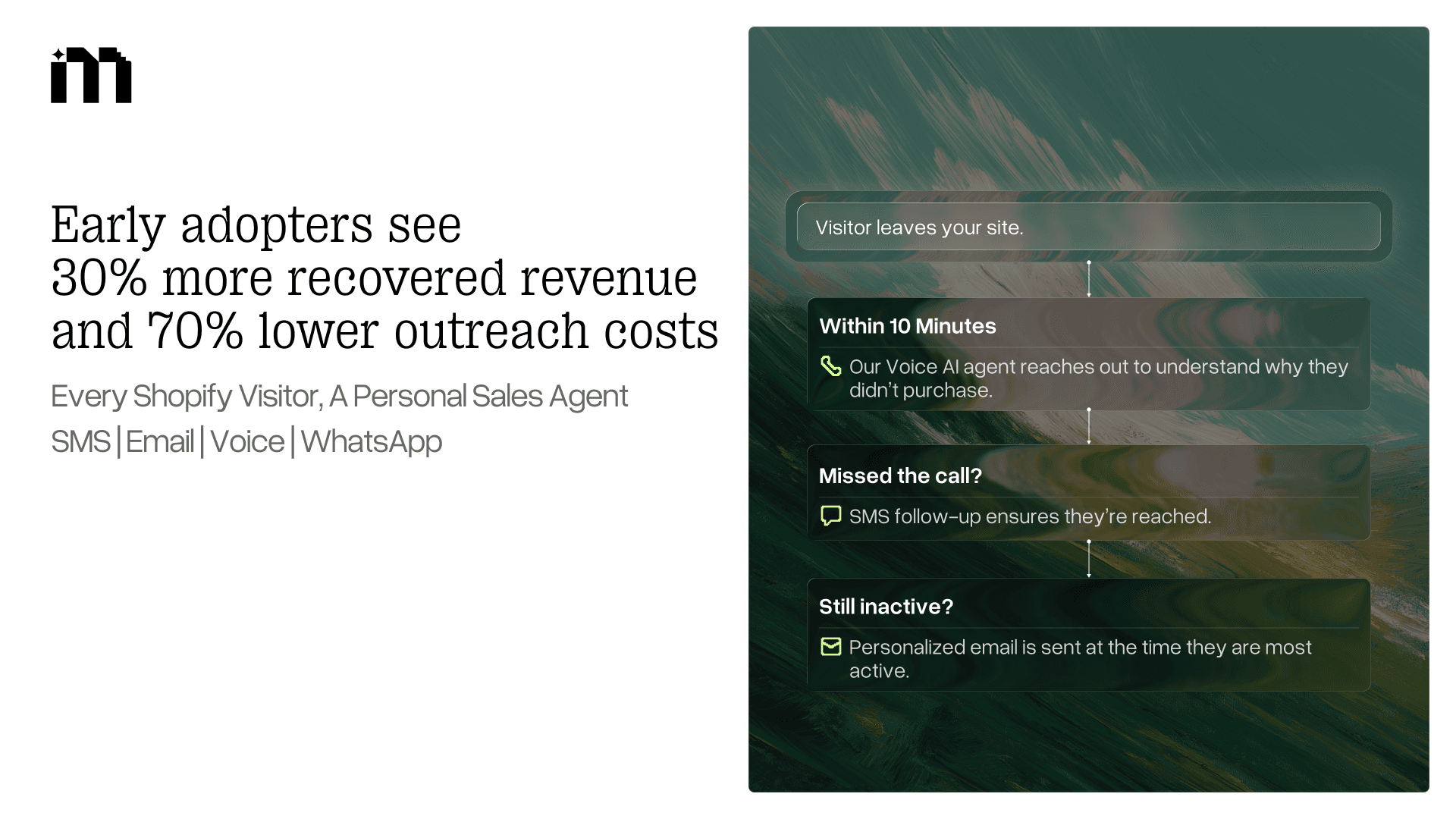
Omnichannel outreach
Modern shoppers interact with brands across multiple touchpoints. They check email during work, respond to SMS on the go, and engage with WhatsApp in the evening. Effective cart recovery apps leverage this omnichannel engagement by reaching customers through their preferred channel at the optimal time. Instead of relying solely on email, these tools coordinate messages across email, SMS, push notifications, WhatsApp, and even voice calls to maximize the chances of re-engagement.
1:1 hyper-personalized communication
Generic "you forgot something" emails no longer cut it. Today's best recovery apps create unique messages for each customer based on their browsing history, cart contents, and behavioral patterns. They include the exact products left behind, recommend complementary items, and craft offers that match the customer's price sensitivity. This level of personalization makes customers feel understood rather than marketed to.
Understanding intent
Not all cart abandoners are the same. Some are comparison shopping, others got distracted, and some need more information before committing. Advanced recovery apps analyze behavioral signals—time spent on product pages, items viewed, return visits—to determine purchase intent. This allows them to send the right message to each customer type, whether that's a discount for price-sensitive shoppers or product reviews for those needing reassurance.
Timing optimization
The difference between a recovered sale and a lost customer often comes down to timing. Send a message too early, and you seem desperate. Send it too late, and the customer has moved on. Recovery apps track engagement patterns to identify when each customer is most likely to respond. Some shoppers convert within an hour of abandonment, while others need a few days of consideration. Smart timing increases recovery rates without annoying customers.
Behavioral intelligence
The most sophisticated recovery tools don't just respond to abandonment—they anticipate it. By analyzing micro-behaviors like hesitation patterns, scroll depth, and comparison shopping signals, these apps can identify customers likely to abandon before they leave. This enables proactive interventions like exit-intent popups, live chat assistance, or targeted incentives that prevent abandonment in the first place.
Tools and solutions that recover abandoned carts for Shopify stores
The Shopify App Store offers dozens of cart recovery solutions, ranging from simple email automation tools to comprehensive AI-driven platforms. The best choice depends on your store's size, budget, customer base, and technical capabilities.
Here are 20 notable abandoned cart recovery solutions available for Shopify stores:
Markopolo AI
Klaviyo
Omnisend
Privy
PushOwl
Recart
SMSBump (Yotpo)
Tidio
Care Cart
Retainful
Cartly
Hextom
TxtCart
Wisepops
Amplified
ActiveCampaign
Drip
Postscript
Gorgias
Sendlane
Top 10 abandoned cart recovery apps for Shopify: key features, comparison, pros, and cons
App | Primary channels | AI capabilities | Pricing model | Best for |
|---|---|---|---|---|
Markopolo AI | Email, SMS, WhatsApp, Push, Voice | AI revenue agents with behavioral vectorization |
| Stores wanting to recover maximum revenue through hyper- personalization at scale |
Klaviyo | Email, SMS | Predictive analytics, segmentation | Contact-based pricing | Data-driven email marketing |
Omnisend | Email, SMS, Push | Pre-built workflows, cookie tracking | Tiered by contacts | Multi-channel automation beginners |
Privy | Email, SMS, Popups | Basic automation | Tiered pricing | Small stores needing lead capture |
PushOwl | Web push notifications | Smart delivery timing | Per-impression pricing | Stores without customer emails |
Recart | Messenger, SMS | Conversational AI | Performance-based | Messenger-focused recovery |
SMSBump (Yotpo) | SMS, MMS | AI text optimization | Per-message pricing | SMS-first recovery strategies |
Tidio | Live chat, Email, Chatbot | AI chatbot responses | Tiered by operators | Real-time customer support |
Care Cart | Email, Push | Basic automation | Low monthly fee | Budget-conscious new stores |
Retainful | Drip campaigns | Freemium model | Simple email-only recovery |
Markopolo AI
Markopolo AI is the leading solution for abandoned cart recovery. Rather than applying the same workflow to segments of customers, this AI-native customer engagement platform creates individual AI revenue agents for each visitor. These agents understand the complete behavioral context of every shopper and orchestrate completely unique recovery journeys tailored to each person's needs.
The platform's core technology, MarkTag, goes beyond traditional event tracking. It transforms user behavior into 384-dimensional vectors that capture intent, hesitation patterns, and purchase probability. When someone abandons a cart, Markopolo's AI doesn't just send a generic email—it determines whether this specific customer needs social proof, a discount, a comparison guide, or a personal phone call, and delivers that through their preferred channel at their optimal engagement time.
Why is Markopolo AI the best cart recovery app for Shopify
Behavioral vectorization creates true customer understanding
Traditional recovery apps track events like "added to cart" and "left site." Markopolo's MarkTag captures thousands of micro-interactions—mouse movements, hesitation patterns, comparison behavior, scroll depth—and transforms them into a mathematical representation of intent. This 384-dimensional vector allows the AI to understand not just what customers did, but why they did it and what they need to convert.
Individual AI agents replace segment-based campaigns

Most platforms group customers into segments and send the same message to everyone in that group. Markopolo assigns each visitor their own AI agent that creates a completely unique recovery strategy. If you have 10,000 abandoned carts, you get 10,000 different recovery journeys, each optimized for that specific individual's needs and preferences.
Omnichannel orchestration happens automatically

Markopolo coordinates recovery across email, SMS, WhatsApp, push notifications, and AI voice calls without manual configuration. The AI determines the optimal channel, timing, and message for each customer based on their behavioral patterns and engagement history. A customer who responds well to WhatsApp at 7 PM gets contacted there, while someone who prefers email during lunch hours receives that instead.
Real-time decision making enables instant optimization
The platform processes behavioral data and generates recovery strategies in under 50 milliseconds. This speed allows for real-time adjustments—if a customer returns to the site, the recovery sequence adapts immediately. If they engage with a message but don't convert, the next touchpoint reflects that new information.
Lifetime attribution provides complete journey context

Every interaction a customer has with your store contributes to their behavioral profile. Markopolo maintains complete attribution history, understanding how past sessions, previous purchases, and historical engagement patterns should influence current recovery efforts. A returning customer gets treated differently than a first-time visitor, even if their current cart behavior looks similar.
AI-generated content matches individual preferences
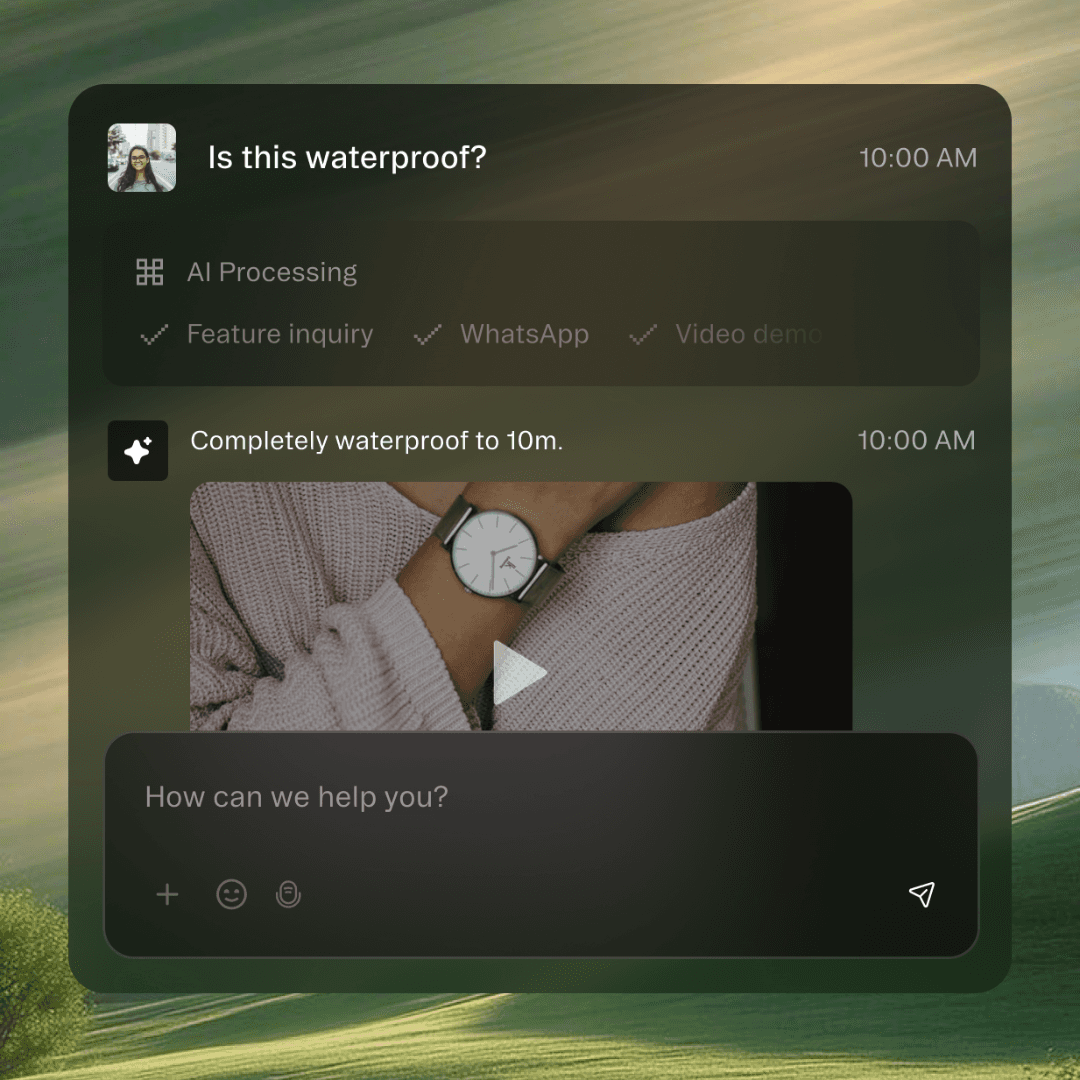
Instead of using templated messages, Markopolo's AI generates personalized content for each customer. The tone, urgency, incentive type, and information included all adapt based on what the AI predicts will resonate with that specific person. Price-sensitive shoppers see value comparisons, while quality-focused buyers receive product detail highlights.
Voice AI adds a human touch at scale
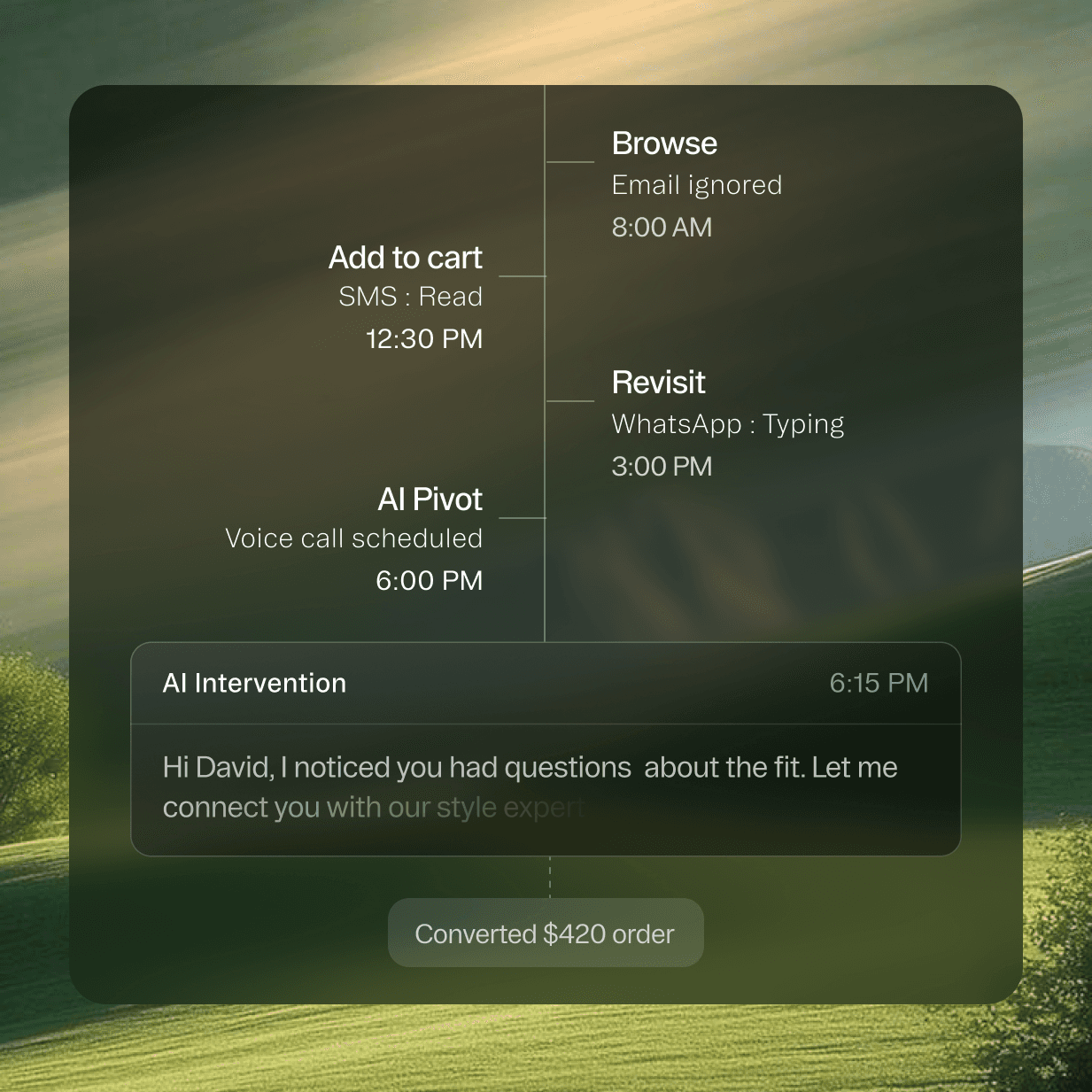
Markopolo includes conversational AI capabilities even for voice calls that conducts natural, context-aware conversations with customers. The AI knows the customer's full history and can answer questions, address concerns, and guide them back to purchase—all without requiring human agents. This channel reaches customers who ignore digital messages but respond to personal contact.
Continuous learning improves over time
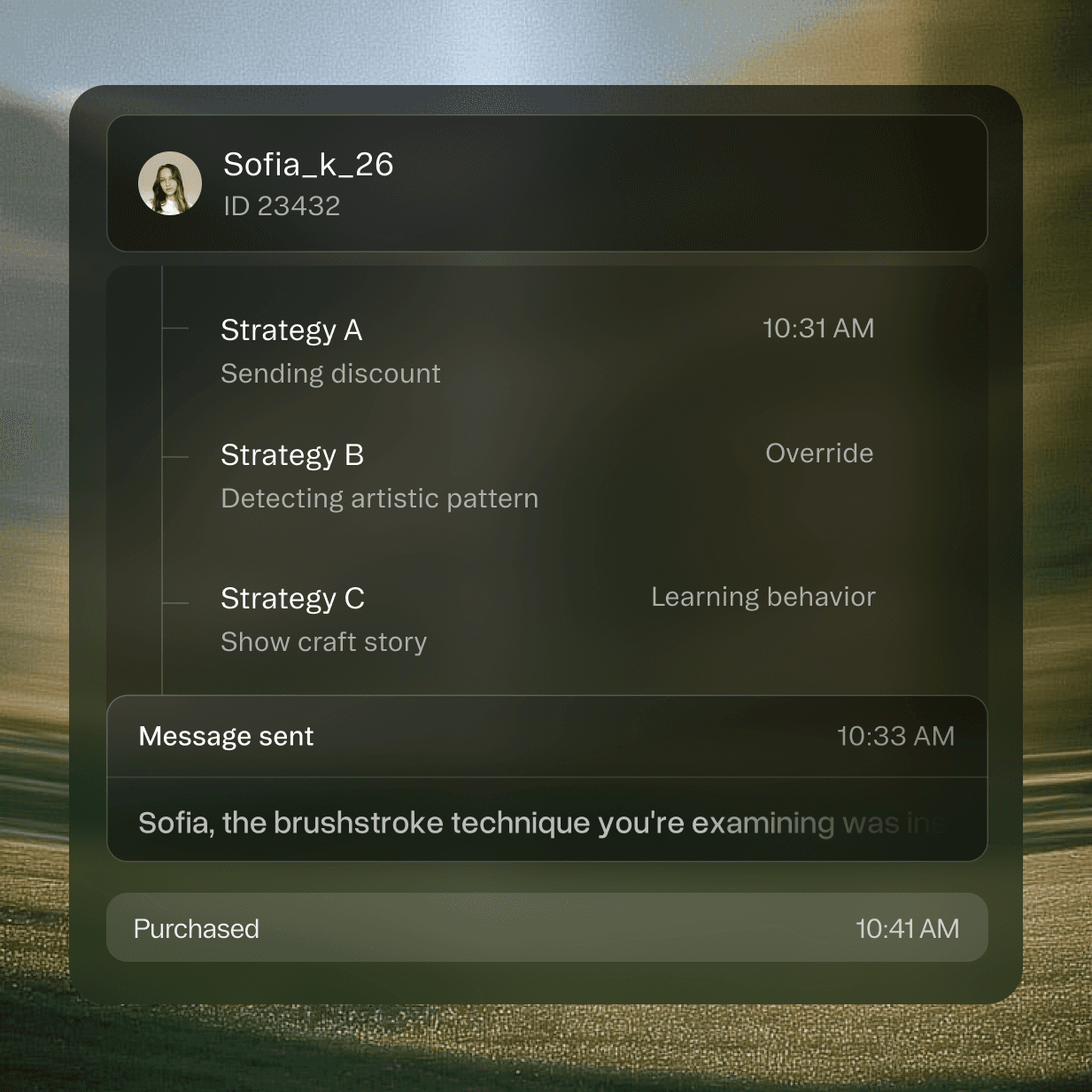
Every interaction feeds back into Markopolo's models. The AI learns what works for different customer types, product categories, and business contexts. Recovery strategies become more effective over time as the system accumulates data about what drives conversions for your specific store and customer base.
Predictive intervention prevents abandonment before it happens
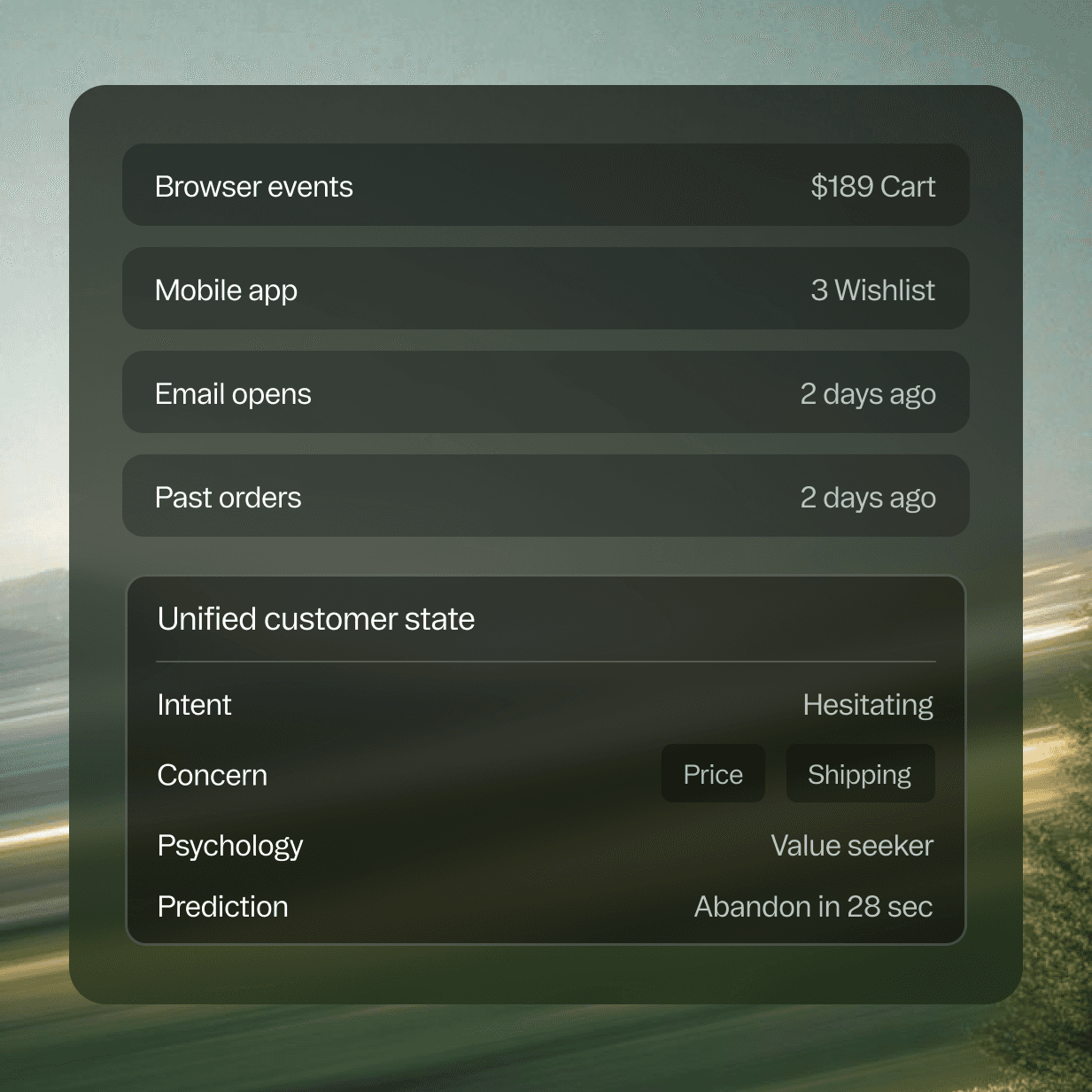
Markopolo's behavioral analysis can identify customers likely to abandon three pages before they actually leave. This enables proactive interventions—personalized incentives, live chat triggers, or targeted messages—that address hesitation before it leads to abandonment. Prevention yields better results than recovery after the fact.
Value-based pricing aligns costs with results
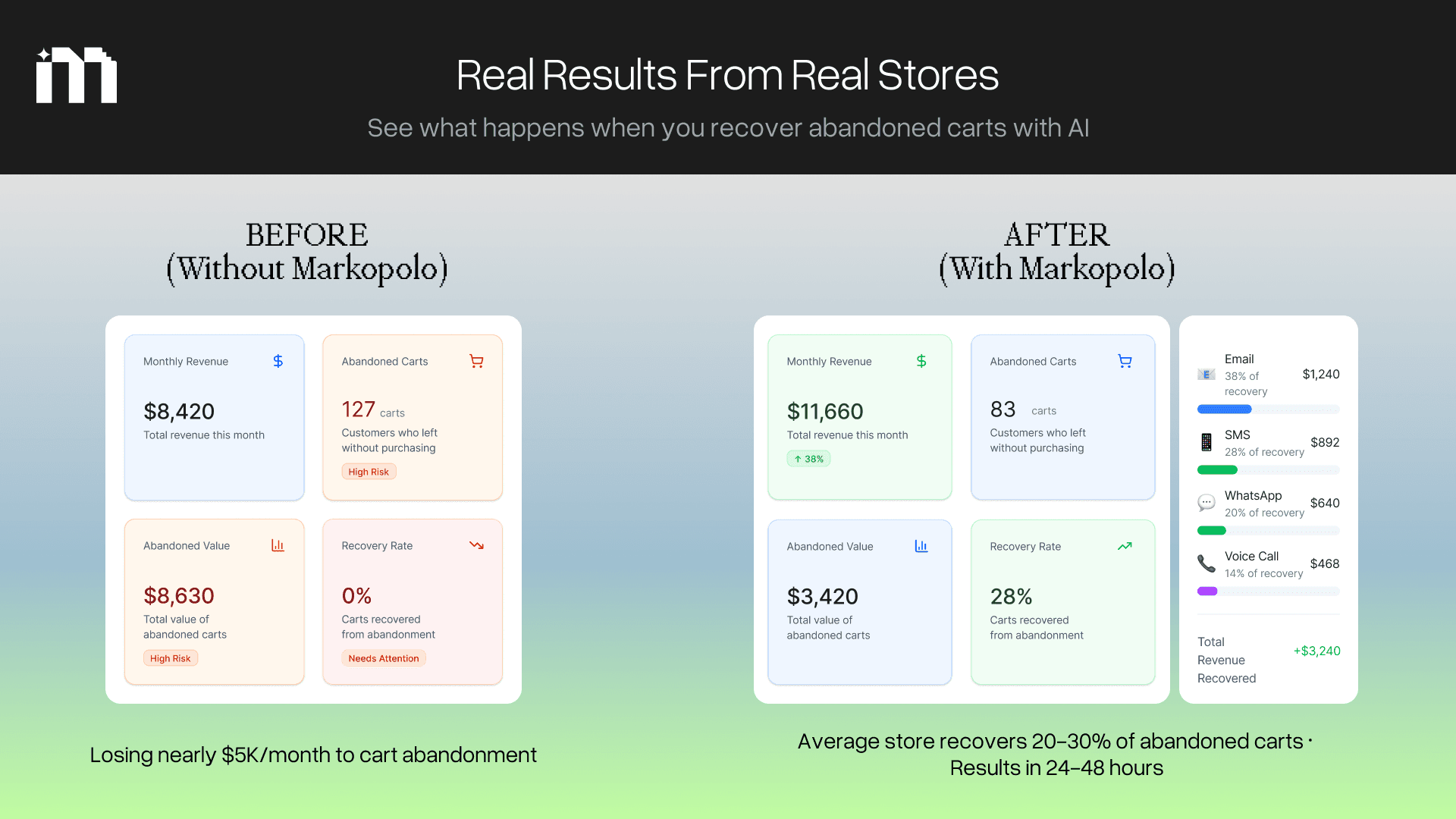
Instead of charging per contact or per message, Markopolo uses a revenue-share model that ties costs directly to recovered sales. This means you pay for results, not activity, and the platform's success is aligned with yours.
Pros
Creates truly individual recovery journeys rather than segment-based campaigns
Coordinates across six or more channels automatically
Behavioral vectorization provides deep customer understanding
AI voice calling reaches customers who ignore digital messages
Real-time processing enables instant optimization
Continuous learning improves results over time
Revenue-share pricing aligns incentives with performance
Native Shopify integration with simple setup
Cons
Advanced features may need learning curve for traditional marketers
Klaviyo
Klaviyo has established itself as a powerful email and SMS marketing platform with strong e-commerce integrations. The platform excels at data-driven segmentation and provides robust abandoned cart flow capabilities within its broader marketing automation suite.
Klaviyo's strength lies in its predictive analytics and customer data platform capabilities. It pulls data from multiple sources to create detailed customer profiles, enabling sophisticated segmentation for cart recovery campaigns. The platform offers pre-built abandoned cart flows that can be customized extensively.
Why Shopify stores can consider Klaviyo
Klaviyo works well for stores that want deep control over their email marketing strategy and have the resources to build and optimize custom flows. Its segmentation capabilities allow for detailed audience targeting, and its integration with Shopify provides access to rich customer data. The platform suits merchants who prefer a hands-on approach to marketing automation.
Pros
Powerful segmentation and predictive analytics
Deep Shopify integration with comprehensive data sync
Extensive customization options for email flows
Strong A/B testing capabilities
Large template library and design flexibility
Cons
Requires significant setup and optimization effort
Contact-based pricing can become expensive as lists grow
Learning curve for advanced features
Limited channels compared to multi-channel platforms
Manual workflow building needed for sophisticated strategies
Comparing Klaviyo vs Markopolo AI for cart recovery
While Klaviyo provides excellent tools for building customized email flows, it still operates on the traditional segment-based model. Marketers must create workflows, define segments, and manually optimize campaigns. Markopolo AI automates this entirely—its AI creates individual strategies for each customer without manual configuration. Klaviyo requires you to decide what message to send to which segment; Markopolo figures this out automatically for every single customer.
Omnisend
Omnisend positions itself as an e-commerce-focused marketing automation platform that combines email, SMS, and push notifications in one interface. The platform emphasizes ease of use with pre-built workflows and drag-and-drop editors.
The platform's abandoned cart recovery features include both standard cart abandonment and checkout abandonment flows. Omnisend's cookie-based tracking can identify returning visitors, allowing recovery emails even for some customers who haven't provided their email address during the current session.
Why Shopify stores can consider Omnisend
Omnisend appeals to Shopify merchants who want multi-channel marketing automation without complex setup. Its pre-built e-commerce workflows get stores running quickly, and the unified interface makes managing email, SMS, and push straightforward. The free tier provides decent functionality for smaller stores testing the platform.
Pros
User-friendly interface with quick setup
Pre-built e-commerce workflows included
Combines email, SMS, and push in one platform
Cookie-based tracking expands recovery reach
Free tier available for small stores
Cons
Limited AI capabilities compared to newer platforms
Workflow customization has constraints
Billable contacts include non-subscribers
Cannot exclude specific products from cart emails
Less sophisticated personalization options
Comparing Omnisend vs Markopolo AI for cart recovery
Omnisend simplifies multi-channel marketing but still relies on predefined workflows applied to customer segments. A customer gets the same flow as others in their segment, regardless of individual behavioral nuances. Markopolo AI creates unique recovery sequences for each customer, adjusting channel, timing, and messaging based on individual behavioral vectors. Where Omnisend offers convenience, Markopolo offers intelligence.
Privy
Privy combines email and SMS marketing with on-site conversion tools like popups and banners. The platform focuses on capturing emails before abandonment happens and following up with targeted recovery campaigns.
The platform's strength is in its conversion-focused approach. Exit-intent popups, spin-to-win wheels, and welcome discounts help capture email addresses from visitors who might otherwise leave anonymously. Once captured, Privy's automation handles cart recovery sequences.
Why Shopify stores can consider Privy
Privy suits smaller Shopify stores that need both lead capture and cart recovery in one tool. The platform's focus on growing email lists complements its recovery capabilities—you can't recover carts if you don't have customer contact information. The drag-and-drop editor makes creating popups and emails accessible to non-technical users.
Pros
Combines lead capture with cart recovery
Easy-to-use popup and email builders
Good for growing email lists
Affordable for smaller stores
Simple automation setup
Cons
Limited to email and SMS channels
Basic personalization capabilities
Analytics less detailed than specialized platforms
Can feel intrusive if popups aren't well-targeted
Scaling costs increase significantly
Comparing Privy vs Markopolo AI for cart recovery
Privy focuses on the basics—capture emails and send recovery sequences. This works for simple needs but leaves significant value on the table. Markopolo AI doesn't just recover carts; it understands why each customer abandoned and addresses their specific hesitation. Privy sends the same discount to everyone; Markopolo might send social proof to one customer, a technical comparison to another, and a premium upgrade offer to a third.
PushOwl
PushOwl specializes in web push notifications for Shopify stores. Push notifications appear directly in customers' browsers or devices, providing a recovery channel that doesn't require email addresses or phone numbers.
The platform's focus on push notifications fills a specific gap—recovering sales from visitors who never provided contact information. With one-click subscription prompts, PushOwl builds a subscriber base that can be reached instantly when they abandon carts.
Why Shopify stores can consider PushOwl
PushOwl makes sense for stores where many visitors abandon without providing email addresses. Push notifications have high visibility and quick delivery, reaching customers while their purchase intent is still fresh. The channel works well alongside email and SMS as part of a broader recovery strategy.
Pros
Reaches customers without email or phone
High open rates for push notifications
Quick implementation with one-click subscriptions
Cost-effective per-impression pricing
Works across devices via browser
Cons
Single channel limits recovery options
Subscribers must have browser permission enabled
Less space for detailed messaging
Can feel intrusive if overused
No email or SMS capabilities
Comparing PushOwl vs Markopolo AI for cart recovery
PushOwl does one thing—push notifications—well. But cart recovery often requires multiple touchpoints across different channels. Markopolo AI includes push notifications as part of its orchestration capabilities while also coordinating email, SMS, WhatsApp, and voice calls. More importantly, Markopolo determines when push is the right channel for a specific customer versus when another approach would work better.
Recart
Recart focuses on Messenger and SMS marketing for e-commerce recovery. The platform built its reputation on Facebook Messenger marketing and has expanded to include SMS capabilities with conversational AI features.
The platform emphasizes two-way conversations rather than one-way broadcasts. Customers can respond to recovery messages, ask questions, and receive AI-assisted answers that guide them back to purchase.
Why Shopify stores can consider Recart
Recart appeals to stores whose customers actively use Messenger and prefer conversational engagement. The platform's performance-based pricing reduces risk, and its conversational approach can handle customer objections in real-time through AI-powered responses.
Pros
Strong Messenger marketing capabilities
Conversational AI handles customer questions
Performance-based pricing available
Two-way communication builds engagement
Good open rates on Messenger
Cons
Channel limitations (Messenger + SMS only)
Messenger reach declining as platform evolves
Less effective for customers who don't use Messenger
Requires Facebook Business integration
Limited email capabilities
Comparing Recart vs Markopolo AI for cart recovery
Recart's conversational approach adds value, but it's constrained to Messenger and SMS. Markopolo AI provides conversational capabilities across more channels, including AI voice calls that can conduct natural conversations with customers. Additionally, Markopolo's behavioral intelligence determines who would benefit from conversation versus who just needs a simple reminder—not every customer wants to chat.
SMSBump (Yotpo)
SMSBump, now part of Yotpo, provides SMS marketing automation for e-commerce. The platform integrates with Yotpo's broader product suite including reviews and loyalty programs.
The platform's strength lies in SMS-specific optimization—timing, character counts, compliance management, and conversion tracking. Integration with Yotpo reviews enables including social proof in recovery messages.
Why Shopify stores can consider SMSBump
SMSBump fits stores that want to prioritize SMS as their primary recovery channel. The platform's compliance features handle regulatory requirements across different regions, and integration with Yotpo's ecosystem adds value for stores already using their reviews or loyalty products.
Pros
SMS-focused optimization and compliance
Integration with Yotpo ecosystem
AI text optimization features
Strong analytics for SMS performance
Good deliverability management
Cons
Per-message pricing adds up quickly
SMS-primary focus limits multi-channel options
Requires Yotpo ecosystem for full value
Email capabilities less developed
International SMS costs can be high
Comparing SMSBump vs Markopolo AI for cart recovery
SMSBump excels at SMS but treats it as the primary channel for most situations. Markopolo AI determines whether SMS is the right channel for each specific customer—some people ignore texts but respond to emails, others prefer WhatsApp, and some need a phone call. Markopolo's channel selection is personalized, not assumed.
Tidio
Tidio combines live chat, chatbots, and email marketing in one platform. Its approach focuses on real-time intervention during the shopping experience rather than post-abandonment recovery alone.
The platform's AI chatbot can engage visitors while they're browsing, answer questions, and address concerns before they lead to abandonment. This proactive approach complements traditional recovery emails.
Why Shopify stores can consider Tidio
Tidio works well for stores where customer questions frequently lead to abandonment. The live chat capability provides immediate assistance, while chatbots handle common queries around the clock. It's particularly useful for products that require explanation or have complex variations.
Pros
Real-time customer engagement via chat
AI chatbot handles common questions
Prevents abandonment through immediate support
Combines chat and email in one platform
Good for complex products requiring explanation
Cons
Chat focus may not suit all store types
Requires monitoring for live chat effectiveness
Limited multi-channel recovery options
Chatbot AI has knowledge limitations
Higher tiers needed for advanced features
Comparing Tidio vs Markopolo AI for cart recovery
Tidio excels at real-time support but has limited capability for sophisticated post-abandonment recovery. Markopolo AI includes proactive intervention capabilities while also providing comprehensive recovery orchestration after customers leave. The AI revenue agents can predict abandonment before it happens and intervene appropriately, then continue with personalized recovery if the customer still leaves.
Care Cart
Care Cart provides basic abandoned cart recovery through email and push notifications at an affordable price point. The platform targets new Shopify stores needing simple, cost-effective recovery tools.
The platform includes spin-to-win popups for email capture alongside standard cart recovery sequences. Its straightforward approach makes it accessible to merchants without marketing automation experience.
Why Shopify stores can consider Care Cart
Care Cart suits new stores with limited budgets that need to start recovering carts immediately. The low cost and simple interface reduce barriers to implementation. For stores just testing cart recovery as a strategy, it provides a low-risk starting point.
Pros
Very affordable pricing
Simple setup and interface
Includes email capture tools
Good for beginners
Free plan available
Cons
Basic functionality only
Limited personalization options
Fewer channels than comprehensive platforms
Minimal AI or automation intelligence
May outgrow quickly as store scales
Comparing Care Cart vs Markopolo AI for cart recovery
Care Cart handles the basics—send an email when someone abandons a cart. This recovers some sales but leaves most opportunities on the table. Markopolo AI's approach of creating individual AI agents for each customer typically achieves 30-40% recovery rates compared to the 10-15% typical of basic email-only approaches. The investment difference pays for itself in additional recovered revenue.
Retainful
Retainful focuses on email-based cart recovery with drip campaign capabilities. The platform emphasizes simplicity and affordability for stores that want email recovery without complex multi-channel orchestration.
The platform provides customizable email sequences with drag-and-drop editing. Features like next-order coupons and referral programs extend beyond basic cart recovery to improve customer lifetime value.
Why Shopify stores can consider Retainful
Retainful appeals to stores that want straightforward email recovery and aren't ready for multi-channel complexity. The platform's additional features around coupons and referrals provide value beyond cart recovery alone.
Pros
Simple email-focused approach
Affordable freemium pricing
Easy-to-use email builder
Additional features like coupons and referrals
Good for email-only strategies
Cons
Email-only limits recovery reach
Less sophisticated personalization
Missing SMS, push, and other channels
Limited AI capabilities
May not scale well for larger stores
Comparing Retainful vs Markopolo AI for cart recovery
Retainful represents the traditional approach to cart recovery—email sequences triggered by abandonment events. This worked well a decade ago, but customer expectations and behavior have evolved. Markopolo AI meets customers where they are, through whichever channel and at whatever time works best for each individual. The difference in recovery rates reflects this fundamental approach difference.
How to pick the right cart recovery app
Selecting the best abandoned cart recovery app requires matching your store's specific needs with platform capabilities. Here are the key factors to evaluate.
Match channels to customer preferences
Consider where your customers actually engage. Younger demographics may respond better to SMS and WhatsApp, while older customers often prefer email. Review your store's traffic sources and customer demographics to identify likely channel preferences. Markopolo AI eliminates guesswork by automatically determining optimal channels for each individual customer based on their behavioral patterns.
Evaluate automation intelligence
Basic automation sends the same sequence to everyone. Advanced AI like Markopolo creates unique strategies for each customer. Consider how much manual work you want to do building and optimizing flows versus having AI handle personalization automatically. Stores with limited marketing resources benefit significantly from AI-driven platforms that optimize without constant manual intervention.
Consider total cost of ownership
Pricing models vary significantly—per contact, per message, flat monthly fees, or revenue share. Calculate your expected costs based on your store's volume and compare against likely recovered revenue. Markopolo AI's revenue-share model reduces risk because costs scale with results rather than activity. A platform that costs more but recovers significantly more revenue delivers better ROI.
Assess integration requirements
Recovery apps need clean data to work effectively. Evaluate how each platform integrates with Shopify and any other tools in your stack. Markopolo AI's MarkTag provides comprehensive behavioral tracking that goes far beyond standard Shopify integration, capturing the micro-interactions that enable true personalization.
Plan for scale
Choose a platform that can grow with your business. Basic tools may work at low volume but become limiting as you scale. Markopolo AI processes millions of events and generates hundreds of thousands of unique journeys without degrading performance. The AI actually improves over time as it learns from more data.
Why Shopify stores should choose Markopolo AI for recovering abandoned carts
True personalization creates individual experiences
Most recovery platforms claim personalization but actually apply segment-based rules to groups of customers. Markopolo AI treats every customer as an individual with their own AI agent creating a unique recovery journey. This approach consistently achieves 30-40% recovery rates compared to the 10-15% typical of segment-based tools. The difference comes from understanding what each specific person needs to convert.
Omnichannel orchestration maximizes reach
Customers don't live on a single channel. Some check email constantly, others respond only to texts, and many prefer WhatsApp or even phone calls. Markopolo AI automatically orchestrates across all these channels, determining not just what to say but how and when to say it for each individual customer. This orchestration happens automatically without manual workflow building.
AI intelligence compounds over time
Every interaction in your store feeds Markopolo's learning models. The AI gets smarter about your specific customers, products, and business context with each recovery attempt. Six months in, the platform knows your customer base intimately—their patterns, preferences, and conversion triggers. This compound intelligence creates a widening advantage over static rule-based systems.
Value alignment through revenue-based pricing
Markopolo AI's pricing model ties costs to recovered revenue. You pay for results, not activity or contact counts. This alignment means Markopolo's success depends on your success—the platform only makes money when you recover sales. This fundamentally different approach removes the risk of paying for tools that don't deliver.