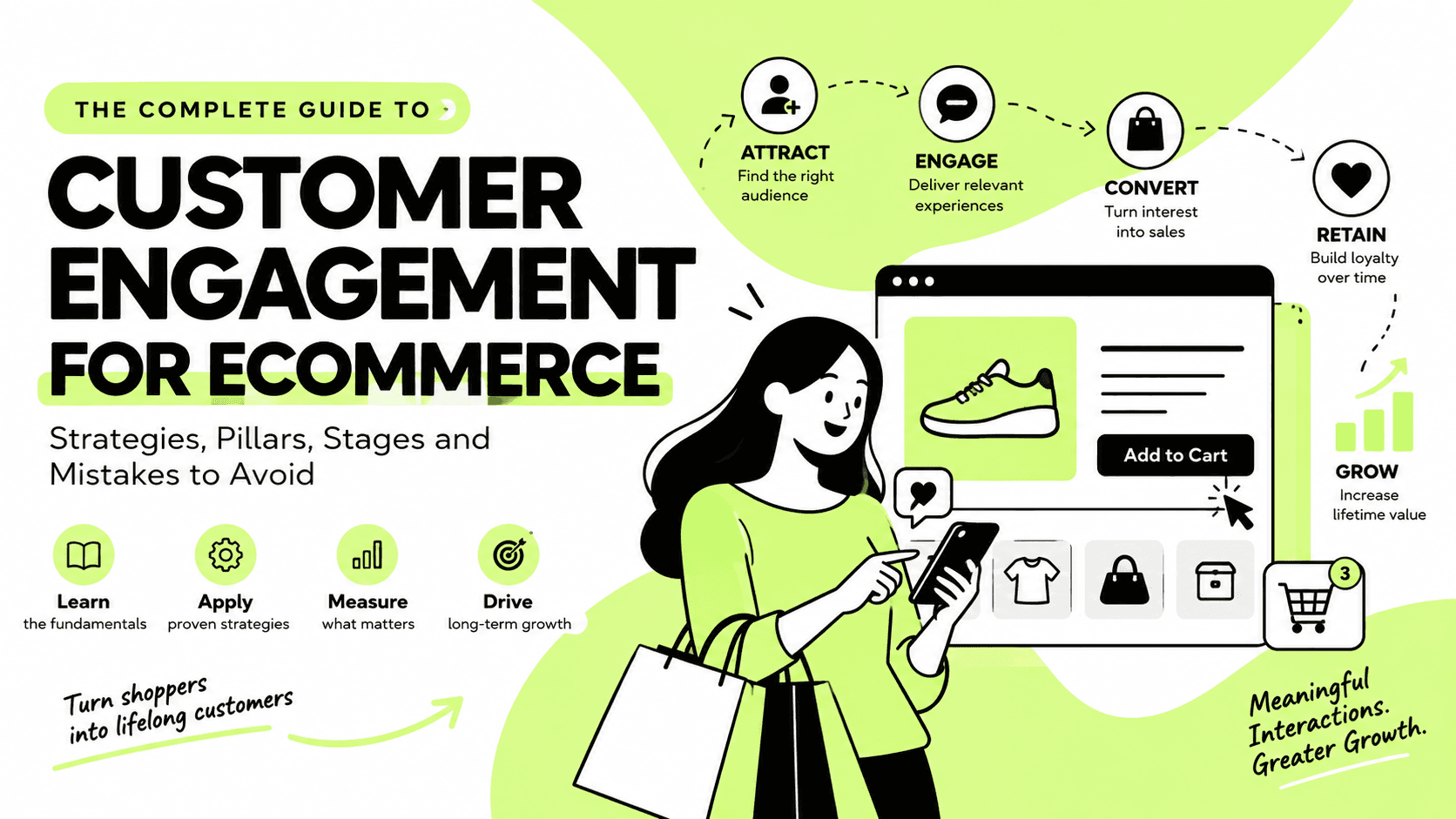
Customer Engagement in eCommerce: Definition, Strategies, Pillars, Stages and Mistakes to Avoid (Comprehensive Guide)
Sirazum Monir Osmani
eCommerce customer engagement usually refers to how actively customers interact with and build relationships with an online store.
That engagement spans the entire customer lifecycle, from the first website visit and product discovery to purchase, retention, loyalty, and reactivation. The strongest customer engagement strategies in eCommerce typically combine personalization, abandoned cart and checkout recovery, omnichannel communication, loyalty programs, proactive support, better product discovery, community building, and useful post-purchase experiences.
Behind those strategies are three important pillars: the customer lifecycle, customer journey orchestration, and personalization. Together, they help eCommerce businesses understand who to engage, when to engage them, and what interaction is most relevant.
Customer engagement matters for eCommerce because stronger relationships can contribute to higher retention, more repeat purchases, increased customer lifetime value, stronger loyalty, and more predictable revenue. As operations become more , complex customer engagement platforms also become increasingly important for coordinating siloed customer data and communication across different channels.
However, more communication does not automatically mean better engagement. Generic messaging, excessive promotions, disconnected channels, poor customer data, overusing discounts, and implementing AI without a clear strategy can easily reduce engagement instead of improving it.
What Is Customer Engagement in eCommerce?
Customer engagement in eCommerce is the ongoing cognitive, emotional, and behavioral involvement an online shopper develops with an eCommerce brand through digital interactions across the customer lifecycle.
It includes every meaningful customer interaction, from opening an email or SMS, browsing a category page to reviewing a purchase, joining a loyalty program, contacting support, or recommending a product.
This is why engagement involves more than observable customer behavior. A customer may also develop trust, familiarity, or an emotional connection with a business over time. Together, these interactions strengthen the broader brand relationship.
For an online store owner, this means a conversion should not be viewed as the end of engagement. The purchase is simply one interaction within a much longer relationship that can continue through delivery, product usage, repeat purchasing, loyalty, referrals, and reactivation.
Customer engagement is therefore different from customer experience. Engagement describes the customer's continuing involvement with the brand, whereas experience describes the quality of what the customer encounters.
What Is the Difference Between Customer Engagement and Customer Experience in eCommerce?
The difference between customer engagement and customer experience in eCommerce is that engagement measures customer involvement, while customer experience reflects the overall quality of interactions across touchpoints.
Customer experience may include website usability, shipping speed, support quality, checkout simplicity, and other customer satisfaction touchpoints. Engagement describes what customers do in response: returning to the website, interacting with campaigns, making another purchase, leaving reviews, or developing loyalty.
For example, you may create a very smooth checkout experience. That is customer experience. If the customer later opens your post-purchase emails, joins your loyalty program, returns for another purchase, and recommends the product, those behaviors indicate customer engagement.
A good customer experience can therefore encourage engagement, but the two concepts are not interchangeable.
What Is the Difference Among Customer Engagement, Retention, and Loyalty in eCommerce?
The difference among customer engagement, retention, and loyalty in eCommerce is that engagement creates interactions, retention sustains repeat behavior, and loyalty develops stronger long-term brand preference.
The three often influence one another in sequence. Relevant engagement can encourage a repeat purchase, repeated purchases can improve customer retention, and consistently positive relationships can eventually create customer loyalty and stronger brand preference.
For eCommerce businesses, this progression matters because stronger retention and loyalty can increase CLV, or customer lifetime value. Your engagement strategies should therefore support the relationship before, during, and after a transaction rather than focusing exclusively on conversion.
What Are the Strategies for Customer Engagement in eCommerce?
The main strategies for customer engagement in eCommerce include personalization, abandoned cart and checkout recovery, omnichannel engagement, loyalty programs, gamification, proactive support, community building, product discovery, and post-purchase engagement.
So, eCommerce stores should implement the following strategies for better customer engagement:
Personalize the Customer Experience
Personalizing the customer experience means adapting interactions according to individual customer context, preferences, and behavior.
For an eCommerce store, personalization can include relevant product recommendations, personalized search results, dynamic merchandising, and personalized content or offers. Instead of showing every visitor exactly the same experience, the store adapts what customers see according to signals such as browsing activity, previous purchases, product affinity, location, or lifecycle stage.
If you are an eCommerce marketer, the important point is that personalization should go beyond adding a customer's first name to an email. The product, message, timing, offer, and channel can all become more relevant when they are informed by actual customer context.
Recover abandoned carts and checkouts
Recovering abandoned carts and checkouts means automatically re‑engaging shoppers who left your store without completing a purchase, so they return and finish the order.
By utilizing email, SMS, WhatsApp, or AI voice call, you can trigger timely reminders to shoppers who added products to their cart or started the checkout process but did not complete their purchase.
These outreaches can include the abandoned products, product benefits, customer reviews, shipping information, or relevant support options to address potential purchase barriers. Avoid relying on discounts in every reminder, since some customers may only need reassurance, clearer information, or a simpler path back to checkout.
Build Omnichannel Customer Engagement
Building omnichannel customer engagement means coordinating customer interactions across channels instead of managing each channel independently.
A shopper might discover a product on your website, receive a reminder through email, get a transactional update through SMS, and later interact through your mobile app or social media.
The goal is not to use every available channel. The goal is to select channels according to context while maintaining a consistent experience.
For your eCommerce team, that might mean preventing someone who has already completed a purchase from continuing to receive cart-abandonment messages through another channel. Avoiding this type of disconnected messaging becomes increasingly important as you add email, SMS, push notifications, WhatsApp, social media, and other customer touchpoints.
Create a Customer Loyalty Program
Creating a customer loyalty program means rewarding customers for repeat purchases and other valuable interactions with your eCommerce brand.
Programs can include points, membership tiers, rewards, exclusive product access, early sales access, and referral incentives. Effective programs give customers a reason to continue the relationship beyond the immediate purchase.
If repeat purchases are important to your business model, loyalty programs can also give you additional engagement opportunities that do not depend entirely on discounts.
3. Use Gamification
Gamification improves eCommerce engagement by adding interactive mechanics such as challenges, milestones, progress tracking, badges, or rewards to otherwise ordinary customer activities.
For example, showing customers how close they are to unlocking a loyalty reward can encourage continued interaction. Gamification works best when the activity adds value instead of creating unnecessary friction.
Provide Proactive Customer Support
Providing proactive customer support means helping shoppers before they need to actively request assistance.
This can involve live chat, AI chatbots, self-service resources, real-time order tracking, product guidance, or proactively answering common questions about sizing, delivery, compatibility, and returns.
If your analytics show that customers repeatedly leave from the same product or checkout step, the engagement opportunity may not be another promotional campaign. It may be answering the question that prevents them from continuing.
Proactive support can therefore be especially useful at high-friction points in the purchase journey.
Build an eCommerce Community
Building an eCommerce community means creating opportunities for customers to interact with your brand and with other customers beyond purchases.
Reviews, user-generated content, customer stories, social communities, and referral programs can all create participation. Participation builds social proof while giving existing customers additional ways to maintain their relationship with the brand.
For eCommerce categories where customers naturally want to share outcomes, styles, routines, or use cases, community-driven engagement can become particularly valuable.
Improve Product Discovery
Improving product discovery means helping shoppers find relevant products quickly and with less effort.
Effective site search, clear navigation, recommendations, related products, recently viewed items, and personalized merchandising can all improve discovery.
Better discovery also creates engagement because customers spend more time interacting with products that are genuinely relevant to them. If you manage a large catalog, improving discovery can be just as important as improving promotional communication.
Create Valuable Post-Purchase Experiences
Creating valuable post-purchase experiences means continuing useful customer communication after an order is completed.
Order confirmations and shipping updates are only the beginning. Brands can also provide product education, review requests, complementary cross-sells, replenishment reminders, and loyalty enrollment opportunities.
For store owners focused heavily on acquisition, this is an important area to examine. You have already paid to acquire the customer and earned the first purchase. A strong post-purchase experience helps you use that existing relationship rather than restarting from zero for every future sale.
Building these experiences becomes easier when you understand the broader pillars of eCommerce customer engagement.
What Are the Main Pillars of Customer Engagement for eCommerce?
The main pillars of eCommerce customer engagement include the customer lifecycle, customer journey orchestration, and personalization.
1. Customer Lifecycle for eCommerce
The eCommerce customer lifecycle is the progression customers follow from initial acquisition through purchase, retention, loyalty, and possible reactivation.
The customer lifecycle functions as a pillar of engagement because the type of interaction a customer needs changes according to their lifecycle stage.
A prospect in the acquisition stage may need product education. A first-time customer may need onboarding. An existing customer may respond better to replenishment, cross-sell, or loyalty communication.
If you run the same campaign logic for all three customers, you ignore the context that makes engagement relevant in the first place.
Effective lifecycle marketing recognizes these differences and adapts the customer journey accordingly.
2. Customer Journey Orchestration for eCommerce
eCommerce customer journey orchestration is the coordination of customer interactions based on real-time context across different channels and touchpoints.
Orchestration uses behavioral signals, customer data, and predefined or intelligent triggers to decide what should happen next.
For example, a customer who recently purchased a product should not continue receiving abandoned-cart reminders for the same item. Journey orchestration helps coordinate these decisions across touchpoints, producing a more contextual omnichannel experience.
For eCommerce directors overseeing multiple tools and teams, orchestration becomes increasingly important as customer journeys become more complex. Without coordination, each platform can act on its own version of the customer and produce contradictory experiences.
3. Personalization for eCommerce
Personalization in eCommerce refers to tailoring customer experiences according to individual context, behavior, preferences, and other relevant data.
Personalization can use behavioral data, purchase history, customer preferences, browsing activity, and lifecycle information to determine what each shopper sees or receives.
That may include product recommendations, personalized search, relevant promotions, or dynamic content.
A good example is a returning customer who previously purchased running shoes seeing compatible running accessories rather than the same generic homepage promotion shown to every visitor.
If you are evaluating your own personalization efforts, ask whether the experience would actually be different if you removed the customer's name. If nothing meaningful changes, you may be customizing rather than truly personalizing.
True personalization creates relevant experiences based on customer context rather than superficial customization.
What Are Some Key Examples for Customer Engagement in eCommerce?
Some of the main examples for customer engagement in eCommerce are:
Browse Abandonment Recovery: A shopper repeatedly views a product but leaves without purchasing. You can engage them with a relevant reminder, additional product information, reviews, or related alternatives rather than immediately offering a discount.
Replenishment Engagement: A customer who buys a consumable product can receive a reminder around the expected replenishment period. This demonstrates the importance of engagement based on product context rather than arbitrary campaign schedules.
VIP Engagement: High-value repeat customers can receive early product access, special rewards, personalized recommendations, or invitations to exclusive programs.
Churn Prevention: A previously active customer whose engagement has declined can enter a win-back journey based on inactivity, purchase frequency, or predicted churn risk.
These examples show why the importance of engagement extends beyond generating immediate clicks. Good engagement reacts to the customer's current relationship with the business.
Why Is Customer Engagement Important for eCommerce?
Customer engagement is important for eCommerce because it strengthens customer relationships, encourages repeat purchases, supports loyalty, increases lifetime value, and can improve long-term revenue efficiency.
For eCommerce teams under pressure to keep growing while acquisition costs remain significant, engagement is particularly valuable because it helps generate more value from customers you have already acquired.
The benefits of customer engagement are:
Higher Retention Rate: Relevant ongoing interactions give customers reasons to continue buying from the same store. Improving the retention rate reduces dependence on constantly replacing existing customers.
Higher Repeat Purchase Rate: Post-purchase communication, replenishment campaigns, personalized recommendations, and loyalty initiatives can increase the repeat purchase rate.
Greater Purchase Frequency: Engagement keeps useful products, offers, and content visible throughout the relationship. Greater purchase frequency can contribute directly to higher revenue per customer.
Higher CLV: Better retention and repeat purchasing can increase CLV, or customer lifetime value. This gives your business more room to invest in acquisition while remaining profitable.
Better CAC Efficiency: When existing customers generate more revenue over time, your store becomes less dependent on repeatedly paying CAC, or customer acquisition cost, for every new sale.
Stronger Loyalty and Advocacy: Customers who consistently receive relevant experiences are more likely to develop loyalty. Loyal customers can eventually become advocates through reviews, referrals, and user-generated content.
Better Revenue Quality: Engagement can create more recurring revenue from existing customers rather than relying exclusively on one-time transactions.
A Stronger AI Strategy: Customer engagement provides practical use cases for AI across personalization, prediction, segmentation, orchestration, and customer support. The technology becomes valuable when it supports a clear engagement strategy rather than being deployed simply because AI is available.
For an eCommerce director, the business case is therefore broader than improving campaign metrics. Customer engagement can influence the economics of acquisition, retention, and customer value together.
How Is AI Changing Customer Engagement in eCommerce?
AI is changing customer engagement in eCommerce by helping brands analyze customer behavior, personalize interactions, predict intent, automate decisions, and respond to customers in real time.
The ways AI is changing eCommerce customer engagement are listed below:
AI Personalization: AI can process browsing, transaction, preference, and engagement data to determine relevant content or products. This allows personalization to operate across larger audiences without your team manually creating every variation.
Real-Time Customer Segmentation: AI-assisted segmentation can continuously reorganize customers according to changing behavior. A shopper can move from browser to high-intent prospect or from repeat customer to churn risk as new signals appear.
Predictive Engagement: Predictive models can estimate outcomes such as purchase likelihood, churn risk, or future product interest. Your team can then prioritize customers who are more likely to benefit from a particular interaction.
Next-Best Action: AI can help determine whether the next interaction should be a recommendation, reminder, support message, loyalty incentive, or no message at all. It can also help select the right channels according to customer context.
AI Customer Support: AI chatbots and assistants can answer common questions, recommend products, guide customers through the buying process, and hand more complex cases to human agents.
What Are the Best Customer Engagement Channels for eCommerce?
The best customer engagement channels for eCommerce include websites, email, SMS,WhatsApp, AI voice calls, push notifications, mobile apps, social media, live chat, and chatbots.
Channel | Main Role | Lifecycle Relevance |
|---|---|---|
Website | Product discovery, personalization, content, recommendations, conversion | Important in each stage, particularly acquisition, onboarding, and conversion |
Education, offers, cart recovery, post-purchase communication, retention | Useful throughout acquisition, conversion, retention, loyalty, and reactivation | |
SMS | Time-sensitive reminders, transactional messages, offers | Particularly effective for conversion, post-purchase updates, retention, and reactivation |
Conversational support, order updates, product recommendations, and personalized offers | Useful for onboarding, conversion, post-purchase engagement, retention, and reactivation | |
AI Voice Calls | Automated conversational support, reminders, order updates, and personalized outreach | Useful for onboarding, conversion, post-purchase support, retention, and reactivation |
Push Notifications | Real-time reminders, updates, promotions, product alerts | Useful for conversion, retention, and reactivation |
Mobile App | Personalized shopping, loyalty, notifications, account experiences | Strong for retention and loyalty among existing customers |
Social Media | Discovery, community, user-generated content, conversations | Particularly relevant for acquisition, engagement, and advocacy |
Live Chat | Human support and purchase assistance | Useful during onboarding, consideration, conversion, and support |
Chatbot | Automated support, product guidance, FAQs, routing | Useful across discovery, conversion, onboarding, and post-purchase support |
If you manage several of these channels, resist treating them as independent distribution lists. A customer does not think of your email team, SMS platform, website, and support desk as separate businesses. To the customer, they are all your brand.
The best channel therefore depends on what the customer is trying to accomplish in each stage, not simply which channel has the highest average open or click rate.
What Are the Stages of Customer Engagement in eCommerce?
The stages of customer engagement in eCommerce include acquisition, onboarding, conversion, retention, loyalty, and reactivation.
Stage | How Customer Engagement Works |
|---|---|
Acquisition | Introduce the brand, products, value proposition, content, and social proof to relevant prospects. |
Onboarding | Help new subscribers or first-time customers understand products, benefits, account features, and what to expect. |
Conversion | Reduce friction through recommendations, product information, social proof, cart recovery, support, and contextual incentives. |
Retention | Encourage repeat purchasing through post-purchase education, cross-sell, replenishment, personalized communication, and relevant offers. |
Loyalty | Strengthen the relationship through rewards, VIP treatment, referrals, exclusive access, and recognition. |
Reactivation | Re-engage inactive customers through relevant reminders, new products, personalized win-back communication, or incentives where appropriate. |
For marketers, these stages provide a useful framework for planning campaigns. Instead of asking, “What email should we send this week?”, you can ask, “Which customer group needs engagement, what stage are they in, and what action would be helpful next?”
Separating engagement into stages also makes measuring properly easier because the objective of acquisition engagement is different from the objective of loyalty or reactivation engagement.
How to Measure Customer Engagement in eCommerce?
eCommerce customer engagement is measured using behavioral, interaction, relationship, and financial KPIs that show how customers interact with the brand and create long-term value.
The main eCommerce customer engagement metrics are listed below:
Engagement Metrics: These include email opens and clicks, SMS interactions, push engagement, social interactions, chatbot conversations, loyalty participation, and other channel-level actions. Choose each KPI according to the purpose of the interaction rather than treating every click as equally meaningful.
Behavioral Metrics: Behavioral measures include product views, search activity, add-to-cart rate, conversion rate, repeat purchase rate, purchase frequency, and time between purchases. These indicate whether engagement is influencing actual customer behavior.
Relationship Metrics: Retention rate, churn rate, loyalty participation, referral activity, review frequency, and customer feedback can indicate the strength of the ongoing customer relationship.
Financial Metrics: CLV, revenue per customer, repeat customer revenue, average order value, and CAC-to-CLV relationships help connect engagement efforts to financial outcomes.
If you report customer engagement internally, avoid stopping at channel-level numbers. An email click is useful information, but whether engaged customers subsequently purchase more frequently, remain customers longer, or generate more value is usually more important to the business.
Measuring the wrong indicators is one of several common customer engagement mistakes.
What Are the Common Mistakes in Customer Engagement that eCommerce Brands Should Avoid?
The common customer engagement mistakes for eCommerce are listed below.
Generic Messaging: Generic campaigns ignore customer behavior and context. Use segmentation and personalization to make communication more relevant.
Excessive Communication: Too many emails, messages, or notifications can create fatigue. Introduce frequency rules and suppress unnecessary communication.
Treating Every Customer Identically: A first-time visitor and a loyal customer have different needs. Segment customers according to lifecycle stage, behavior, value, and intent.
Ignoring Post-Purchase Engagement: Ending engagement after checkout wastes opportunities to strengthen the relationship. Build useful post-purchase journeys involving education, reviews, replenishment, and loyalty.
Focusing Only on Acquisition: Constant acquisition without retention can create expensive growth. Balance acquisition investment with retention and repeat-purchase strategies.
Disconnected Channels: Uncoordinated email, SMS, push, and social campaigns create inconsistent experiences. Centralize customer data and coordinate messaging across channels.
Overusing Discounts: Repeated discounts can train customers to wait for promotions. Use relevance, convenience, service, loyalty benefits, and product value alongside financial incentives.
Vanity Metrics: High opens or clicks do not automatically represent business impact. Connect engagement KPIs to conversion, retention, purchase frequency, and CLV.
Ignoring Feedback: Engagement should be a two-way relationship. Collect and act on reviews, support conversations, surveys, and other customer feedback.
Poor-Quality Customer Data: Incomplete or fragmented data produces weak segmentation and personalization. Improve tracking, identity resolution, integrations, and data hygiene.
Using AI Without a Clear Engagement Strategy: AI cannot fix an undefined customer journey. Define customer objectives, lifecycle stages, triggers, and measurement before adding automation.
Not Using Good Platforms: Disconnected tools make engagement harder to manage at scale. Choose platforms that connect customer data, segmentation, communication, personalization, and measurement where possible.
If several of these problems sound familiar, you do not necessarily need more campaigns. You may need better customer data, clearer lifecycle logic, or stronger coordination between the systems your team already uses.
Why Choosing the Right Customer Engagement Platform for eCommerce Is Important?
Choosing the right customer engagement platforms for eCommerce are important because the technology determines how effectively your business can understand customers and coordinate relevant interactions at scale.
A suitable platform helps eCommerce teams communicate consistently across email, SMS, WhatsApp, push notifications, AI voice call, chat, social media, and other channels.
More importantly, the platform can function as a centralized engagement system by connecting disjointed customer data and interactions across those channels. Connected information makes it easier to understand where customers are in their journey and avoid fragmented experiences.
For eCommerce marketers and directors managing larger customer bases, this becomes particularly important. Manually coordinating audiences, behavioral events, lifecycle stages, campaigns, and channel rules quickly becomes inefficient.
The right platform, such as Markopolo AI, can support stronger customer relationships, more repeat purchases, higher customer lifetime value, and more scalable customer lifecycle marketing and journey orchestration.
Why Is Customer Lifecycle Marketing Important for Customer Engagement in eCommerce?
Customer lifecycle marketing in eCommerce is important for customer engagement because it aligns communication with what customers need at different stages of their relationship with a brand.
And, choosing the right customer lifecycle marketing platform for eCommerce is a must because manually managing customer data, segments, stages, and multichannel communication becomes increasingly difficult at scale.
This allows businesses to coordinate the broader customer journey rather than running isolated campaigns.
Is Understanding Customer Journey Orchestration Important for Proper Customer Engagement in eCommerce?
Yes, understanding customer journey orchestration in eCommerce is important for proper customer engagement because it keeps interactions contextual, coordinated, and timely across the entire customer journey.
Moreover, choosing the right customer journey orchestration platform for eCommerce is necessary because coordinating large numbers of real-time customer interactions manually becomes impractical as your business grows.
Journey orchestration is a core customer engagement pillar because it connects customer data, behavioral signals, triggers, channels, and lifecycle stages into coordinated actions.
If you take one idea from this guide, it should be that successful customer engagement for eCommerce ultimately comes down to relevance. Understand where your customer is, recognize what they have already done, determine what they need next, and deliver that interaction through the most appropriate channel.
When lifecycle thinking, personalization, orchestration, measurement, and technology work together, customer engagement stops being a collection of disconnected campaigns and becomes a coordinated system for building stronger customer relationships over time.