Social proof cart abandonment campaign strategies to recover lost sales
Sirazum Monir Osmani
Cart abandonment rarely happens because the price is wrong. It happens because trust isn’t finished yet.
One small detail often changes that.
When a shopper returns to their cart and sees “4.8★ rated by 2,143 verified buyers”, hesitation drops. Nothing else changed. Same product. Same price. But the risk feels lower because other people already went first.
That’s how social proof works in abandoned cart recovery. It doesn’t push. It reassures. It answers the unspoken question: “Is this worth it?”
In this guide, you’ll learn how to use social proof across email, WhatsApp, SMS, and on-site messages to turn stalled carts into purchases—and move recovery performance beyond the typical 10–15% range toward what high-performing brands consistently see.
What is social proof in the context of cart abandonment?
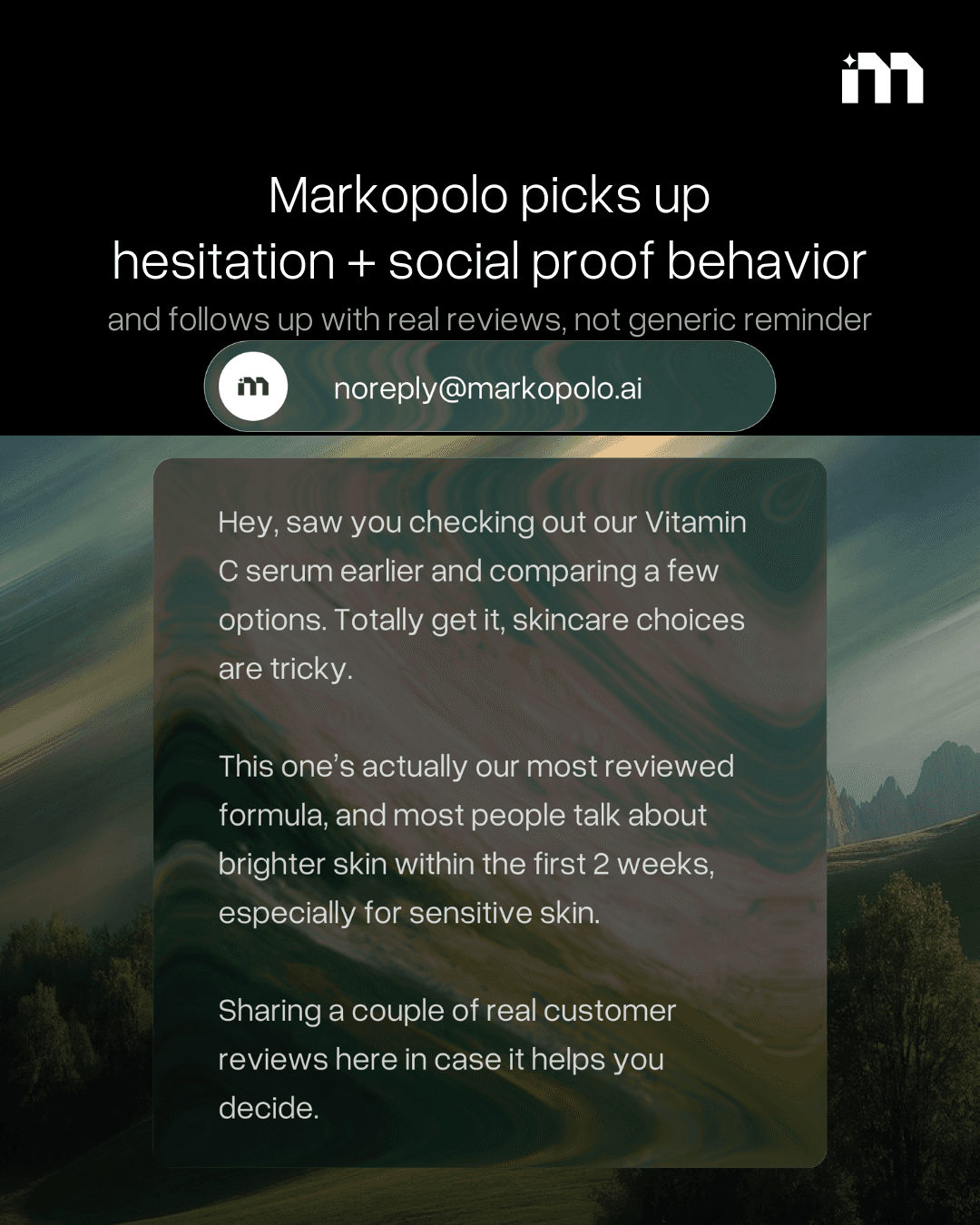
Social proof is the psychological trigger that makes people follow the crowd. In ecommerce, it shows up as reviews, ratings, purchase notifications, and user-generated content.
For cart abandonment, social proof answers the unspoken objection: "Is this product actually worth it?"
Most recovery emails lead with discounts. That trains customers to abandon carts on purpose. Social proof takes a different angle. It validates the purchase decision without slashing margins.
Here's the difference in action:
Discount approach: "Come back! Here's 15% off your cart."
Social proof approach: "The jacket in your cart has 4.8 stars from 1,200 reviews. Here's what customers are saying."
The second approach builds trust. It also protects profit margins when you apply it across your cart recovery strategies.
The Baymard Institute found that 48% of cart abandonments happen because of unexpected costs, but a significant chunk—around 17%—stems from lack of trust. Social proof directly addresses that trust gap.
Top social proof strategies for your recovery campaigns
Leveraging real-time purchase notifications
Real-time purchase notifications create urgency without fake countdown timers. They show that other people are buying right now, which triggers fear of missing out.
A notification like "Sarah from Austin just bought this" does two things:
Proves demand is real
Creates subtle pressure to act
The key is authenticity. Fake notifications destroy trust the moment a customer catches on. Use actual purchase data, and update it in real time.
For recovery campaigns, include this data in your messaging: "12 people bought this item while it sat in your cart." That's specific. That's real. That works.
Using customer reviews and star ratings in recovery emails
Reviews are the closest thing to a sales rep in an inbox. A product with 4.5 stars and 500 reviews answers objections before the customer even thinks of them.
Place star ratings directly below the product image in your recovery email. Don't bury them. The visual hierarchy should be:
Product image
Star rating and review count
One standout quote from a review
CTA button
Pull quotes that address common hesitations. If customers often worry about sizing, use a review that says, "Fits perfectly—I'm usually between sizes and the medium was spot on."
Showcasing "best-seller" status and trending data
Labels like "Best Seller" and "Trending" work because they signal consensus. If hundreds of people chose this product, it's probably a safe bet.
Use these labels in recovery campaigns when they're accurate:
"You left a best-seller in your cart"
"This is our #1 product in [category]"
"Trending: 300 people are looking at this right now"
Specificity matters. "Popular item" is vague. "#1 in skincare for the past 3 months" is concrete.
Incorporating user-generated content (UGC) as trust signals
UGC—photos and videos from real customers—outperforms polished brand content for trust. It shows products in real life, not in a studio.
In cart recovery emails, include 2-3 customer photos below the product. Add a line like: "See how 5,000+ customers style this."
For WhatsApp recovery messages, UGC works even better. The platform is inherently personal. A customer photo feels native to the channel.
Pull UGC from Instagram, TikTok, or direct submissions. Always get permission, and credit the customer. This turns buyers into advocates and makes the content feel genuine.
How to build an abandoned cart WhatsApp communication sequence with social proof
WhatsApp has open rates above 90%. That makes it the highest-attention channel for recovery for brands using abandoned cart recovery platforms. The trick is matching the conversational tone of the platform.
Here's a three-message sequence built around social proof:
Message 1 (sent 30 minutes after abandonment):
Hey [First Name]! You left the [Product Name] in your cart. Quick heads up—it's got a 4.8-star rating from 2,000+ customers. Still interested?
Message 2 (sent 24 hours later):
[First Name], just so you know: 45 people bought the [Product Name] in the last 24 hours. Here's what one customer said: "[Short review quote]." Want me to save your cart?
Message 3 (sent 48 hours later):
Last check-in! The [Product Name] is one of our top 5 best-sellers this month. If you have questions, I'm here. Otherwise, your cart expires soon.
Notice what's missing: aggressive discounts. Each message builds trust instead of training the customer to wait for a coupon.
The timing also matters. Behavioral data shows that different customers respond at different times. Some buy impulsively within an hour. Others need two days to research. Segment your audience and adjust timing based on past behavior.
Platforms like Markopolo allow you to build these sequences with AI-generated personalization. The system analyzes each customer's behavior—price sensitivity, channel preference, engagement patterns—and adjusts the message and timing automatically. Instead of one sequence for everyone, each customer gets a unique recovery journey.
How to build an abandoned cart email sequence with social proof
For cart recovery, this channel still does most of the heavy lifting. It doesn’t open as often as WhatsApp, but it gives you room to structure the message, control visual flow, and apply abandoned cart email best practices without forcing the sale.
The subject line: creating urgency and curiosity
Subject lines determine whether your email gets opened. Social proof can boost open rates by adding credibility to the preview.
Examples that work:
"Your cart item has 4.8 stars (1,200 reviews)"
"2,000 customers love this—here's why"
"Still thinking it over? See what buyers are saying"
Avoid clickbait. "You won't BELIEVE what's in your cart" might get opens, but it damages trust.
Test subject lines with and without social proof. Most brands see a 10-20% lift when they lead with ratings or review counts.
The body content: where to place testimonials for maximum impact
The body of a recovery email should guide the eye from product to proof to action.
Above the fold:
Product image (left)
Star rating + review count (right, next to the image)
One-line value prop
Mid-section:
Featured customer quote with attribution ("—Jessica M., verified buyer")
Optional: 2-3 UGC photos in a row
Bottom:
CTA button
Trust badges (free shipping, easy returns, secure checkout)
Keep the testimonial relevant to the product. A generic "Great company!" quote doesn't move the needle. A quote like "This moisturizer cleared my skin in two weeks" addresses a specific benefit.
Call-to-action (CTA) optimization: moving from doubt to trust
The CTA button is where hesitation either breaks or hardens. Social proof can soften the transition.
Instead of a generic "Complete Purchase," try:
"Join 10,000+ happy customers"
"Get the best-seller"
"See why it's rated 4.8 stars"
These CTAs acknowledge that others have already made the choice. The customer isn't taking a risk—they're joining a crowd.
Button color and placement matter too. High contrast, above the fold, and repeated at the bottom of the email. Don't make customers scroll to find it.
Best practices for implementing social proof prevention techniques
Social proof can backfire if it slows down your site or looks spammy. Technical execution matters.
Mobile optimization: Over 70% of e-commerce traffic is mobile. Social proof widgets—like live purchase notifications—need to load fast and display cleanly on small screens. Test every element on iOS and Android. If a pop-up covers the "Add to Cart" button, it's doing more harm than good.
Page load speeds: Every second of delay costs conversions. Social proof widgets that pull real-time data can add latency. Use lazy loading for non-critical elements. Compress images in UGC carousels. Aim for under 3 seconds total page load.
A/B testing: Don't assume social proof always wins. Test:
Emails with reviews vs. emails without
Subject lines with star ratings vs. urgency-based lines
WhatsApp messages with UGC vs. text-only
Run tests for at least two weeks or 1,000 sends—whichever comes first. Statistical significance matters more than gut feel.
Authenticity audits: Audit your social proof quarterly. Remove outdated reviews. Update "best seller" claims if rankings change. Fake or stale proof erodes trust faster than no proof at all.
AI-driven platforms can automate much of this. Markopolo's behavioral intelligence layer, for example, tracks which types of social proof resonate with each customer segment. A price-sensitive shopper might respond better to "great value" reviews, while a premium buyer reacts to exclusivity signals. The system learns and adapts in real time.
3 high-converting abandoned cart email templates (social proof focus)
Template 1: The review-led recovery
Subject line: Your cart item has 4.8 stars—here's what customers say
Body:
Hi [First Name],
You left the [Product Name] behind. Before you move on, check out what [X] customers are saying:
⭐⭐⭐⭐⭐ "[Customer quote addressing key benefit]" —[Customer Name], Verified Buyer
[Product Image with Star Rating]
This is one of our top-rated products for a reason.
[CTA: Complete Your Order]
Still have questions? Reply to this email—we're here to help.
Template 2: The trending product alert
Subject line: 50 people bought this today—your cart is waiting
Body:
Hey [First Name],
The [Product Name] in your cart is trending!
🔥 50+ purchases in the last 24 hours
⭐ 4.7-star average from 800 reviews
📦 Free shipping on your order
[Product Image + UGC Photo Grid]
Here's what one recent buyer said:
"[Short, specific testimonial]"
[CTA: Get Yours Before It's Gone]
Template 3: The UGC showcase
Subject line: See how real customers use the [Product Name]
Body:
Hi [First Name],
Your [Product Name] is still in your cart. Here's how other customers are using it:
[3 UGC Images in a Row]
"[Customer quote 1]" —@instagramhandle "[Customer quote 2]" —@instagramhandle
Join [X]+ happy customers!
[CTA: Complete Your Purchase]
Each template leads with proof, not discounts. Customize the testimonials based on the product category and common objections.
Measuring ROI: metrics to track for your social proof campaigns
Social proof isn't a "set and forget" tactic. Track these metrics to know if it's working:
Conversion rate
The percentage of abandoned carts recovered. Industry average sits around 10-15%. Well-executed social proof campaigns can push this to 25-40%.
Revenue per email (RPE)
Total revenue divided by emails sent. This shows the dollar value of each recovery message. Compare RPE for social proof emails vs. discount-led emails.
Open rate
Test subject lines with social proof elements (star ratings, review counts) against generic lines. Track which approach gets more opens.
Click-through rate (CTR)
Measures how many people clicked the CTA. Social proof in the body should lift CTR by reducing hesitation.
Time to recovery
How long does it take for a customer to convert after abandonment? Social proof often shortens this window because it answers objections immediately.
Unsubscribe rate
If social proof feels spammy or inauthentic, unsubscribes will spike. Monitor this to catch issues early.
Build a dashboard that tracks these metrics by channel (email, WhatsApp, SMS) and by template. Identify what's working and double down.
AI-powered platforms simplify this. Markopolo's analytics layer tracks revenue contribution across every touchpoint, attributing conversions to specific messages and social proof elements. This removes guesswork and shows exactly which strategies drive results.
How does Markopolo AI reduce cart abandonment using social proof
Cart abandonment isn't just a checkout problem. It's a trust problem. Discounts treat the symptom. Social proof treats the cause.
The strategies in this guide—real-time notifications, reviews in recovery emails, UGC in WhatsApp messages—all work toward one goal: showing hesitant shoppers that other people already trust you.
But execution at scale is hard. Manually segmenting audiences, timing messages, and personalizing content for thousands of customers isn't realistic for most teams.
That's where Markopolo comes in.
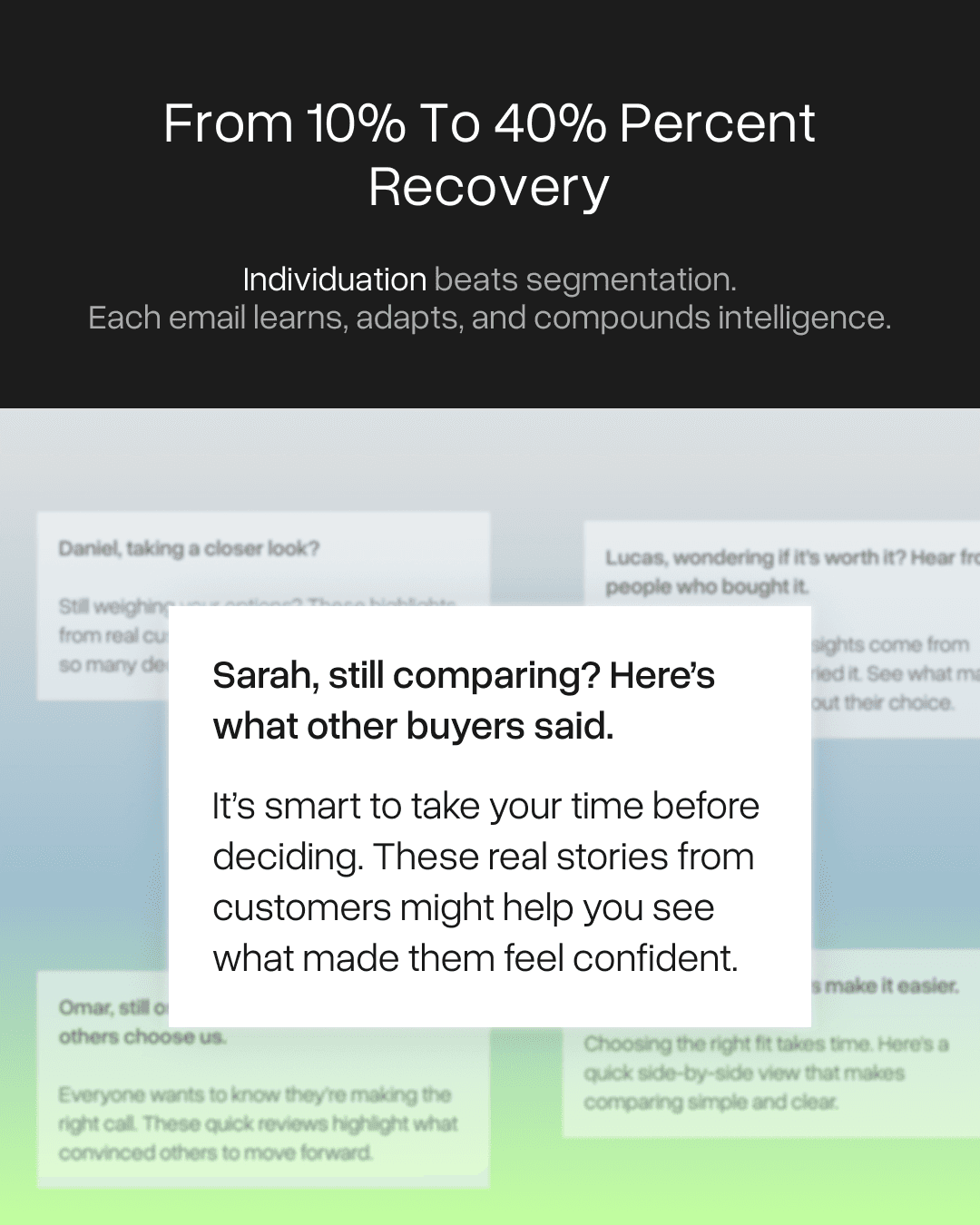
Markopolo's AI-driven platform analyzes each customer's behavior—their hesitation patterns, channel preferences, and response to different types of proof. Instead of sending the same recovery sequence to everyone, it creates unique journeys for each individual.
A price-sensitive shopper gets value-focused reviews. A premium buyer sees exclusivity signals. A researcher gets detailed testimonials. Each message arrives at the optimal time, on the preferred channel, with the right social proof.
The result: recovery rates that break through the 10-15% ceiling and push toward 30-40%.
Social proof works. AI makes it scale. Together, they recover revenue that would otherwise