The ultimate abandoned cart strategy: How to recover lost sales in 2026
Sirazum Monir Osmani
Your checkout page isn't broken. Your customers aren't flaky. You're just treating every abandoner the same way—and that's why you're stuck at a 10% recovery rate.
Studies show that 30-50% of shoppers who abandon never even open the follow-up email, yet most recovery tools still assume shoppers just got distracted. In reality, price sensitivity, trust gaps, timing, and comparison behavior drive most drop-offs, and one message can’t solve four different decisions.
Here's the uncomfortable truth: cart abandonment isn't a single problem. It's dozens of individual problems—each requiring a different solution for each customer. The stores winning in 2026 aren't the ones with the cleverest email subject lines. They're the ones who understand why each customer left and respond accordingly.
This guide breaks down the complete abandoned cart strategy into two phases: prevention (stopping abandonment before it happens) and recovery (bringing customers back after they leave). Because the best cart recovery is the one you never have to make.
What is cart abandonment and why is it a critical metric?
Cart abandonment happens when a shopper adds items to their cart but leaves without completing the purchase. It's measured as a percentage: the number of abandoned carts divided by the total number of carts created.
But here's why it matters more than most metrics on your dashboard: abandoned carts represent qualified intent. These aren't window shoppers. These are people who found your product, decided they wanted it, and got close enough to taste the purchase. Something stopped them at the finish line—making cart recovery one of the highest-leverage bottom-of-funnel marketing plays you have, because you're not generating new demand, you're converting demand that's already there.
The Baymard Institute puts the average cart abandonment rate at 70.19% across industries. That means for every 10 customers who add something to their cart, seven leave empty-handed. If your store generates $100,000 in monthly revenue, you're potentially losing $233,000 to abandoned carts.
Cart abandonment rate serves as a diagnostic tool for your entire customer experience. High abandonment on mobile? Your checkout isn't optimized. Abandonment spikes on certain products? Pricing or trust issues. Abandonment after shipping calculation? Your costs are surprising customers—and if those issues go unchecked, even the smartest abandoned cart recovery software is forced to work overtime trying to win back shoppers you could have converted on the first pass
The metric tells you where the leak is. Your strategy plugs it.
Top reasons shoppers abandon their carts
Understanding why customers leave is non-negotiable. You can't fix what you haven't diagnosed.
Unexpected costs
Shipping fees, taxes, and handling charges that appear at checkout cause 48% of abandonments. Customers calculate a mental total while browsing. When the final number jumps, trust breaks.
Forced account creation
Requiring registration before purchase adds friction at the worst possible moment. The customer is ready to pay, and you're asking them to remember another password. Nearly a quarter of abandonments stem from this single issue.
Complicated checkout processes
Every additional form field, every unnecessary page, every confusing navigation element gives customers a reason to reconsider. The average checkout flow has 23 form elements. The optimized ones have 12.
Security concerns
Customers need to trust you with their payment information. Missing trust badges, outdated design, or unfamiliar payment options trigger doubt. If your site looks like it was built in 2015, customers assume your security is equally dated.
Comparison shopping
Many customers add items to carts as a way to bookmark products while they check competitors. These shoppers aren't lost. They're deciding. Your recovery strategy needs to recognize the difference.
Technical issues
Page errors, slow load times, and payment processing failures account for a significant chunk of abandonments. These are customers who wanted to complete the purchase but couldn't.
In many cases, these issues come down to how much control you have over your checkout infrastructure. If your current setup limits how you optimize performance, customize payment flows, or fix friction points quickly, it may be worth considering a shift.
Some ecommerce teams choose to migrate to WooCommerce, while others choose Shopify to gain deeper control over speed, flexibility, and the overall checkout experience.
Lack of payment options
Buy now, pay later options have become expected. Customers without credit cards or those facing cash flow timing issues will abandon if their preferred payment method isn't available.
The pattern here matters: most abandonment stems from preventable friction, not lack of interest. Address the friction first, and your recovery efforts become far more effective.
Phase 1: Proactive strategies to prevent abandoned carts
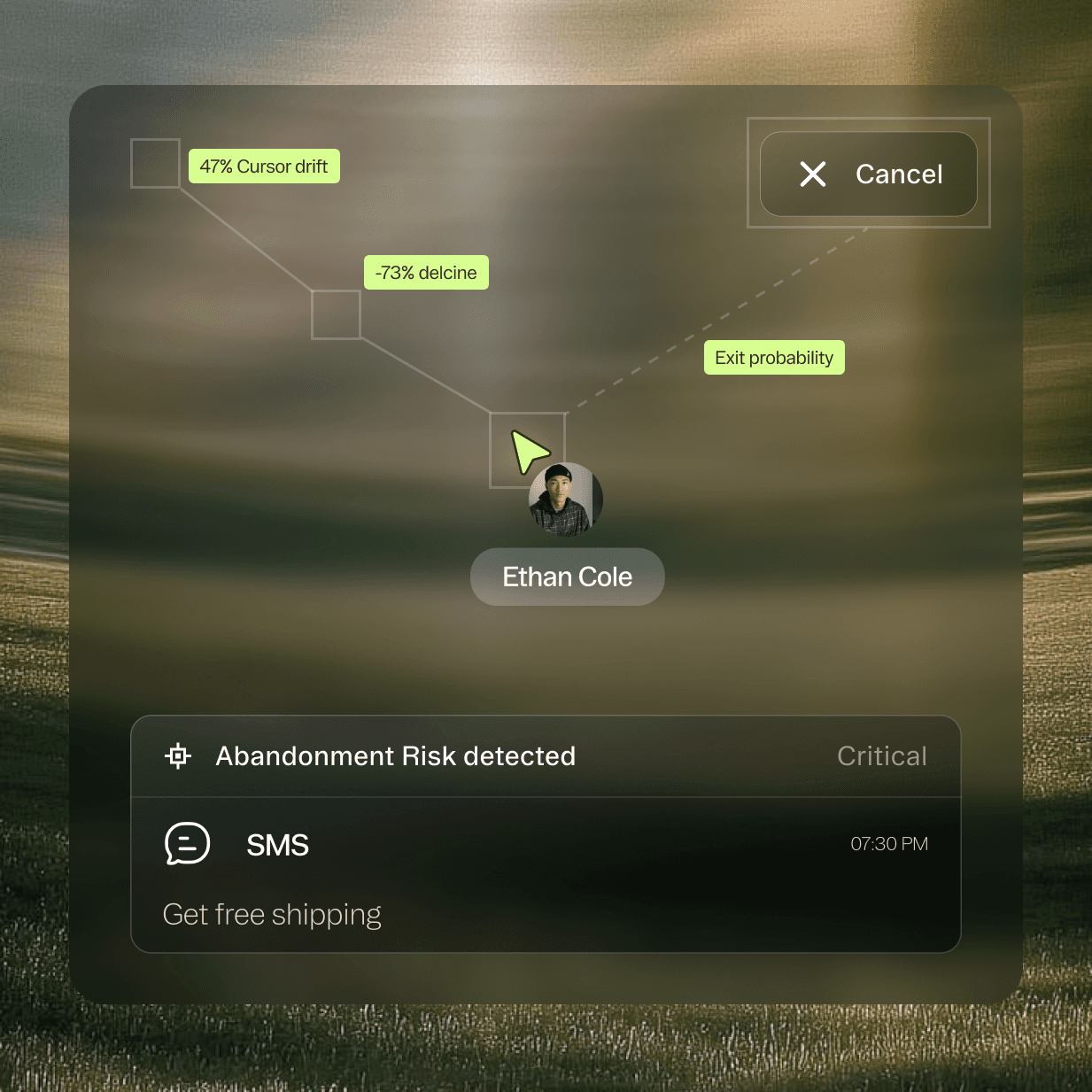
Prevention beats recovery every time. A customer who never abandons doesn't need a re-engagement sequence. These strategies, especially when powered by smart automation, address root causes before they become lost sale
Optimize your checkout flow for speed
Checkout should feel like a downhill slide, not an obstacle course.
Start by reducing form fields to the absolute minimum. You need a shipping address, payment information, and contact details. Everything else is optional at best, conversion-killing at worst. Auto-fill compatible fields so returning customers breeze through.
Single-page checkouts outperform multi-page flows in most cases. Customers see the entire process at once, which reduces perceived effort and eliminates the "how many more steps?" anxiety. If you must use multiple pages, add a progress indicator showing exactly where they are.
Load time matters more than aesthetics at checkout. Every additional second of load time increases abandonment. Compress images, minimize scripts, and prioritize speed over visual flourish. Your product pages can be beautiful. Your checkout needs to be fast.
Test your checkout on mobile obsessively. Over 60% of e-commerce traffic comes from mobile devices, but mobile conversion rates lag behind desktop by nearly 50%. The culprit is usually checkout friction—tiny buttons, difficult form entry, and layouts that don't adapt properly.
Remove all distractions from the checkout page. Navigation menus, promotional banners, and product recommendations compete for attention at the worst possible moment. The only action available should be completing the purchase.
Be transparent about shipping costs and fees
The surprise at checkout needs to disappear entirely.
Display shipping costs as early as possible—ideally on the product page itself. A shipping calculator that shows estimated costs based on the customer's location removes the guessing game. Customers can make informed decisions before adding to cart.
Free shipping thresholds work, but only if they're visible throughout the shopping experience. Show progress toward free shipping in the cart. "Add $15 more for free shipping" motivates additional purchases and removes the cost surprise.
If you can't offer free shipping, consider building shipping costs into product prices. A $45 product with free shipping converts better than a $40 product with $5 shipping, even though the total is identical. Psychology beats math.
Be upfront about taxes and fees. Display "including tax" pricing where regulations allow. For regions requiring tax addition at checkout, show estimated totals early. International customers especially need clarity on duties and import fees before they commit.
Offer guest checkout options
Not every customer wants a relationship with your brand. Some just want to buy a product.
Guest checkout should be the default option, not hidden behind a login wall. Present account creation as a benefit after purchase: "Save your information for faster checkout next time." This captures the same data without blocking the sale.
Social login options reduce friction for customers who prefer not to create new credentials. Integration with Google, Apple, or PayPal accounts lets customers authenticate with a single click. They trust those platforms, and that trust transfers to your checkout.
If account creation is genuinely necessary for your business model—subscriptions, for example—explain why clearly. Customers accept reasonable friction when they understand the reason.
Use exit-intent popups to save the sale
Exit-intent technology detects when a customer is about to leave and triggers a last-chance intervention.
The key is making the popup valuable, not annoying. A generic "Wait! Don't go!" message wastes the moment. Instead, address the likely reason for abandonment. Offer a discount, highlight free shipping, or surface social proof at the point of exit.
Timing matters. Trigger on genuine exit signals—cursor moving toward the browser close button, tab switching, back button behavior. Don't interrupt customers who are simply scrolling or reading.
Segment your exit offers based on cart value and customer behavior. A first-time visitor with a $50 cart might need a discount. A returning customer with a $500 cart probably needs reassurance about shipping or returns. One-size-fits-all popups underperform targeted interventions.
Mobile exit-intent requires different triggers since there's no cursor to track. Use scroll-up behavior, time-on-page thresholds, or pause patterns to identify likely abandoners on mobile devices.
Phase 2: Reactive strategies for abandoned cart recovery
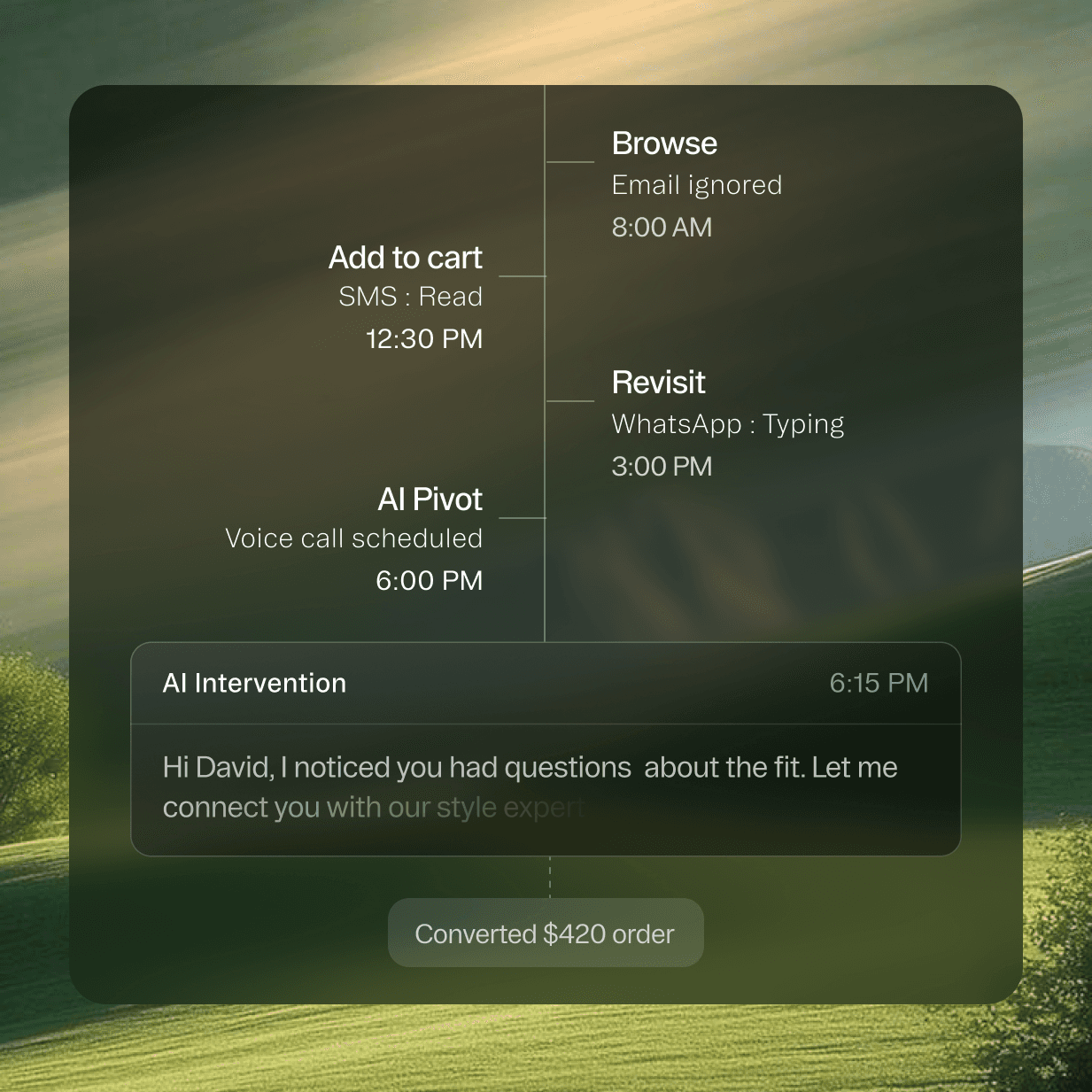
Prevention reduces abandonment. Recovery captures the customers who leave anyway. A comprehensive strategy needs both.
The perfect abandoned cart email sequence
Email strategies for cart abandonment remain the highest-ROI way to recover lost revenue, but timing and content determine whether your message converts or gets ignored.
Email one: Send within the first hour. The customer's intent is still warm. Keep this message simple—remind them what they left behind with a clear product image and a single call-to-action returning to checkout. No discount yet. Many customers simply got distracted and will complete the purchase with a gentle nudge.
Email two: Send in 24 hours. Now address potential objections. Include customer reviews or testimonials for the abandoned product. Mention your return policy, shipping speed, or customer service availability. Social proof and risk reduction work better than discounts at this stage.
Email three: Send at 48-72 hours. This is your discount email if you're going to send one. Make the offer time-limited to create urgency. "Complete your purchase in the next 24 hours and save 10%" performs better than an open-ended discount.
Personalization goes beyond inserting the customer's name. Reference the specific products abandoned. If behavioral data suggests price sensitivity, lead with value messaging. If the customer typically buys premium products, emphasize quality over savings—and use AI for cart recovery to automatically match each abandoner with the right offer, channel, and timing based on their unique behavior.
Subject lines should create curiosity without being manipulative. "Still thinking it over?" outperforms "YOU FORGOT SOMETHING!!!" every time. Test extensively—subject line performance varies dramatically by audience.
Using SMS and push notifications for instant recovery
Email open rates hover around 20%. SMS open rates exceed 90%.
SMS cart recovery messages work because they reach customers immediately, on the device most likely in their hand. Send your first SMS within 30 minutes of abandonment. Keep the message short: what they left, why they should return, and a direct link to checkout.
Frequency requires restraint. One SMS, maybe two at most. Any more and you've crossed from helpful reminder into spam territory. Ensure customers have explicitly opted into SMS marketing before sending.
Push notifications offer similar immediacy for customers who have your app installed or have enabled browser notifications. These messages appear directly on device screens without requiring email check or message opening.
Combine channels strategically rather than blasting the same message everywhere. Start with SMS for its immediacy, follow up with email or WhatsApp for detail and social proof, use push notifications for time-sensitive offers. AI voice calls can also work in high-intent scenarios where a human-like conversation can answer last-minute questions, clarify options, and gently steer the customer back to a completed purchase. The channels should complement each other, not duplicate.
Retargeting ads: Bringing customers back to your site
Retargeting keeps your products visible after customers leave your site.
Dynamic product ads show customers the exact items they abandoned, served through social media feeds and display networks. This specificity outperforms generic brand advertising by significant margins. The customer already expressed interest—remind them why.
Frequency capping prevents annoyance. Showing the same ad 47 times doesn't increase conversions; it creates brand resentment. Set reasonable limits and rotate creative to maintain effectiveness.
Exclude converted customers immediately. Nothing damages brand perception like continuing to advertise a product someone already purchased. Your exclusion lists need real-time updates.
Segment your retargeting audiences by cart value and customer history. High-value carts deserve more aggressive bidding and potentially different creative emphasizing premium benefits. Returning customers might need different messaging than first-time abandoners.
Attribution matters for optimization. Track which retargeting efforts actually drive conversions versus which simply claim credit for purchases that would have happened anyway. View-through conversions are worth less than click-through conversions.
Phase 3: Retention and loyalty strategies to stop future abandonment
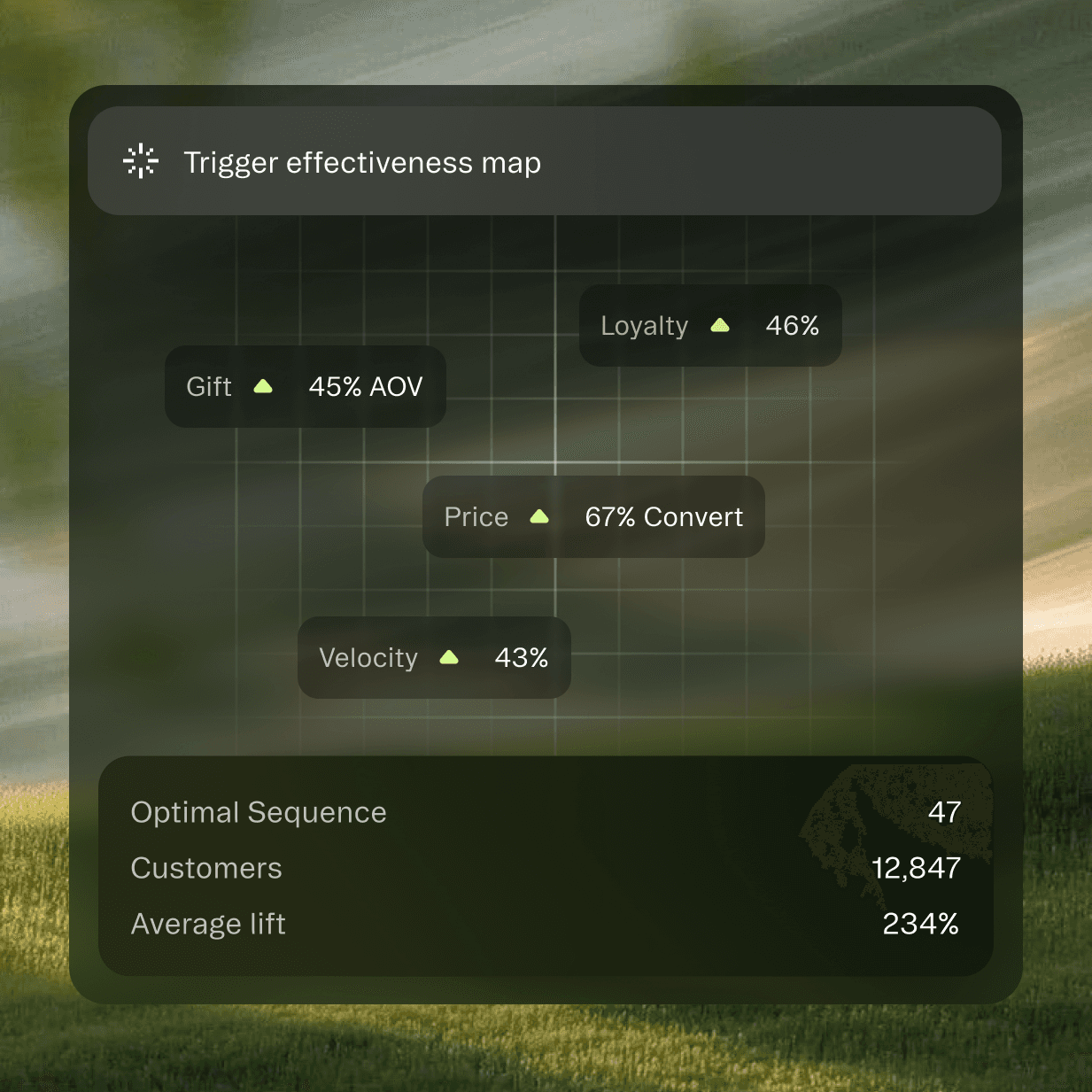
Recovery fixes yesterday's problem. Retention prevents tomorrow's.
Making customers revisit
Returning customers abandon carts at lower rates than first-time visitors. They've already navigated your checkout, established trust with your brand, and stored their payment information. Every friction point that caused their first hesitation has been smoothed.
Customer lifetime value compounds the impact. Recovering a customer who makes one purchase is valuable. Retaining a customer who makes ten purchases over two years is transformational. The math favors retention investment over endless acquisition spending.
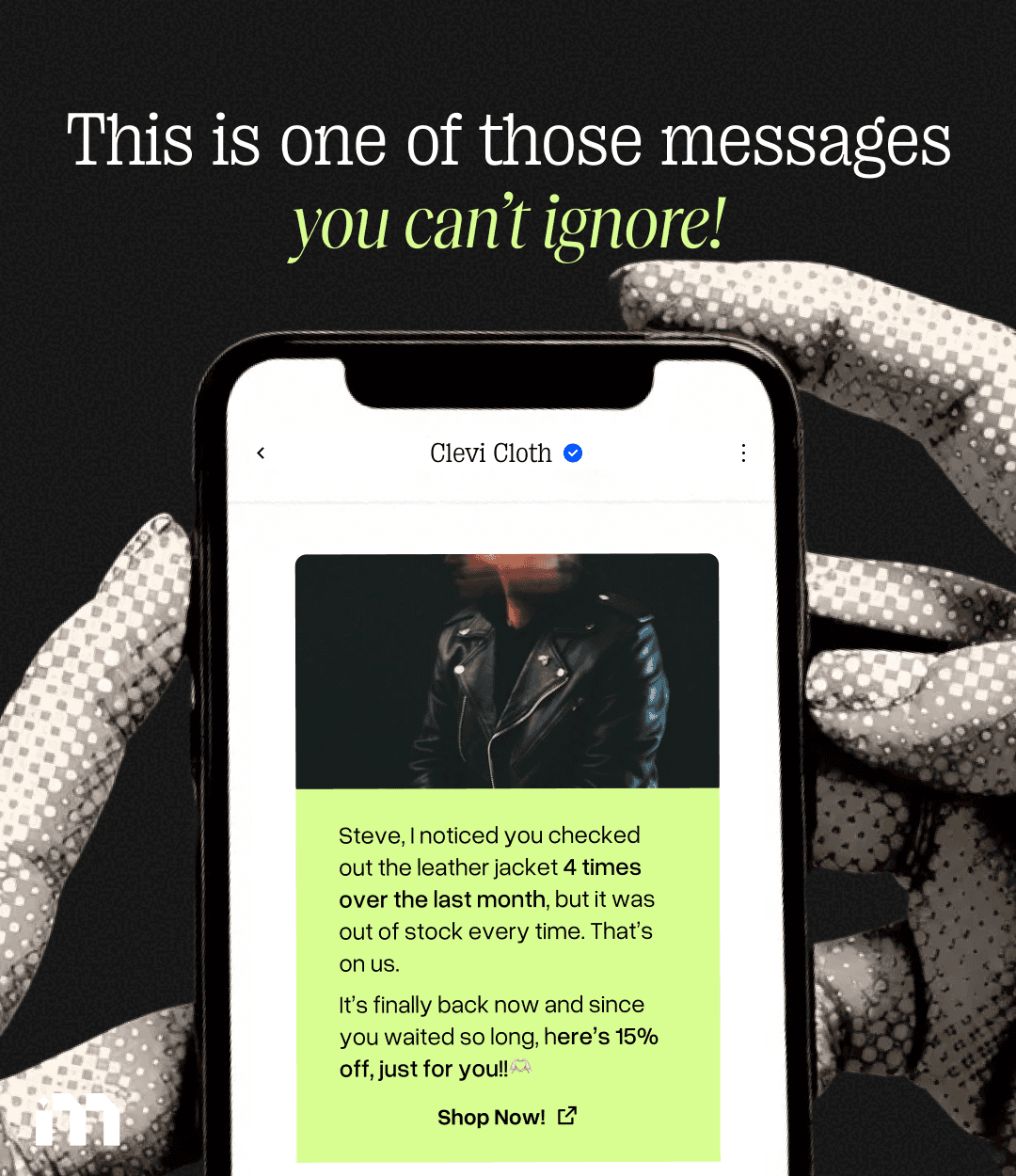
Retention data improves your entire operation. Understanding why customers return—and why they don't—reveals insights that acquisition data can't provide. These patterns inform product development, pricing strategy, and customer experience improvements.
Building loyalty programs that incentivize a finished checkout
Points, rewards, and status tiers create psychological switching costs.
Structure your loyalty program to reward purchase completion specifically. Points earned on completed purchases, not just cart additions, drive the behavior you want. Bonus points for completing purchases within a certain timeframe add urgency without requiring discounts.
Motivate continued engagement with tiered status. Customers approaching the next tier—and the benefits it unlocks—have additional incentive to complete purchases rather than abandon. Show progress toward the next tier during checkout.
Reduce abandonment directly with exclusive member benefits. Free shipping for loyalty members removes the cost surprise that causes so many abandoned carts. Early access to sales or products creates perceived value that extends beyond discounts.
Turning recovered shoppers into long-term brand advocates
The customer you recover isn't just a saved sale. They're a relationship opportunity.
Follow up after purchase with genuine value. Order updates, usage tips, and care instructions demonstrate that you see beyond the transaction. Customers who feel valued return without prompting.
Request feedback specifically from recovered customers. Understanding what convinced them to complete the purchase reveals which recovery tactics work and why. This insight improves your strategy for future abandoners.
Turn satisfied customers into acquisition channels through referral programs. A customer who almost abandoned, completed the purchase, and loved the product has a story to tell. Make sharing easy and rewarding.
Measuring success: How to calculate your abandoned cart rate
You can't improve what you don't measure accurately.
Cart abandonment rate = (Carts created - Carts completed) / Carts created × 100 |
|---|
If 1,000 customers add items to their cart and 300 complete purchases, your abandonment rate is 70%. Industry benchmarks hover around this number, but your goal should be improvement from your own baseline, not hitting an arbitrary target.
Recovery rate = Recovered carts / Abandoned carts × 100 |
|---|
This measures the effectiveness of your recovery efforts specifically. If 700 carts are abandoned and your campaigns bring back 70, your recovery rate is 10%. Leading strategies achieve 15-30% recovery rates through sophisticated personalization.
Revenue recovered = Number of recovered carts × Average order value |
|---|
This puts a dollar figure on your recovery efforts. If you recover 70 carts with a $75 average order value, you've recovered $5,250. Compare this against the cost of your recovery campaigns to calculate true ROI.
Track abandonment by segment to identify specific problems: device type, traffic source, customer history, cart value, and product category. Aggregate numbers hide actionable insights. A 70% overall abandonment rate might include 50% on desktop and 85% on mobile—pointing directly at mobile checkout issues.
Monitor trends over time rather than obsessing over individual data points. Daily fluctuations happen. Weekly and monthly trends reveal whether your strategies are working.
How Markopolo AI is best for reducing abandoned carts
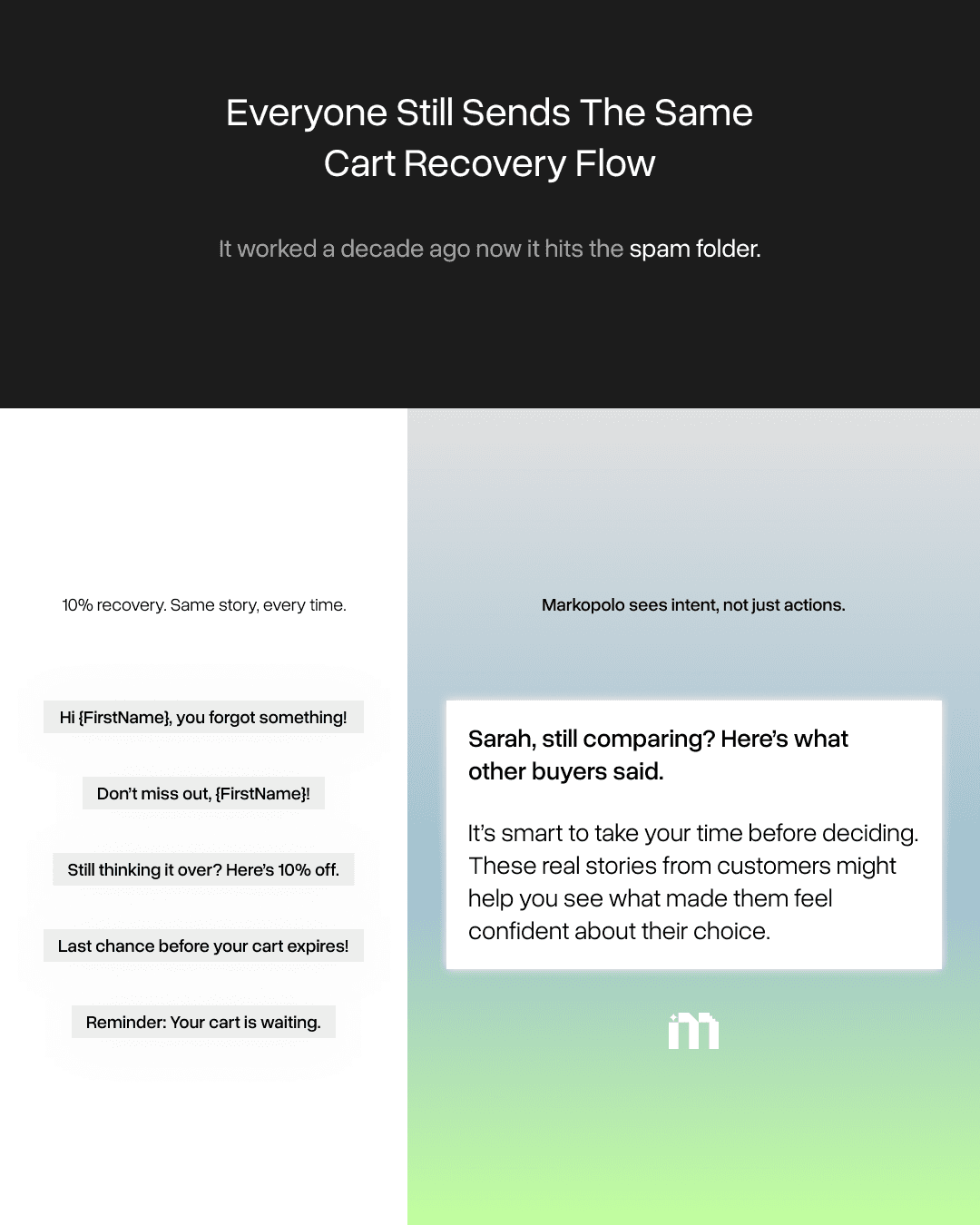
Traditional recovery tools treat every abandoner the same way. Same email. Same timing. Same generic discount. That's why they plateau at 10-15% recovery rates.
Markopolo approaches abandonment differently. Instead of segment-based campaigns, the platform creates an individual AI revenue agent for every customer. Each agent understands that specific person's behavior: their hesitation patterns, their channel preferences, their price sensitivity, their need for social proof versus urgency.
When a customer abandons their cart, the AI doesn't just send an email. It creates a unique recovery strategy. One customer might need a WhatsApp message with customer reviews sent at 7 PM. Another might need an SMS about limited stock sent immediately. A third might need a voice call offering a payment plan the next day.
The MarkTag behavioral intelligence system makes this possible. Rather than tracking simple events like "added to cart" and "abandoned," MarkTag captures 384 dimensions of customer behavior—hesitation patterns, comparison behavior, scroll depth, reading patterns. This transforms raw actions into mathematical understanding of intent.
The result: recovery rates of 30-40% instead of 10-15%. Not through better email templates, but through treating every abandoner as the individual they are.
For e-commerce teams tired of diminishing returns from traditional tools, this represents a fundamental shift. Instead of building workflows and hoping they work, you deploy AI agents that figure out the right approach for each customer automatically.
The stores that will win abandoned cart recovery in 2026 won't be the ones with the most aggressive discount sequences. They'll be the ones who understand that every customer who leaves has a different reason—and respond accordingly.