10 best email marketing platforms for abandoned cart recovery in 2026
Sirazum Monir Osmani
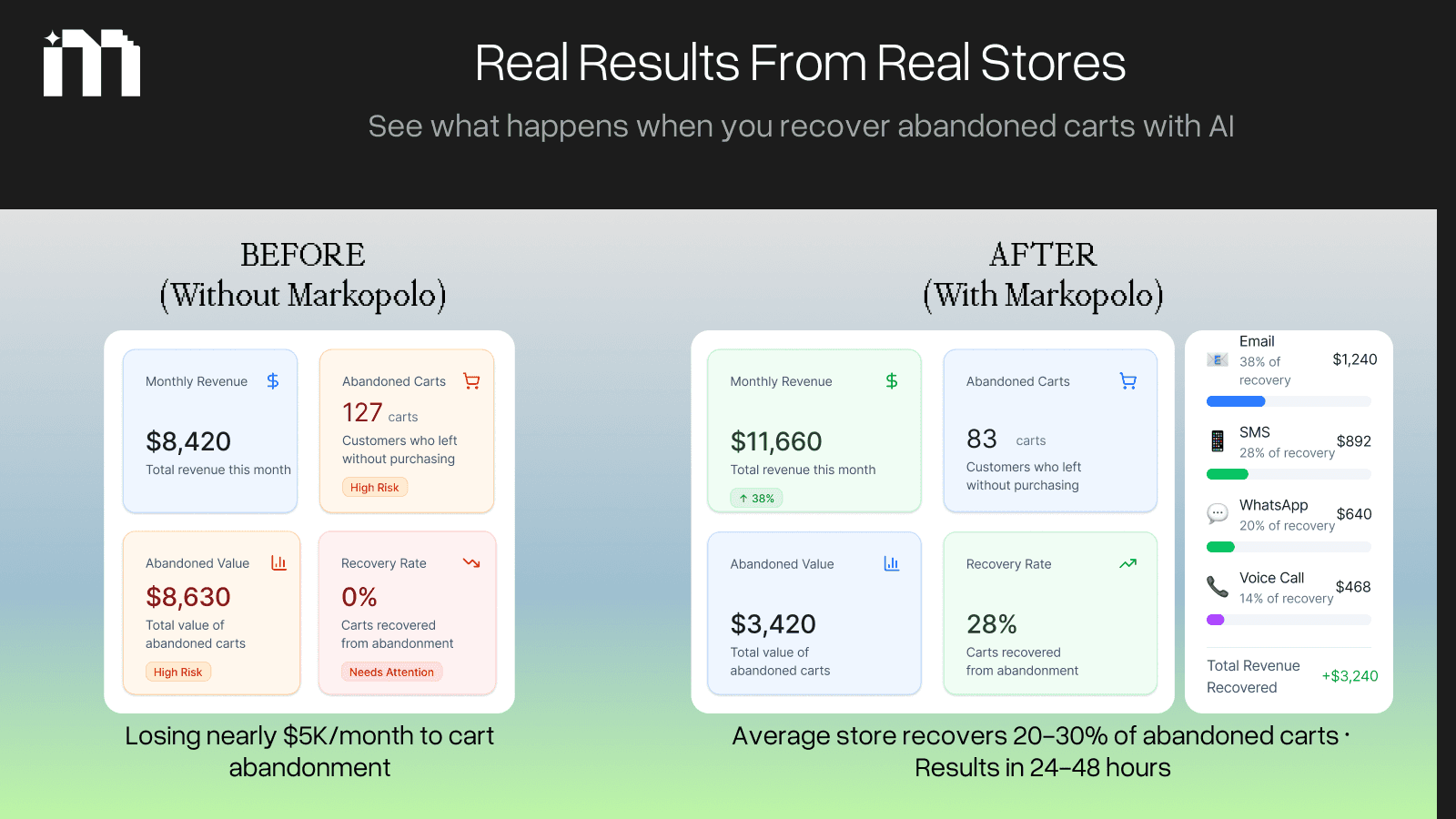
Ecommerce stores that fail to re-engage shoppers who leave without buying lose revenue every day. But the right platform, paired with abandoned cart email best practices, can recover 30–40% of those lost sales.
This guide breaks down the best email marketing platforms for cart recovery, the features that actually impact conversions, and how to choose the right tool for your ecommerce business.
How do email marketing platforms recover abandoned carts?
Cart abandonment happens for many reasons. Unexpected shipping costs. Distractions. Comparison shopping. A good email platform doesn't just send reminders. It understands why someone left and responds with the right message at the right time.
Omnichannel outreach
Effective cart recovery goes beyond email alone. Modern platforms coordinate messages across email, SMS, WhatsApp, push notifications, and even voice calls. When a customer ignores an email, an SMS might catch their attention. When they browse on mobile but buy on desktop, the platform tracks that journey. The best platforms like Markopolo AI orchestrate these channels automatically, choosing the right one based on each customer's behavior patterns and preferences.
1:1 hyper-personalized communication
True personalization means more than inserting someone's first name. It means understanding that Sarah browses at lunch, compares prices, and buys on mobile after reading reviews. Advanced platforms create unique messages for each customer based on their browsing history, purchase patterns, price sensitivity, and preferred communication style. This level of personalization can triple recovery rates compared to generic templates.
Understanding customer intent
Not every cart abandonment is the same. Some shoppers are comparison shopping. Others got distracted. Some have concerns about shipping or returns. Platforms with behavioral intelligence can detect these intent signals. They identify hesitation patterns, research phases, and purchase readiness. This lets them send the right type of message. A comparison shopper might need social proof. A price-sensitive buyer might respond to a discount. Someone who abandoned the checkout might just need reassurance.
Real-time behavioral tracking
The timing of recovery emails matters as much as the content. Platforms that track behavior in real time can identify the optimal moment to reach out. This might be 47 minutes after abandonment for one customer and 3 hours for another. Real-time tracking also captures micro-behaviors like mouse movements, scroll depth, and product zoom actions. These signals reveal purchase intent and help predict what will bring each customer back.
Automated journey orchestration
Manual workflows don't scale. When you have thousands of abandoned carts daily, you need automation that adapts to each customer with built-in strategies for abandoned cart recovery. This means smart platforms generate unique recovery journeys automatically, deciding which channel to use, what message to send, and when to send it based on each shopper’s behavior. They adjust in real time to customer responses: if someone opens but doesn't click, the next message might try a different approach, a different incentive, or even a different channel as part of more intelligent strategies for abandoned cart recovery. This orchestration happens in milliseconds across millions of customers, turning what used to be manual guesswork into continuously optimized, revenue-focused automation.
Email marketing tools and solutions for abandoned cart recovery
The market offers many options for cart recovery emails. Here are 20 platforms worth considering:
Markopolo AI
Klaviyo
Mailchimp
Omnisend
Drip
ActiveCampaign
Braze
Privy
Moosend
Attentive
Iterable
HubSpot
Rejoiner
GetResponse
Brevo (Sendinblue)
ConvertKit
Mailerlite
Postscript
Yotpo
Retention.com
Top 10 email marketing platforms for abandoned cart recovery: key features, comparison, pros, and cons
Platform | Starting price | Multi-channel | AI personalization | Behavioral tracking | Best for |
Markopolo AI |
| Email, SMS, WhatsApp, Push, Voice (omnichannel) | Individual-level AI agents | 384-dimensional behavioral vectors | D2C ecommerce brands seeking hyper-personalized emails for maximum revenue recovery |
Klaviyo | $45/mo | Email, SMS | Segment-based | Event tracking | Shopify stores with basic needs |
Mailchimp | $13/mo | Email, SMS | Basic templates | Limited | Small businesses starting out |
Omnisend | $16/mo | Email, SMS, Push | Workflow-based | Event-based | Multi-channel beginners |
Drip | $39/mo | Email, SMS | Visual workflows | Ecommerce-focused | Mid-size ecommerce |
ActiveCampaign | $29/mo | Email, SMS | Predictive sending | Site tracking | B2B with some ecommerce |
Braze | Custom pricing | Email, SMS, Push, In-app | ML-powered | Real-time | Enterprise brands |
Privy | Free to $30/mo | Email, SMS | Basic | Popup-focused | Small Shopify stores |
Moosend | $9/mo | AI recommendations | Basic tracking | Budget-conscious brands | |
Attentive | Custom pricing | SMS, Email | AI-generated | Behavioral | SMS-first strategies |
Markopolo AI
Markopolo AI is a leading email marketing tool for recovering abandoned carts. It deploys individual AI revenue agents for each customer instead of creating workflows that apply to segments. These agents understand each person's behavioral fingerprint through MarkTag, a system that captures 384-dimensional vectors of customer intent and context.
The platform processes millions of events per second and generates unique recovery strategies in under 50 milliseconds. When someone abandons a cart, Markopolo's AI knows if they're in research mode, price-sensitive, or just distracted. It chooses the right channel, the right message, and the right timing for that specific person. This approach achieves 30-40% cart recovery rates compared to the 10-15% industry average.
Why is Markopolo AI the email platform for recovering abandoned carts
Behavioral intelligence
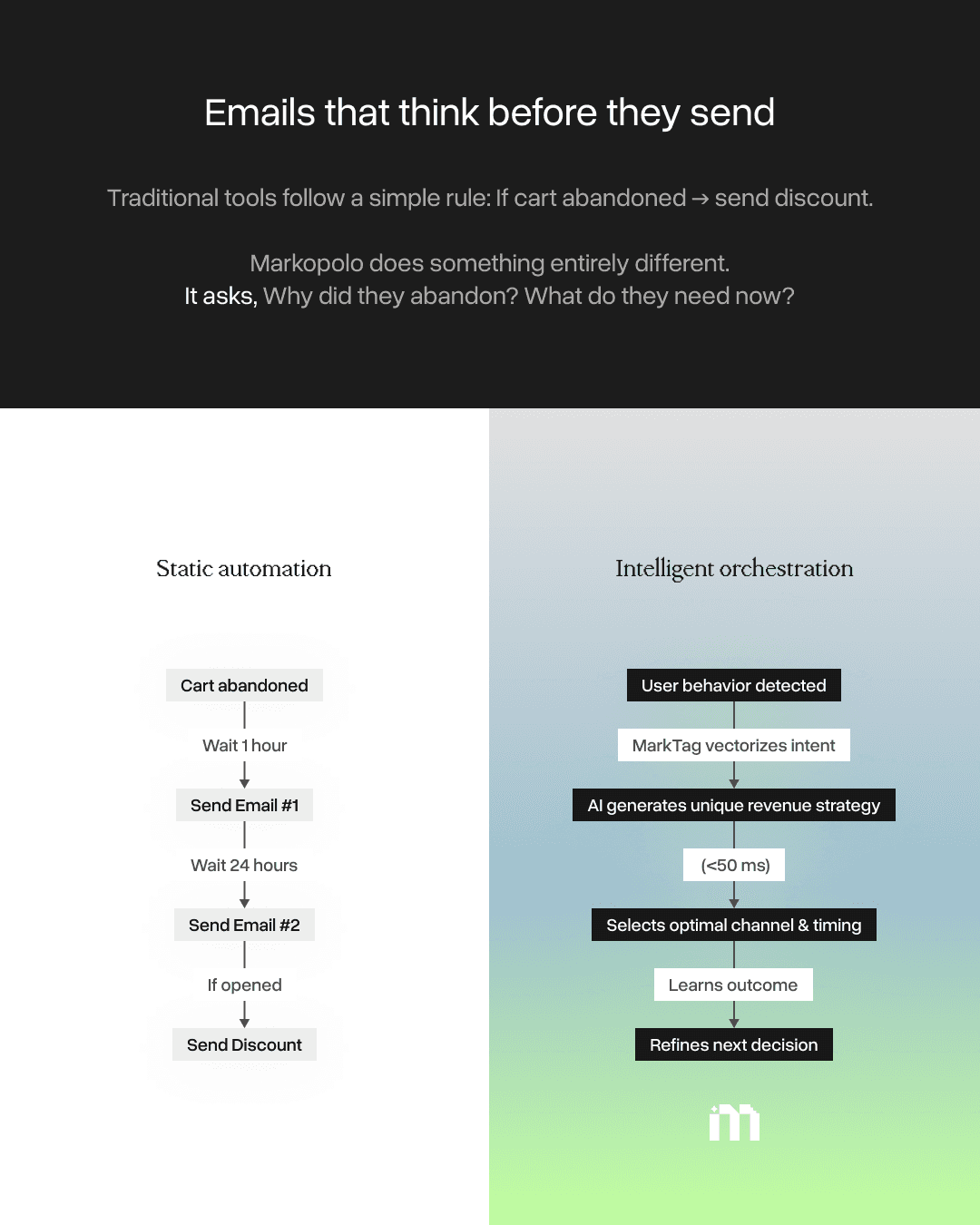
Markopolo AI's "MarkTag" isn't just another tracking pixel. It transforms human behavior into mathematical understanding through 384-dimensional vectors. Every micro-interaction gets captured: hesitation patterns, comparison behavior, scroll depth, reading patterns, and cart activity with context. This creates a complete picture of customer intent that goes far beyond simple event tracking.
Individual AI agents for each customer
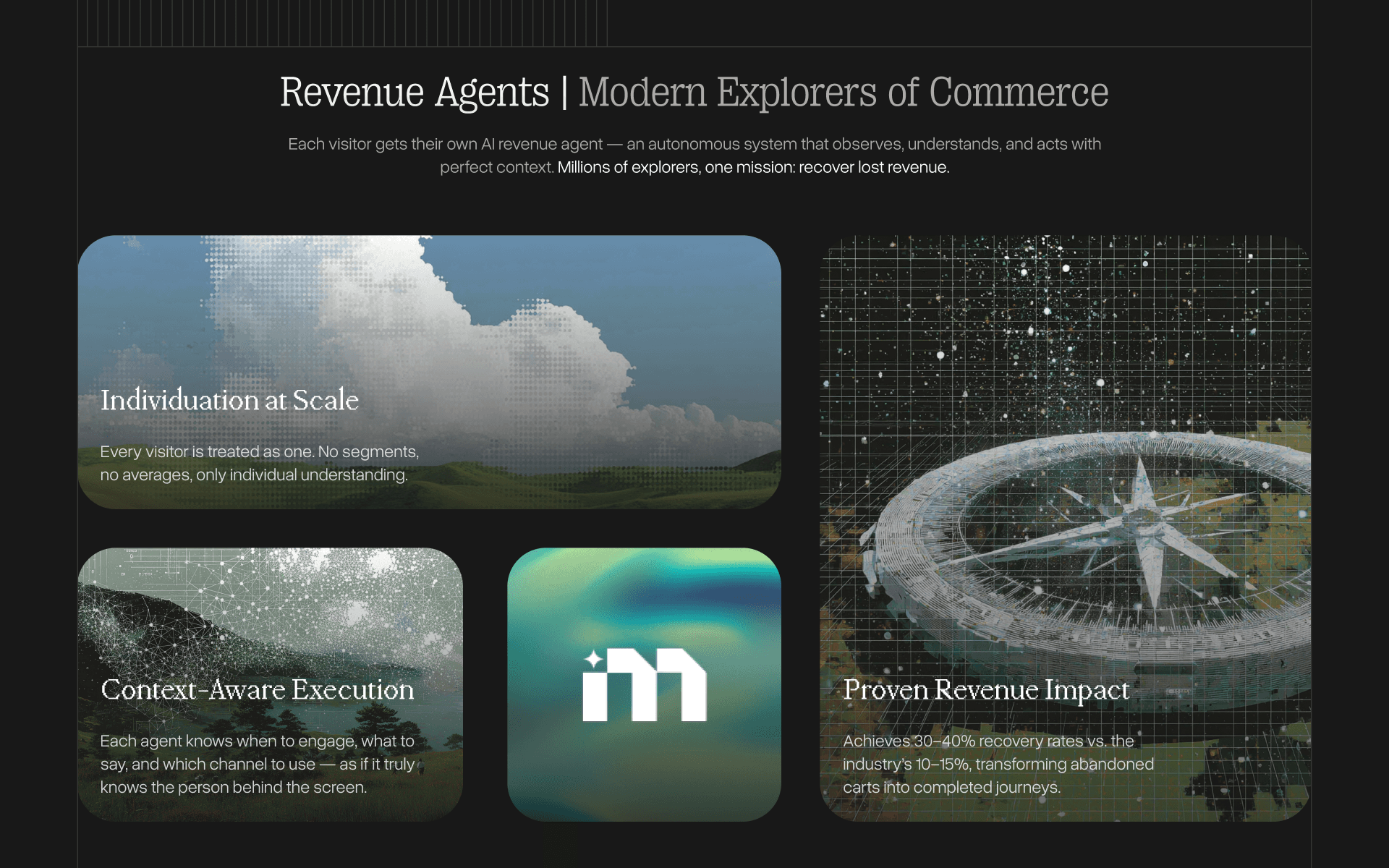
Traditional platforms segment customers into groups and apply the same workflow to everyone in a segment. Markopolo creates a dedicated AI agent for each visitor. This agent has perfect memory of every interaction, knows exactly when and how to engage, and never sleeps or forgets. One million visitors means one million unique strategies.
Real-time journey orchestration

The AI generates completely unique journeys in milliseconds. It doesn't choose from preset templates. It creates strategies based on behavioral vectors, real-time context, business goals, inventory levels, and product profitability. Each journey adapts continuously based on customer responses.
True omnichannel coordination

Markopolo orchestrates across email, SMS, WhatsApp, push notifications, and AI-powered voice calls. The platform chooses the optimal channel for each customer based on their engagement history. If Sarah responds to WhatsApp at 7 PM but ignores emails, her AI agent knows that.
Predictive intent understanding

The platform predicts what will bring each customer back before sending anything. A price-sensitive researcher gets a value comparison. An impulse premium buyer gets urgency messaging about limited stock. A technical validator gets detailed specifications and expert reviews. The AI knows the difference.
Lifetime attribution modeling

Every touchpoint gets weighted and attributed. The system identifies causal relationships, not just correlations. It tracks behavioral momentum, detecting velocity toward or away from conversion. This context persists across sessions and devices.
Sub-50ms decision making

Speed matters in cart recovery. Markopolo processes events and generates strategies in under 50 milliseconds. This real-time capability enables intervention at the optimal moment for each customer, not just at preset intervals.
Continuous learning per customer
Every interaction makes the AI smarter for that specific customer. By month 6, the system predicts behavior with 85%+ accuracy. By month 12, it knows customers better than they know themselves. This compound intelligence effect widens the performance gap over time.
Value-based pricing alignment
The pricing model ties Markopolo's success to merchant success. Instead of charging per contact or per send, pricing includes a percentage of recovered revenue. This creates alignment: Markopolo only wins when merchants recover more sales.
Infrastructure built for scale
The platform processes 1 million events per second, generates 100,000 unique journeys per minute, and handles 10 million concurrent user sessions. This infrastructure means performance doesn't degrade as you grow.
Pros
Achieves 30-40% cart recovery rates vs 10-15% industry average
Creates unique journeys for each individual customer
Processes behavioral data in 384 dimensions
Coordinates six channels including AI voice calls
Generates strategies in under 50 milliseconds
Learns and improves for each customer over time
Aligns pricing with revenue recovery results
Scales to millions of customers without performance loss
Provides complete lifetime attribution
Predicts optimal intervention timing and channel
Cons
Advanced features may require a learning curve for traditional marketers
Klaviyo
Klaviyo has become the default choice for Shopify stores looking for email marketing. The platform offers solid ecommerce integrations and pre-built flows for common scenarios including abandoned cart recovery. It uses event-based triggers to send automated messages when customers leave items in their carts.
Email marketing features Klaviyo
Klaviyo provides a visual flow builder for creating automated sequences. The platform integrates deeply with Shopify, pulling in product data, order history, and customer information. It offers A/B testing, predictive analytics for customer lifetime value, and segmentation based on purchase behavior. SMS capabilities come at an additional cost.
Pros
Deep Shopify integration with one-click setup
Large template library for ecommerce use cases
Strong segmentation capabilities
Predictive analytics for CLV scoring
Active community and extensive documentation
Cons
Pricing scales quickly as contact lists grow
SMS requires separate pricing
Personalization limited to segment-level
Same flows apply to everyone in a segment
No voice channel capability
Requires manual workflow creation and optimization
Comparing Klaviyo vs Markopolo AI for cart recovery emails
Klaviyo applies the same automated flow to everyone who abandons a cart. Markopolo AI creates a unique strategy for each individual. Klaviyo segments customers into groups. Markopolo treats each customer as a segment of one. This fundamental difference explains why Markopolo achieves 30-40% recovery rates while Klaviyo users typically see 10-15%. Klaviyo requires marketers to build and optimize workflows. Markopolo's AI handles strategy generation automatically, freeing teams to focus on other priorities.
Mailchimp
Mailchimp is one of the most recognized names in email marketing. The platform has evolved from a simple email tool to an all-in-one marketing platform. For abandoned cart recovery, it offers basic automation capabilities and integrations with major ecommerce platforms.
Email marketing features Mailchimp
Mailchimp provides a drag-and-drop email builder with pre-designed templates. The customer journey builder allows creation of automated sequences triggered by cart abandonment. It offers basic segmentation, A/B testing, and send time optimization. Recent updates added SMS capabilities in select markets.
Pros
Familiar interface that many marketers already know
Free tier available for small lists
Wide range of integrations
Good deliverability reputation
Content studio for design assets
Cons
Automation capabilities are basic compared to specialized tools
Ecommerce features feel bolted on rather than native
Pricing becomes expensive as you scale
Limited behavioral tracking
No WhatsApp or voice channels
Segment-based approach limits personalization
Comparing Mailchimp vs Markopolo AI for cart recovery emails
Mailchimp sends the same cart recovery sequence to all abandoners. Markopolo AI understands each customer's intent and context. Mailchimp tracks basic events like opens and clicks. Markopolo captures 384 dimensions of behavioral data including hesitation patterns and comparison behavior. For businesses serious about maximizing cart recovery, Markopolo's individual-level AI approach dramatically outperforms Mailchimp's template-based workflows.
Omnisend
Omnisend focuses specifically on ecommerce marketing automation. The platform positions itself as an alternative to Klaviyo with more accessible pricing and built-in multi-channel capabilities. Cart recovery is one of its core use cases.
Email marketing features Omnisend
Omnisend offers pre-built automation workflows for abandoned carts, browse abandonment, and post-purchase sequences. The platform includes email, SMS, and push notifications in one interface. It provides product recommendation blocks, discount code generation, and campaign reporting. The automation editor uses a visual drag-and-drop approach.
Pros
Multi-channel included in base pricing
Ecommerce-specific features and templates
More affordable than Klaviyo at similar scales
Good Shopify and WooCommerce integrations
Product picker makes adding items easy
Cons
Automation logic is fairly basic
Personalization limited to product recommendations
Analytics less detailed than competitors
No voice channel capability
Segment-based approach like most platforms
SMS coverage varies by region
Comparing Omnisend vs Markopolo AI for cart recovery emails
Omnisend offers solid multi-channel automation at accessible prices. But it still applies the same workflow logic to segments of customers. Markopolo AI creates individual strategies based on each person's behavioral fingerprint. Omnisend users build workflows manually. Markopolo's AI generates optimal journeys automatically. For D2C brands wanting to maximize recovery rates, Markopolo's individual-level intelligence delivers significantly better results.
Drip
Drip built its reputation as an ecommerce-focused alternative to general marketing automation tools. The platform emphasizes visual workflow building and integrates with major ecommerce platforms for cart recovery and customer lifecycle campaigns.
Email marketing features Drip
Drip provides a visual workflow builder that displays customer journeys as flowcharts. The platform offers dynamic content, behavior-based triggers, and revenue attribution reporting. It includes SMS capabilities and integrates with Facebook and Instagram for advertising. Liquid templating allows advanced personalization.
Pros
Visual workflow builder is intuitive
Strong revenue attribution reporting
Liquid templating for advanced customization
Good ecommerce platform integrations
Reasonable pricing for mid-market
Cons
Learning curve for advanced features
SMS capabilities less robust than specialists
No WhatsApp or voice channels
Requires manual workflow building and optimization
Segment-based personalization
Support quality inconsistent
Comparing Drip vs Markopolo AI for cart recovery emails
Drip requires marketers to design workflows and decide on logic. Markopolo AI generates optimal strategies automatically for each customer. Drip applies workflows to segments. Markopolo treats each customer as unique. While Drip offers solid ecommerce automation, Markopolo's AI-driven approach consistently achieves higher recovery rates by understanding individual intent and context.
ActiveCampaign
ActiveCampaign started as an email marketing tool and expanded into full marketing automation and CRM. The platform serves both B2B and ecommerce use cases, offering sophisticated automation capabilities and predictive features.
Email marketing features ActiveCampaign
ActiveCampaign offers advanced automation with conditional logic, split testing, and goal tracking. The platform includes predictive sending to optimize delivery times, lead scoring, and site tracking. Its CRM integration connects marketing activities with sales processes. Machine learning features predict customer behaviors.
Pros
Powerful automation capabilities
Built-in CRM saves money on separate tools
Predictive sending optimization
Good for hybrid B2B/B2C businesses
Extensive integration marketplace
Cons
Interface can feel overwhelming
Ecommerce features not as native as specialists
Pricing increases with CRM features
No WhatsApp or voice channels
Setup requires significant time investment
Better suited for B2B than pure D2C
Comparing ActiveCampaign vs Markopolo AI for cart recovery emails
ActiveCampaign offers powerful automation but requires manual setup and optimization. Markopolo AI generates strategies automatically based on individual behavior. ActiveCampaign's predictive features work at segment level. Markopolo's AI creates unique approaches for each customer. For D2C ecommerce focused on cart recovery, Markopolo's specialized approach outperforms ActiveCampaign's generalist platform.
Braze
Braze serves enterprise brands with sophisticated customer engagement needs. The platform offers real-time data processing, machine learning features, and coordination across mobile, web, and messaging channels. It requires significant investment and technical resources.
Email marketing features Braze
Braze provides real-time data streaming, canvas-based journey building, and intelligent channel selection. The platform includes predictive churn modeling, dynamic content personalization, and connected content for API-driven emails. It supports email, SMS, push, in-app messaging, and content cards.
Pros
Enterprise-grade real-time data processing
Sophisticated machine learning features
Strong mobile engagement capabilities
Extensive customization options
Robust API for custom integrations
Cons
Expensive with custom pricing
Requires technical resources to implement
Overkill for smaller ecommerce businesses
Long implementation timelines
Still uses segment-based approach
No integrated voice channel
Comparing Braze vs Markopolo AI for cart recovery emails
Braze offers enterprise capabilities but applies machine learning to segments rather than individuals. Markopolo AI creates unique strategies for each customer. Braze requires significant technical investment. Markopolo works autonomously out of the box. Both process data in real time, but Markopolo's 384-dimensional behavioral vectors provide deeper understanding of individual intent. For cart recovery specifically, Markopolo's focused approach delivers better ROI.
Privy
Privy focuses on helping small ecommerce businesses grow their email lists and recover sales. The platform combines popup forms with email and SMS marketing, making it popular among Shopify store owners just getting started with email marketing.
Email marketing features Privy
Privy offers popup and banner builders, basic email automation, and cart abandonment sequences. The platform provides pre-built templates, A/B testing for popups, and integration with major ecommerce platforms. SMS capabilities come included in higher tiers.
Pros
Easy to use for beginners
Free tier available
Strong popup and list-building features
Quick Shopify setup
Affordable pricing for small stores
Cons
Email capabilities are basic
Limited automation sophistication
Personalization options minimal
No advanced behavioral tracking
Not suitable for scaling brands
No WhatsApp or voice channels
Comparing Privy vs Markopolo AI for cart recovery emails
Privy suits small stores just starting with cart recovery emails. Markopolo AI suits businesses serious about maximizing revenue recovery. Privy sends basic automated sequences. Markopolo creates unique AI-driven journeys. Privy tracks simple events. Markopolo understands behavioral intent through 384 dimensions of data. Growing D2C brands will quickly outgrow Privy's capabilities and benefit from Markopolo's sophisticated approach.
Moosend
Moosend offers affordable email marketing automation for businesses watching their budgets. The platform provides solid basics including cart abandonment workflows, product recommendations, and A/B testing at lower price points than competitors.
Email marketing features Moosend
Moosend includes a drag-and-drop editor, pre-built automation templates, and basic behavioral triggers. The platform offers product recommendation widgets, weather-based content, and countdown timers. Real-time analytics show campaign performance.
Pros
Very affordable pricing
Easy to use interface
Good deliverability
Product recommendations included
No sending limits on plans
Cons
Fewer integrations than larger platforms
Automation capabilities basic
Limited multi-channel options
No behavioral vectorization
Basic segmentation
Support can be slow
Comparing Moosend vs Markopolo AI for cart recovery emails
Moosend offers good value for basic email marketing needs. Markopolo AI offers sophisticated revenue recovery that justifies its investment. Moosend sends the same sequence to everyone who abandons. Markopolo creates individual strategies based on behavioral intelligence. For businesses where cart recovery represents significant revenue opportunity, Markopolo's higher recovery rates deliver better return on investment.
Attentive
Attentive specializes in SMS marketing for ecommerce brands. The platform has expanded to include email but maintains its focus on text message engagement. It uses AI to generate message content and optimize send times.
Email marketing features Attentive
Attentive provides AI-generated message content, two-way conversational messaging, and behavioral triggering. The platform offers sign-up forms optimized for mobile numbers, audience segmentation, and performance analytics. Email capabilities complement its core SMS offering.
Pros
Leader in SMS marketing
AI content generation
Strong mobile engagement
Two-way messaging capabilities
Good compliance management
Cons
Email is secondary focus
Expensive for SMS volume
Limited channel breadth
Custom pricing required
Still segment-based approach
No voice channel integration
Comparing Attentive vs Markopolo AI for cart recovery emails
Attentive excels at SMS but treats email as secondary. Markopolo AI orchestrates all channels equally based on individual preferences. Attentive uses AI for content generation. Markopolo uses AI for complete journey orchestration. Both offer behavioral targeting, but Markopolo's 384-dimensional vectors provide deeper intent understanding. For comprehensive cart recovery across channels, Markopolo offers the more complete solution.
How to pick the right email platform for cart recovery
Choosing the right abandoned cart recovery platform depends on your business size, technical resources, and recovery goals. Here's what to consider:
Recovery rate potential
The most important metric is how much revenue you actually recover. Traditional platforms achieve 10-15% recovery rates. AI-driven platforms like Markopolo AI achieve 30-40%. Calculate the revenue difference at your abandonment volume. A platform costing more but recovering twice as much delivers better ROI. Markopolo's value-based pricing with revenue share aligns cost with actual results.
Personalization depth
Ask how the platform personalizes messages. Segment-based personalization applies the same approach to groups. Individual-level personalization creates unique strategies for each customer. The difference in conversion rates is substantial. Markopolo AI's 384-dimensional behavioral vectors enable true 1:1 personalization that traditional platforms cannot match.
Channel coordination
Consider which channels your customers prefer. Some respond to email. Others to SMS or WhatsApp. The best platforms coordinate all channels based on individual preferences. Markopolo AI orchestrates email, SMS, WhatsApp, push notifications, and AI voice calls automatically, choosing the optimal channel for each person.
Automation intelligence
Evaluate how much manual work the platform requires. Building and optimizing workflows takes time. Platforms like Markopolo AI generate strategies autonomously, freeing your team for other priorities. The platform's AI creates and adapts journeys without manual intervention.
Scalability and speed
Your cart recovery platform needs to handle your volume without delays. Processing speed affects timing, and timing affects conversion. Markopolo AI processes events and generates strategies in under 50 milliseconds, handling 1 million events per second. This infrastructure ensures optimal timing at any scale.
Why D2C ecommerce businesses choose Markopolo AI for abandoned cart emails

Ecommerce businesses face unique challenges that Markopolo AI was built to solve. Markopolo suites well for merchants of Shopify, WooCommerce, BigCommerce, Wordpress, as well as native ecosystems. Here's why it fits the D2C model particularly well:
Every customer relationship matters
D2C brands don't have retail partners sharing customer relationships. Each customer connection is yours to nurture or lose. Markopolo AI treats each customer as an individual with their own AI agent. This creates the personalized experience that builds lasting D2C relationships. Generic segment-based messages don't create loyalty. Individual understanding does.
Margins require efficiency
D2C businesses often operate on tight margins. Marketing spend needs to deliver measurable returns. Markopolo AI's value-based pricing means you pay for results, not potential. The platform's higher recovery rates translate directly to recovered revenue. This efficiency matters when every percentage point of conversion affects profitability.
Competition demands differentiation
D2C brands compete against Amazon and established retailers. Superior customer experience is the differentiation. When your recovery emails understand and respond to individual needs, customers notice. Markopolo AI's behavioral intelligence creates experiences that feel personal, not automated. This differentiation builds preference for your brand.
Growth requires scalability
D2C brands need platforms that grow with them. What works for 10,000 customers must work for 1 million. Markopolo AI's infrastructure handles massive scale without performance degradation. The AI improves with more data, so performance gets better as you grow. This scalability means you won't outgrow the platform.