Abandoned cart email best practices: examples, templates, and complete guide
Sirazum Monir Osmani
Shoppers rarely abandon carts because they lose interest. Most leave because the moment was disrupted. But email helps restart that moment.
Email marketing platforms for abandoned cart recovery typically convert at around 10–15%, which is why they remain one of the most reliable ways to recover revenue without relying on discounts. Markopolo AI, on the other hand, converts 30-40%.
This guide explains how to create cart recovery emails that convert, covering message structure, timing, and the subtle psychological triggers that move someone from “I’ll come back” to checkout.
Why abandoned cart emails are essential for ecommerce?
Cart abandonment costs ecommerce brands roughly $18 billion in lost revenue annually. But here's what most marketers miss: an abandoned cart isn't a "no." It's an "I'm not sure yet."
Think about your own shopping behavior. You add items to a cart, get distracted by a Slack notification, and forget about it. Or you're comparing prices. Or you want to think it over. None of those reasons mean you don't want the product.
Abandoned cart emails work because they catch people in that decision window. The customer already did the hard part—they found your product, liked it enough to add it to their cart, and mentally pictured owning it. Your email just needs to nudge them across the finish line.
The math is simple: if you have 1,000 abandoned carts per month at an average order value of $80, and your recovery emails convert even 10% of those, that's $8,000 in revenue you would have lost. Scale that up, and cart recovery becomes one of the highest-ROI activities in your marketing stack.
Crafting high-converting subject lines
Your subject line has one job: get the email opened. But here's what most marketers get wrong: they write subject lines for segments, not individuals.
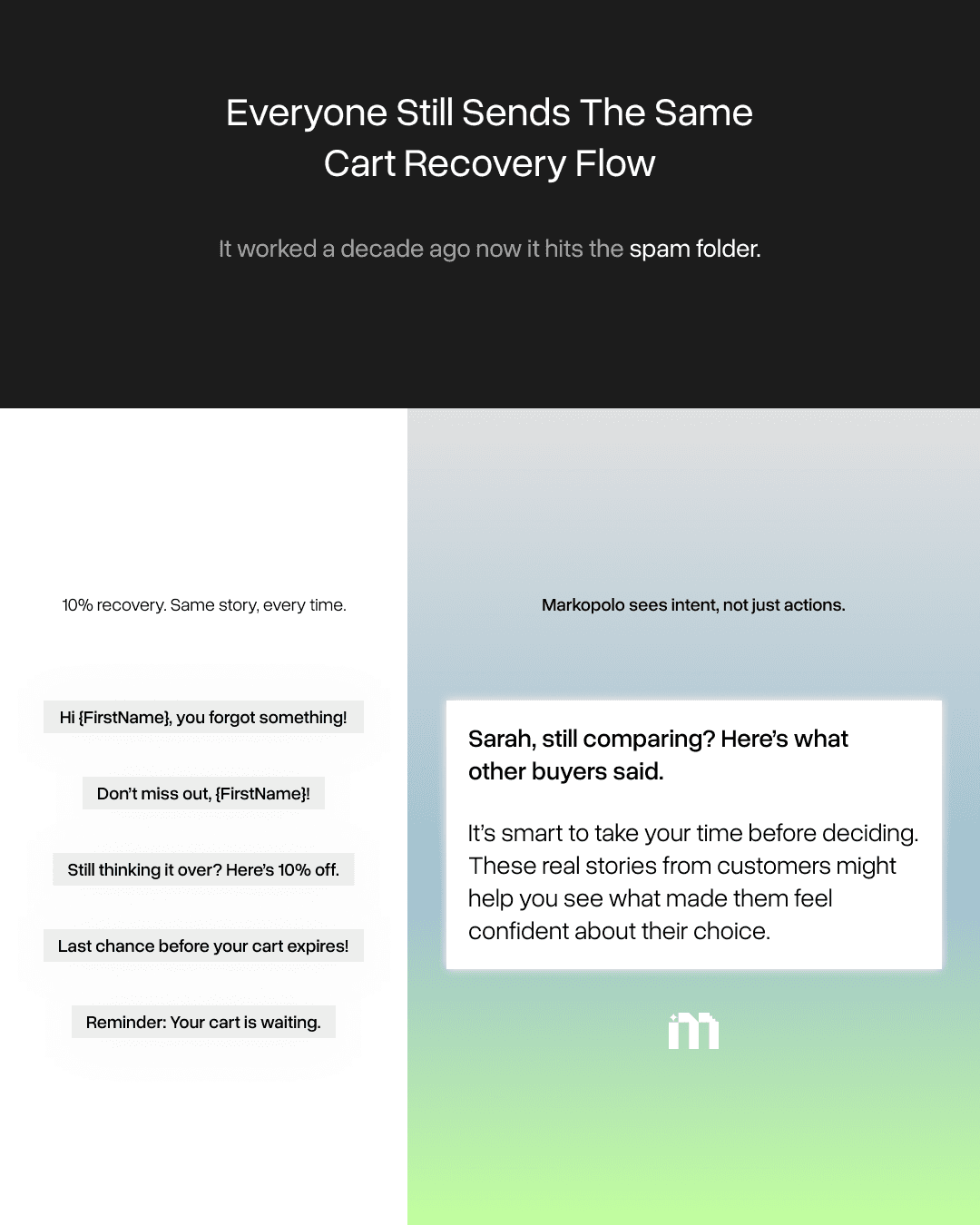
"You left something behind" gets sent to 10,000 people. It's generic because it has to be. The marketer doesn't know if the recipient is a first-time browser, a loyal customer, or someone who's been comparing prices for three days.
The average person receives 121 emails per day. Generic subject lines blend into the noise. Subject lines that feel personally relevant cut through it.
Best practices for curiosity and urgency
Curiosity and urgency work. But only when they match the customer's actual mental state.
Curiosity works best when it's specific. "You left something behind" is vague. "Still thinking about those hiking boots?" creates a mental image. But here's the next level: if you know the customer spent 15 minutes reading reviews before abandoning, "Other hikers loved these—here's why" speaks directly to their hesitation.
Urgency works best when it's real and relevant. Fake urgency ("Only 2 left!" when you have 200 in stock) damages trust. But even real urgency falls flat if it doesn't match intent. A customer in research mode doesn't care about a 24-hour deadline. They're not ready to buy yet. A customer who almost checked out but got distracted? That urgency might be exactly what they need.
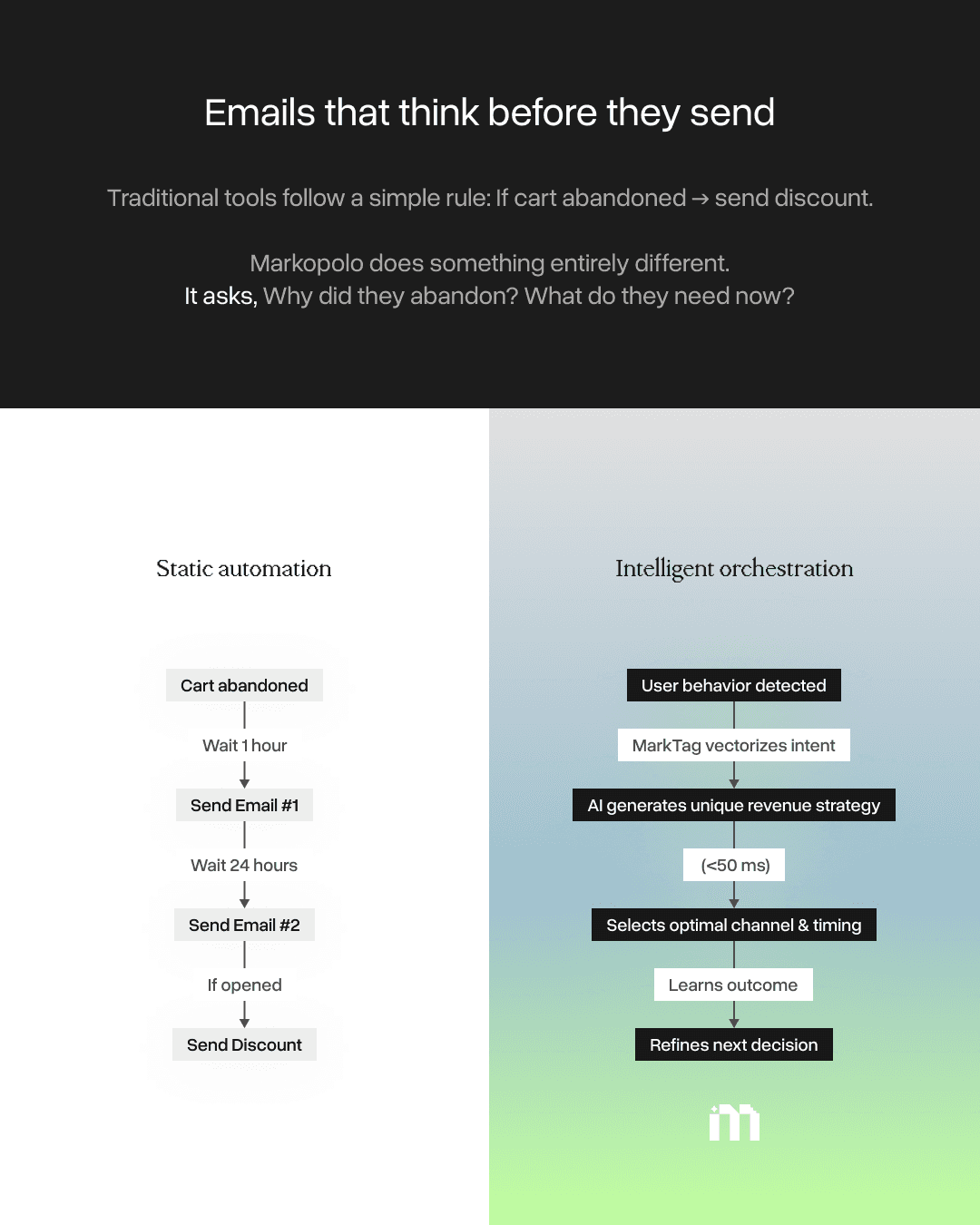
The problem with traditional email platforms: they force you to pick one approach and apply it to everyone. You either send the urgency email or you don't. You can't send urgency to the ready-to-buy customer and social proof to the researcher.
This is where behavioral intelligence changes the game. Modern abandoned cart recovery platforms like Markopolo AI can understand each customer's intent, where they are in their decision journey, what's holding them back, what motivates them, and match the subject line to their actual state of mind.
A few tactical tips for any approach:
Keep subject lines under 40 characters for mobile optimization
Use the recipient's name sparingly—it works, but it's become expected
Test lowercase vs. sentence case; lowercase often feels more personal
Avoid spam triggers like ALL CAPS, excessive punctuation, and words like "free" or "winner"
10 examples of catchy subject lines
Here are subject lines organized by customer intent, not just by "approach":
For the distracted buyer (high intent, just got interrupted):
"Anna, your cart is waiting…"
"Quick—pick up where you left off"
"Still want this? It's ready when you are"
For the researcher (comparing options, needs validation):
"What 129 customers said about [Product]"
"Quick question about your order"
"Dave, here's what you might have missed"
For the price-conscious shopper (looking for deals):
"Joseph, here are cheaper alternatives for [product name]"
"A little help with that decision"
"Free shipping on your [product name]!"
For the impulse browser (casual interest, needs a nudge):
"Your [product name] misses you"
The best subject line isn't about your brand voice—it's about matching the customer's mindset. A luxury skincare brand might use playful copy for an impulse browser and sophisticated copy for a considered purchaser. Same brand, different intent, different approach.
This level of personalization used to be impossible at scale. You'd need a human to read each customer's behavior and craft individual messages. Now, platforms like Markopolo do this automatically—understanding intent from behavioral signals and generating subject lines that match each person's state of mind.
Designing the perfect abandoned cart email template
Design matters, but not in the way most marketers think. The goal isn't to create the most beautiful email, but to create the clearest path to purchase for each specific customer.
Here's the shift: traditional cart emails show the same layout to everyone. But a customer who is unsure about the product quality should see reviews front and center. A customer who needs urgency should see stock levels. A customer who needs reassurance should see your return policy.
One template fits no one perfectly. Dynamic templates that adapt to individual intent fit everyone.
Key elements of a successful email template
Hero image: Contextually show what they're missing |
|---|
The hero image should feature the exact product(s) the customer abandoned. But the surrounding context should match their intent.
For a customer who browsed multiple colors before abandoning: show the specific color they viewed longest. For a customer who checked sizing guides: show the product on a model with size information visible. For a customer who read reviews: show the product alongside a star rating.
These details seem small, but they signal that you understand what matters to this specific person.
Copy: Match the message to the objection |
|---|
The best cart recovery emails have minimal copy, but the right copy. The customer already knows about your product. You don't need to re-sell features. You need to address whatever stopped them from buying.
The challenge: different customers have different objections.
A first-time visitor might worry about trust and returns
A price-sensitive shopper might need reassurance on value
A researcher might need social proof and validation
A distracted buyer might just need a simple reminder
Traditional email platforms force you to guess the most common objection and write for that. You address shipping concerns and hope that was the issue. Behavioral intelligence removes the guessing—you know what each customer cared about based on what they clicked, how long they stayed, and what they compared.
CTA: Personalized one button, one action |
|---|
Your call-to-action button should be impossible to miss. Use a contrasting color, make it full-width on mobile, and use action-oriented text.
But even CTA copy can be personalized. "Complete my order" works for someone who is ready to buy. "See what others are saying" might work better for someone who needs validation. "Check if it's still available" creates urgency for someone who responds to scarcity.
Optimizing for mobile devices
Over 60% of email opens happen on mobile devices. If your cart recovery email doesn't work on a phone, it doesn't work.
But here's what most mobile optimization guides miss: mobile isn't just about screen size. It's about context. Someone checking email on mobile at 7 PM is in a different mindset than someone on desktop at 2 PM.
Behavioral intelligence can detect these patterns. If a customer consistently engages on mobile in the evening, that's when they should receive their recovery email—formatted for mobile, timed for their engagement window.
Mobile optimization essentials:
Single-column layout: Side-by-side elements stack awkwardly on small screens
Minimum 44x44 pixel tap targets: Fingers are bigger than mouse cursors
14px minimum font size: Anything smaller requires pinching to zoom
Short paragraphs: Large blocks of text are intimidating on small screens
Preheader text: The preview text that appears after the subject line; use it to extend your hook
Test every email on actual devices before sending. What looks great in your desktop email builder might be unreadable on an iPhone SE.
Mastering the email sequence and timing
Timing can double or halve your recovery rate. But here's the uncomfortable truth: the "optimal send time" is different for every customer.
The industry standard is to send at 1 hour, 24 hours, and 72 hours. Unfortunately, this is a compromise. It's the best guess for an average customer. But your customers aren't average. They're individuals with different schedules, different decision speeds, and different engagement patterns.
When to send the first follow-up (the "golden hour")
The first hour after abandonment is critical. But not for the reason most marketers assume.
Conventional wisdom says to send immediately, while purchase intent is still warm. But there's a catch: a huge percentage of "abandoned" carts are people who got distracted and plan to come back within minutes. If you email them 15 minutes after they stepped away to answer the door, you look desperate.
The "golden hour" isn't a fixed time—it's the window when intent is still warm but the customer has had time to return on their own.
For most brands, this is somewhere between 1-4 hours. But behavioral signals can narrow this dramatically:
A customer who browsed for 20 minutes, compared three products, and read reviews has high intent. They might need a faster nudge.
Someone who added to cart in 30 seconds might be impulse-browsing. They could benefit from more time.
A customer who's purchased before and typically completes checkout within an hour? If they haven't returned in 90 minutes, something's different.
This is where predictive intelligence becomes valuable. Platforms like Markopolo don't just track what customers do—they predict what each customer will do next based on behavioral patterns. The system knows that this specific customer typically converts within 2 hours or not at all, so it triggers a recovery email at the 2-hour mark rather than waiting for an arbitrary 4-hour delay.
The result: emails arrive when they're most likely to work, not when a marketer guessed they might.
How many emails should be in your sequence?
The standard recommendation is a three-email sequence:
Email 1 (1-4 hours): The reminder Simple, no incentive. "Hey, you left something behind. Here's your cart." Many purchases happen from this email alone—people genuinely forgot and appreciate the reminder.
Email 2 (24 hours): Address objections If they didn't buy from email one, something is holding them back. This email should tackle common objections: free shipping threshold, easy returns, secure checkout, customer reviews. Still no discount—you're removing friction, not buying the sale.
Email 3 (48-72 hours): The incentive If they're still on the fence after two emails, a small incentive can tip the scale. This could be a percentage discount, free shipping, or a bonus gift with purchase. Make it time-limited (24-48 hours) to create urgency.
But here's the limitation of this model: it assumes every customer needs the same journey. In reality:
A loyal customer who's purchased five times doesn't need three emails. One reminder is probably enough—and three might annoy them.
A first-time visitor with low engagement might need more touchpoints, not fewer.
A price-sensitive shopper (identified by coupon searches or competitor tab-switching) might respond to a discount on email one—waiting until email three means losing them to a competitor.
A customer who needs social proof might never respond to discounts at all. They need reviews and testimonials, not 10% off.
This is the fundamental problem with sequence-based thinking: it treats customers as a funnel to be moved through stages, rather than individuals with unique needs.
The alternative is 1:1 journey orchestration. Instead of "all abandoners get this sequence," each customer gets a unique journey based on their behavioral fingerprint. The researcher gets social proof. The price-sensitive shopper gets a strategic discount. The loyal customer gets a single, friendly reminder. The hesitant first-timer gets reassurance about returns.
Markopolo's AI creates these individual journeys automatically. It observes each customer's complete behavioral pattern, not just cart abandonment. It analyzes how they browsed, what they compared, where they hesitated, what channels they preferred,—and generates cart recovery strategies designed for that specific person.
The result: 30-40% recovery rates instead of the 10-15% ceiling that traditional sequences hit.
Proven email strategies to improve cart recovery rates
Beyond timing and design, the content of your emails determines whether someone clicks "buy" or clicks "delete." But the most effective content isn't universal—it's matched to individual intent.
Using social proof and reviews
Social proof is one of the most effective conversion tools in marketing. Customers who need validation always search for it.
When someone abandons a cart, they often have lingering doubts. Is this product actually good? Will it fit? Is this brand trustworthy? Social proof answers these questions with evidence instead of claims.
But here's what behavioral intelligence reveals: not every customer needs the same type of validation.
A customer who spent 10 minutes reading reviews before abandoning is screaming "I need more validation." Their cart recovery email should lead with reviews—the specific kind of reviews they were reading. If they filtered for reviews mentioning "sizing," show reviews about fit. If they sorted by most critical, show reviews that acknowledge downsides but conclude positively.
A customer who added to cart immediately without reading reviews? They probably don't need social proof. They might need urgency, or a reminder, or nothing at all except a convenient link back to checkout.
Traditional email platforms can't make this distinction. They send the same social proof email to everyone, which means it's perfectly targeted for some customers and irrelevant for others.
Markopolo's behavioral intelligence identifies which customers need validation based on their actual browsing patterns—review reading, comparison shopping, FAQ visits, time spent on testimonial pages. These customers get social-proof-focused recovery emails. Others get whatever approach matches their specific intent signals.
Ways to incorporate social proof in your cart recovery strategy (for customers who need it):
Star ratings: Include the product's average rating next to the image
Review snippets: Pull a compelling one-line review that addresses the customer's specific concern
Customer count: "Join 10,000+ customers who love this product"
User-generated photos: Real customer photos create authenticity
The key is relevance. A glowing review about fit is persuasive for someone who checked the sizing guide. A review about durability matters for someone who compared premium vs. budget options. Match the proof to the doubt.
When to offer discounts vs. free shipping
The discount question is one of the most debated topics in e-commerce marketing. Offer discounts too freely, and you train customers to wait for them. Never offer discounts, and you leave recoverable revenue on the table.
Here's the real answer: discounts work for some customers and backfire with others. The goal isn't to have a discount policy—it's to know which customers need discounts and which don't.
Behavioral signals that indicate price sensitivity:
Coupon code searches or coupon site visits before abandoning
Multiple tabs open comparing competitor prices
Adding and removing items (testing cart totals)
Long hesitation on the checkout page at the payment step
Browsing history focused on sale or clearance sections
Behavioral signals that indicate low price sensitivity:
Fast, confident navigation to premium products
No comparison shopping behavior
Previous purchases at full price
Immediate add-to-cart without checking prices
Focus on product features/reviews rather than price
A customer showing price-sensitive signals might convert with a 10% discount in the first email. Waiting until email three means they've already bought from a competitor or lost interest.
A customer showing low price sensitivity should never receive an unsolicited discount. You're training them to expect discounts and leaving margin on the table. They might respond better to exclusivity, early access, or premium service messaging.
This is where Markopolo's intent understanding becomes critical. The platform identifies price sensitivity from behavioral patterns—not assumptions—and automatically adjusts the recovery approach. Price-sensitive shoppers might receive a strategic discount. Others might receive social proof, urgency messaging, or value reinforcement.
The result: higher recovery rates without blanket discounting that erodes margins.
A practical framework for manual segmentation:
If you don't have behavioral intelligence tools yet, here's a simplified approach:
Start without a discount. Your first email should focus on removing friction, not price reduction. Many customers will convert without any incentive.
Consider free shipping before discounts. Unexpected shipping costs are the #1 reason for cart abandonment. Offering free shipping feels like removing an obstacle rather than devaluing your product.
Reserve discounts for the final email. If a customer hasn't converted after two touchpoints, a small discount (10-15%) can tip the decision. Make it time-limited.
Exclude repeat customers from discount sequences. They've already shown willingness to pay full price.
This framework is better than blanket discounting, but it's still a compromise. True 1:1 personalization—knowing exactly which customers need which incentive—requires behavioral intelligence at scale.
Real-world examples of successful cart recovery email campaigns
Theory is useful, but seeing how different approaches match different customer intents is more practical. Here are three approaches—but remember, the best brands don't pick one approach. They match the approach to each customer.
The minimalist approach
Best for: Customers with high intent who just got distracted. Previous purchasers. Confident browsers who added to cart quickly.
Why it works for these customers: They don't need convincing. They don't need social proof or discounts. They just need a convenient path back to checkout. Anything more feels like noise.
Structure:
Clean, white-space-heavy design
Single product image, no clutter
Three lines of copy: reminder, value proposition, CTA
No discount offered
Example copy:
"You have great taste."
"The [Product Name] you selected is still available. Complete your order whenever you're ready—we'll keep it safe."
[Return to my cart]
Behavioral signals that trigger this approach:
Short time-to-cart (confident browsing)
Previous purchase history
No comparison shopping or review reading
High engagement scores
The social proof approach
Best for: Customers in research mode who need validation. First-time visitors. Browsers who spent time reading reviews or comparing options.
Why it works for these customers: They're not sure yet. They want to buy, but they're worried about making the wrong choice. Third-party validation is more persuasive than brand claims.
Structure:
Product image with star rating prominently displayed
Lead copy focused on customer satisfaction
1-2 review snippets that address likely concerns
Trust signals (guarantee, returns, customer count)
CTA
Example copy:
"Still thinking it over? Here's what other customers say:"
★★★★★ "Worth every penny. I use it daily." — Sarah M.
★★★★★ "Was nervous about ordering online, but the quality exceeded expectations" — Mike R.
✓ 30-day no-questions returns ✓ 10,000+ happy customers
[See more reviews & complete order]
Behavioral signals that trigger this approach:
Extended time spent reading reviews
FAQ page visits
Comparison behavior (multiple product pages, competitor tabs)
Hesitation patterns on product pages
The strategic incentive approach
Best for: Price-sensitive customers identified through behavioral signals. Customers who compared competitor pricing. Browsers who searched for coupon codes.
Why it works for these customers: Price is a real barrier. Without an incentive, they'll either buy from a competitor or wait indefinitely for a sale. A well-timed, appropriately-sized discount converts them without training discount-seeking behavior in customers who don't need it.
Structure:
Product image with original and discounted price
Clear, time-limited offer
Urgency without desperation
Single, prominent CTA
Example copy:
"We noticed you were comparing options."
"Here's 15% off [Product Name] for the next 24 hours. We think you'll love it, but we want to make the decision easier."
[Apply discount & checkout]
Behavioral signals that trigger this approach:
Coupon code searches
Competitor site visits
Price-focused browsing patterns
Add/remove behavior (testing totals)
Long hesitation at payment step
The key insight
Traditional cart recovery picks one of these approaches and applies it to everyone. Some customers get exactly what they need; others get irrelevant messaging that doesn't convert.
1:1 orchestration matches the approach to the customer. The researcher gets social proof. The distracted buyer gets a minimal reminder. The price-sensitive shopper gets a strategic discount. Each person gets a recovery journey designed for their specific intent.
This is what Markopolo builds automatically. The platform's behavioral intelligence observes each customer's complete journey—not just "abandoned cart," but every click, hesitation, comparison, and engagement pattern—and generates an individualized recovery strategy.
The difference in results is dramatic. Traditional sequences plateau at 10-15% recovery. Individualized journeys consistently achieve 30-40%—because every customer gets exactly what they need to convert.
Conclusion: Building your cart recovery email strategy
Cart recovery isn't about sending more emails. It's about sending the right email to the right person at the right time.
The brands stuck at 10-15% recovery rates are doing the same thing: building sequences, applying them to segments, and hoping the average approach works for the average customer.
The brands achieving 30-40% recovery rates have made a fundamental shift. They've stopped treating customers as segments and started treating them as individuals. They've moved from automation to intelligence.
Here's how to build your strategy:
Start with the fundamentals. If you don't have cart recovery emails running, get a basic three-email sequence live. Even a generic setup will recover revenue you're currently losing.
Measure what matters. Track open rates, click rates, and—most importantly—recovered revenue by customer type. You'll quickly see that different customers respond to different approaches.
Identify your behavioral patterns. Even without sophisticated tools, you can start segmenting: first-time vs. returning, high cart value vs. low, fast checkout abandonment vs. early browse abandonment. Different patterns suggest different needs.
Graduate to true personalization. Once you see that different customers need different approaches, the next question is: how do you deliver 1:1 personalization at scale? You can't manually craft individual emails for thousands of abandoners.
This is where AI-driven platforms become essential. Markopolo's approach is fundamentally different from traditional email tools. Instead of building sequences that apply to segments, it creates individual AI revenue agents for each customer.
Each agent has complete behavioral intelligence on its assigned customer—not just what they abandoned, but how they browsed, what they compared, where they hesitated, what channels they prefer, what time they engage, and what messaging resonates with them.
The agent generates a unique recovery journey for that specific person. One customer might get a WhatsApp message with social proof in 2 hours. Another might get an email with a discount in 30 minutes. Another might get a simple reminder the next morning. Each journey is designed for one individual.
This isn't personalization as a feature. It's a fundamentally different architecture—one agent per customer, one journey per intent, one approach per individual. Multiplied by millions.
The result: recovery rates that traditional platforms can't match, because traditional platforms are optimizing for averages while Markopolo is optimizing for individuals.
The bottom line: abandoned carts represent customers who already want your product. The question is whether you understand them well enough to help them complete the purchase. Generic sequences treat everyone the same and recover what they can. Intelligent orchestration understands each individual and recovers what's actually possible.
Start where you are. Measure what works. And when you're ready to move beyond segments to true 1:1 personalization, the technology exists to make it happen.
Ready to see what 1:1 cart recovery looks like? Markopolo creates individual AI revenue agents for every customer—understanding their intent, predicting their needs, and orchestrating personalized journeys that recover 30-40% of abandoned revenue.