AI for customer engagement: best platforms in 2026 with CRM integration, strategies, and future trends
Sirazum Monir Osmani
AI transforms customer engagement from generic campaigns into individualized experiences. The best platforms in 2026 use behavioral intelligence to predict what each customer needs before they ask. Markopolo AI leads this shift with ATHENA, a behavioral foundation model that achieves industry-leading accuracy in predicting customer actions across 603 independent businesses—delivering 30-40% cart recovery rates compared to the industry standard of 10-15%.
Businesses lose billions in revenue every year because they treat customers as segments rather than individuals. A price-sensitive researcher receives the same discount email as an impulse premium buyer. A customer who needs social proof gets urgency messaging. The result? Lower engagement, abandoned carts, and lost revenue.
With conversational AI for customer engagement, every visitor can have a real-time, two-way dialogue with a brand—on chat, WhatsApp, or even voice—tailored to their unique behavior and intent. These AI agents answer questions, remove friction, and deliver the right offer or reassurance at the exact moment it is needed, turning generic campaigns into 1:1 conversations that recover more carts and grow lifetime value.
AI-powered customer engagement platforms excel at this. They understand each customer's unique behavioral fingerprint and orchestrate perfectly timed, personalized interactions across channels.
What's the role of AI in customer engagement?
AI enables businesses to understand and respond to individual customer behavior at scale. Traditional marketing automation applies static workflows to broad segments. AI analyzes behavioral patterns in real-time and generates 1:1 personalized customer engagement strategies.
Predictive behavioral intelligence
AI models analyze thousands of micro-behaviors—hesitation patterns, comparison shopping, time-of-day preferences, channel engagement—to predict what each customer will do next. ATHENA, Markopolo AI's behavioral foundation model, transforms 2.45 million unique URLs into 90 universal behavioral event types, creating a 384-dimensional understanding of each user.
This predictive capability operates at remarkable speed. Markopolo processes behavioral signals and generates personalized strategies in under 50 milliseconds—fast enough to intervene before a customer abandons their cart.
Real-time personalization at scale
AI eliminates the tradeoff between scale and relevance. Where human teams might create 5-10 customer segments, AI creates millions of individual strategies. Each visitor gets their own AI agent that remembers every interaction, understands their current context, and knows exactly when and how to engage.
For ecommerce businesses, this means showing the right product recommendations, sending messages through preferred channels, and timing interventions when customers are most receptive. A D2C brand using Markopolo can send social proof via WhatsApp to a researcher at 7 PM, while offering an impulse buyer immediate SMS about limited stock at 2 PM.
Omnichannel orchestration
Customers interact with businesses across email, SMS, WhatsApp, push notifications, social media, and voice calls. AI executes omnichannel engagement based on individual preferences and context. If a customer typically ignores emails but responds to WhatsApp messages during evening hours, AI prioritizes that channel and timing.
Markopolo's Campaign Agent automatically determines the optimal channel mix for each customer. Someone who abandoned a cart while comparing prices receives different treatment than someone who left because they needed to validate a technical specification.
Automated customer journey creation
Traditional marketing automation requires humans to build workflows: "If cart abandoned, wait 1 hour, send an email." AI replaces rigid workflows with dynamic journey generation. For each individual, AI evaluates their behavioral vector, current context, business goals, inventory levels, and profit margins to create a unique engagement strategy.
This automation extends beyond simple triggers. AI determines whether to offer a discount, share customer reviews, provide technical details, or schedule a voice call—whatever that specific customer needs to complete their purchase.
Continuous learning and adaptation
AI improves with every interaction. When a customer responds positively to social proof but ignores discounts, the model updates its understanding of that individual. Over time, predictions become more accurate and interventions more effective.
This learning compounds across the customer base. Markopolo's cross-domain training on 603 businesses means the model recognizes patterns that transfer across different product categories, price points, and customer demographics.
5 best AI-powered customer engagement platforms and CRM integration tools
Markopolo AI
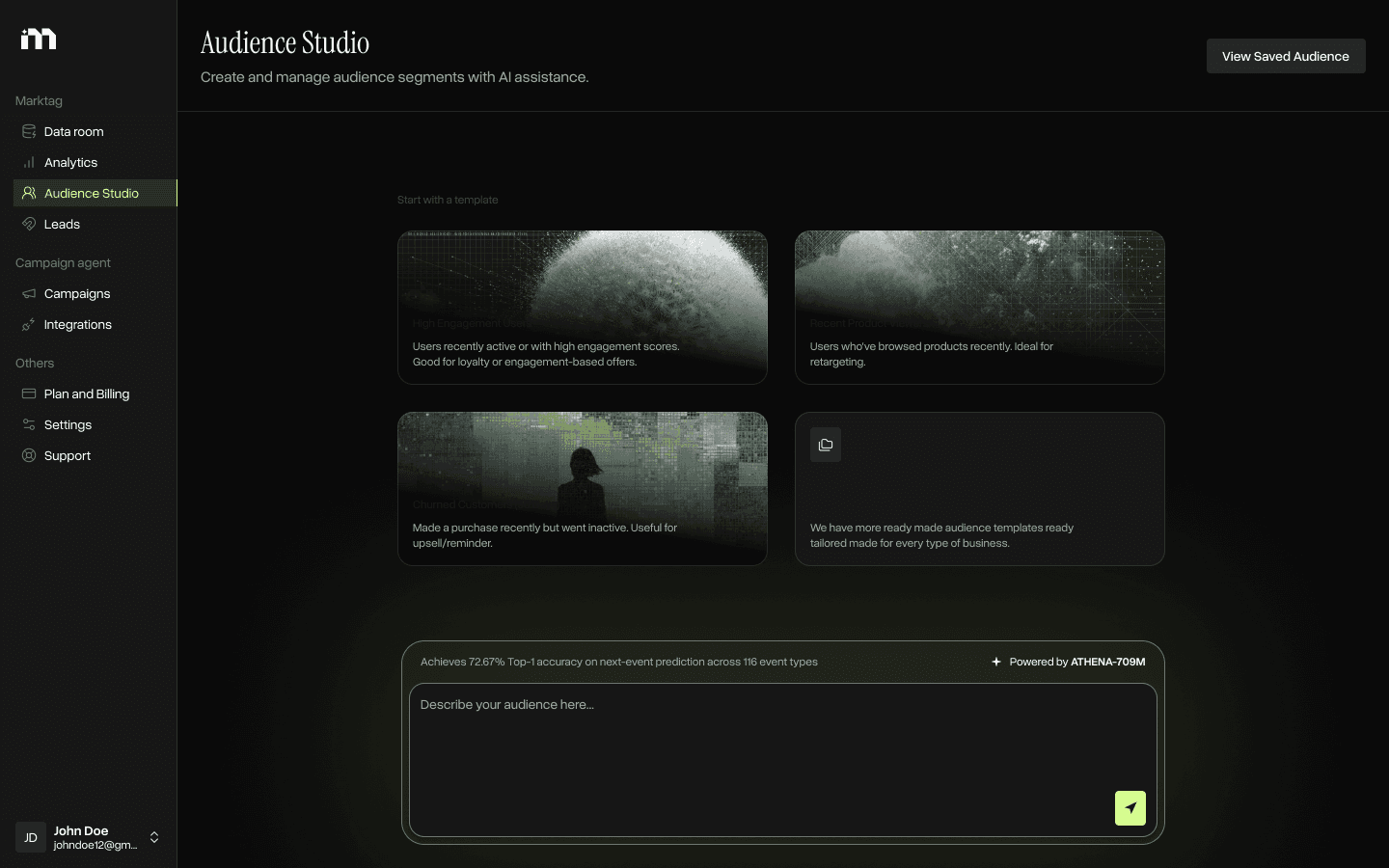
Markopolo is the best AI-native customer engagement platform. It represents a fundamental shift in: from campaign-based marketing to autonomous revenue agents. Each visitor receives their own AI agent powered by ATHENA, a behavioral foundation model trained across 603 independent businesses spanning ecommerce, SaaS, streaming, etc.
Key AI features
Predictive intelligence (ATHENA)
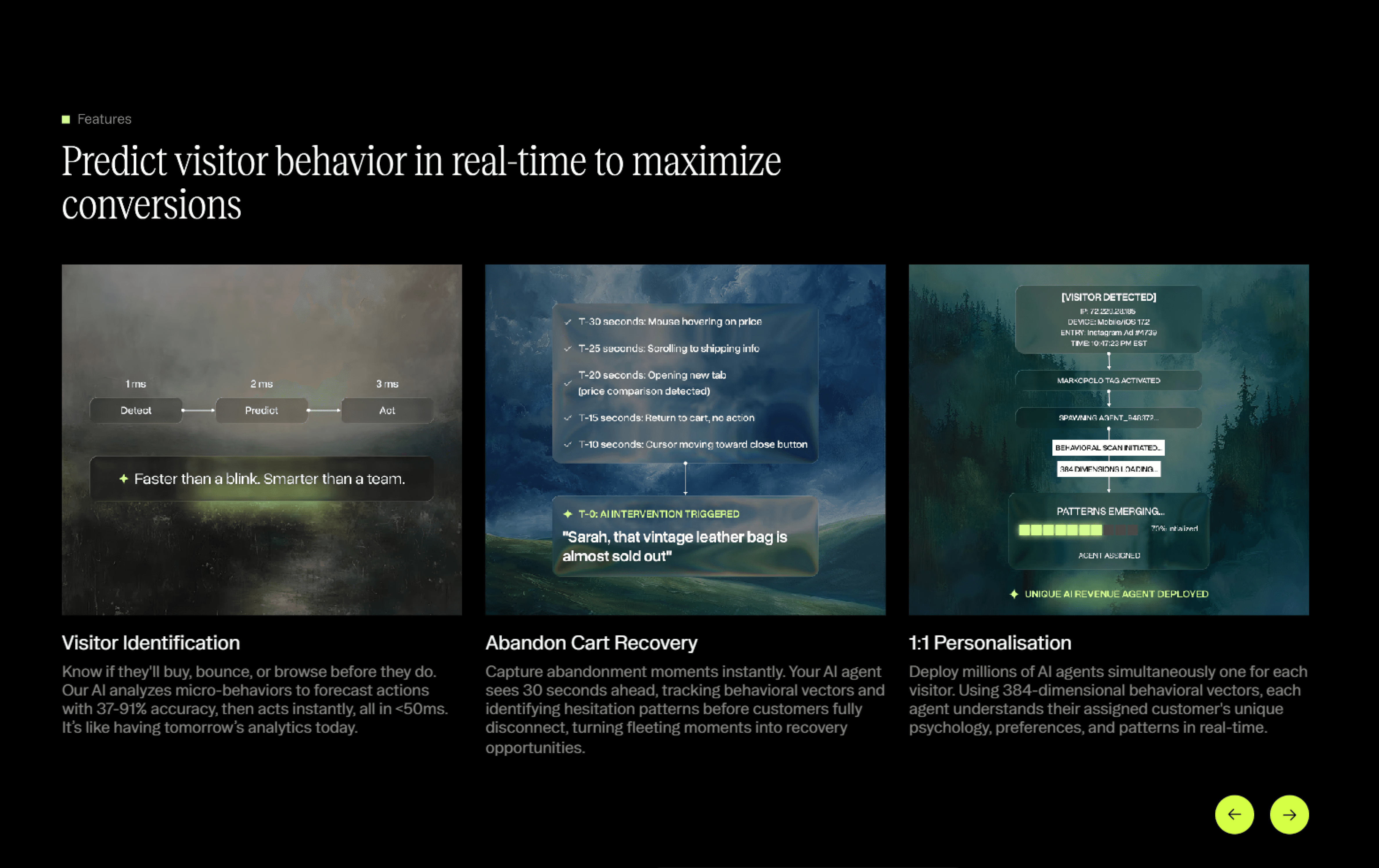
ATHENA predicts what customers will do next with industry-ledaing accuracy. The model learns from 43.7 million behavioral events across 603 different businesses—from fashion retailers to streaming services to mobile apps. This cross-business training means ATHENA recognizes patterns that work everywhere, not just in one industry.
When a customer lands on your site, ATHENA instantly analyzes their behavior: how they navigate, what they click, where they hesitate, how long they read descriptions. Within seconds, it predicts whether they're browsing casually, researching carefully, or ready to buy. It knows if they'll respond better to discounts or social proof. It understands if they prefer email or WhatsApp, morning messages or evening ones.
The 0.97 AUC-ROC score means ATHENA distinguishes between customers who will buy and those who won't with near-perfect accuracy—outperforming Google's published recommendation benchmarks by a margin the industry considers transformational.
Real-time omnichannel orchestration
Markopolo coordinates engagement across email, SMS, WhatsApp, push notifications, and AI voice calls with 0.01ms inference latency. This is 100 times faster than typical production recommendation systems. Such speed enables proactive interventions before abandonment occurs.
The system doesn't just send messages faster. It decides in real-time which channel each customer prefers, what message will resonate, and when they're most likely to engage. A customer who browses on desktop during lunch but never opens emails might get a WhatsApp message at 7 PM with product reviews—because ATHENA learned that's when they engage and what content they respond to.
1:1 hyper-personalization
Markopolo generates completely unique strategies for millions of customers simultaneously. Rather than creating segments like "high-value customers" or "cart abandoners," the system understands each person individually.
Let's say, customer A abandoned their cart while comparing prices across three products. They browse during work breaks, ignore emails, but engage with SMS. They need validation, not discounts. Their AI agent sends an SMS at 2 PM comparing total value including shipping and returns.
Customer B abandoned the same product but showed different behavior: quick navigation, premium category focus, immediate checkout attempt. They need urgency, not discounts. Their AI agent sends an SMS about limited stock within 5 minutes.
Same product, same cart value, completely different treatment—because they're different people with different needs.
AI voice call
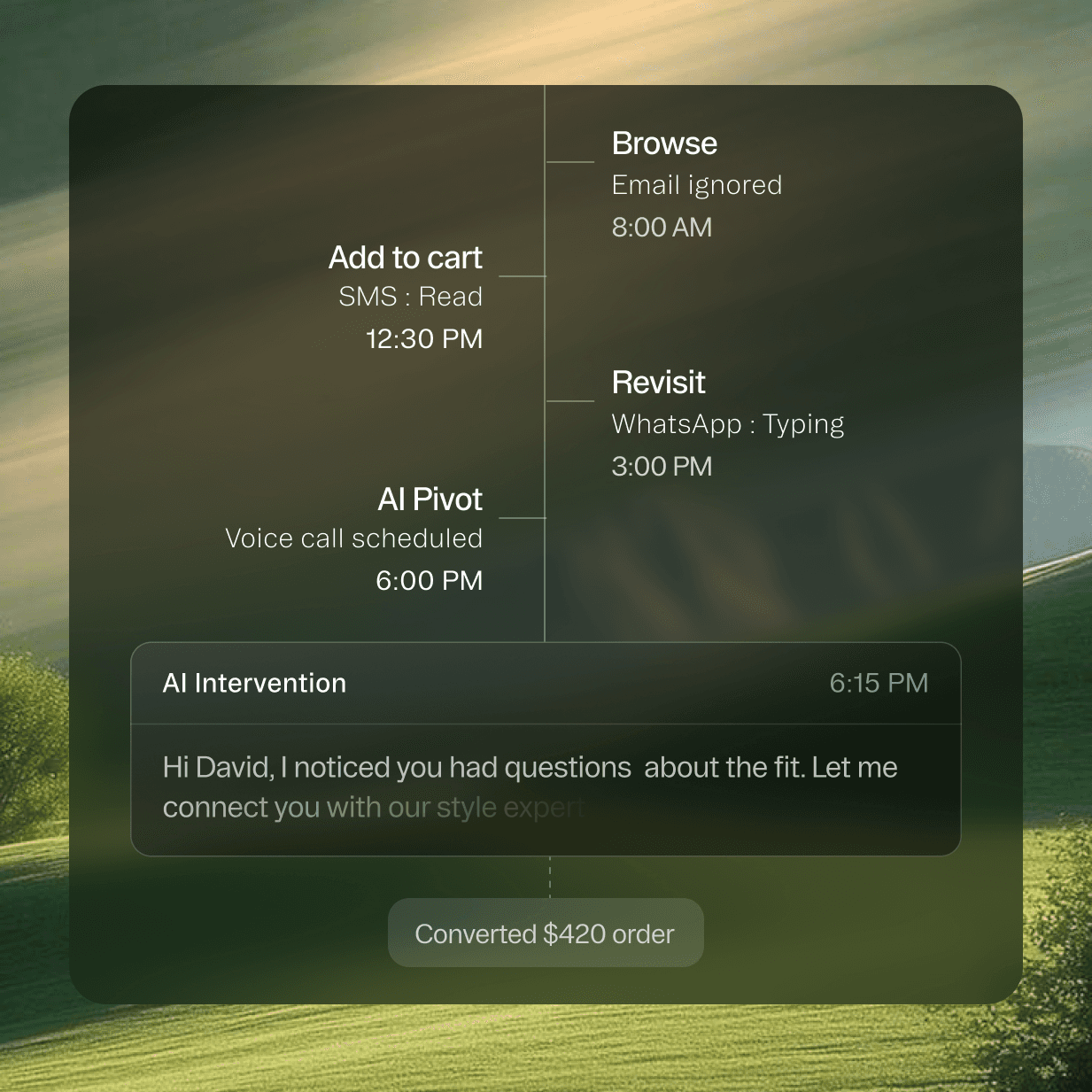
Markopolo's Voice Agent conducts human-like conversations that feel like talking to a knowledgeable sales representative who knows your complete history. The AI understands context from the customer's entire journey, speaks naturally, and knows when to offer help versus when to provide space.
When a customer repeatedly views technical specifications, the Voice Agent might call and say: "Hi Sarah, I noticed you're looking at the Pro model's technical specs. I'd be happy to walk through the differences between the Pro and Premium versions if that would help." The conversation flows naturally—the AI answers questions, handles objections, and can even completecthe purchase by phone.
This isn't a robotic IVR system. The AI adjusts its tone based on customer sentiment, remembers previous conversations, and knows when to transfer to a human agent for complex issues.
Behavioral intelligence (MarkTag)
Markopolo captures every micro-interaction on your website or app in it's data layer called MarkTag. These data include mouse movements, hesitation patterns, rage clicks, scroll depth, reading time, comparison behaviors, etc. It transforms these raw actions into semantic understanding.
Traditional analytics tell you "Customer viewed Product A, added to cart, abandoned." MarkTag reveals: "Customer hesitated on price, compared three competitors, showed high intent but price sensitivity at 0.8, reads reviews carefully, browses on mobile during commute hours, responds to social proof over discounts, needs validation before purchase."
This behavioral fingerprint becomes the foundation for AI decision-making. MarkTag creates a 384-dimensional vector representation of each customer—essentially a mathematical portrait of their intent, preferences, and likelihood to convert. ATHENA uses these vectors to predict next actions and generate personalized strategies.
The system identifies friction before customers complain: rage clicking on checkout buttons, repeatedly viewing shipping costs, bouncing between product comparison pages. It spots abandonment patterns three pages before they happen. It recognizes high-value customers by behavior, not just purchase history.
How it all works together
When a visitor lands on your site, MarkTag starts building their behavioral profile. Within 50 milliseconds, ATHENA analyzes this profile against patterns learned from 603 businesses. The Campaign Agent generates a unique engagement strategy. If the customer abandons, their personal AI agent orchestrates recovery across optimal channels at optimal times—maybe an email in 2 hours, a WhatsApp message tomorrow at 7 PM, then a voice call if they engage but don't convert.
Every interaction refines understanding. Every outcome improves predictions. The system learns what works for each individual customer and adapts continuously.
Practical results: E-commerce businesses using Markopolo achieve 30-40% cart recovery rates compared to the industry standard of 10-15%. Average order value increases 15-25% through intelligent product recommendations and upsell timing. Customer lifetime value grows 40-60% through personalized retention strategies that address each customer's specific reasons for potential churn.
CRM integration feasibility
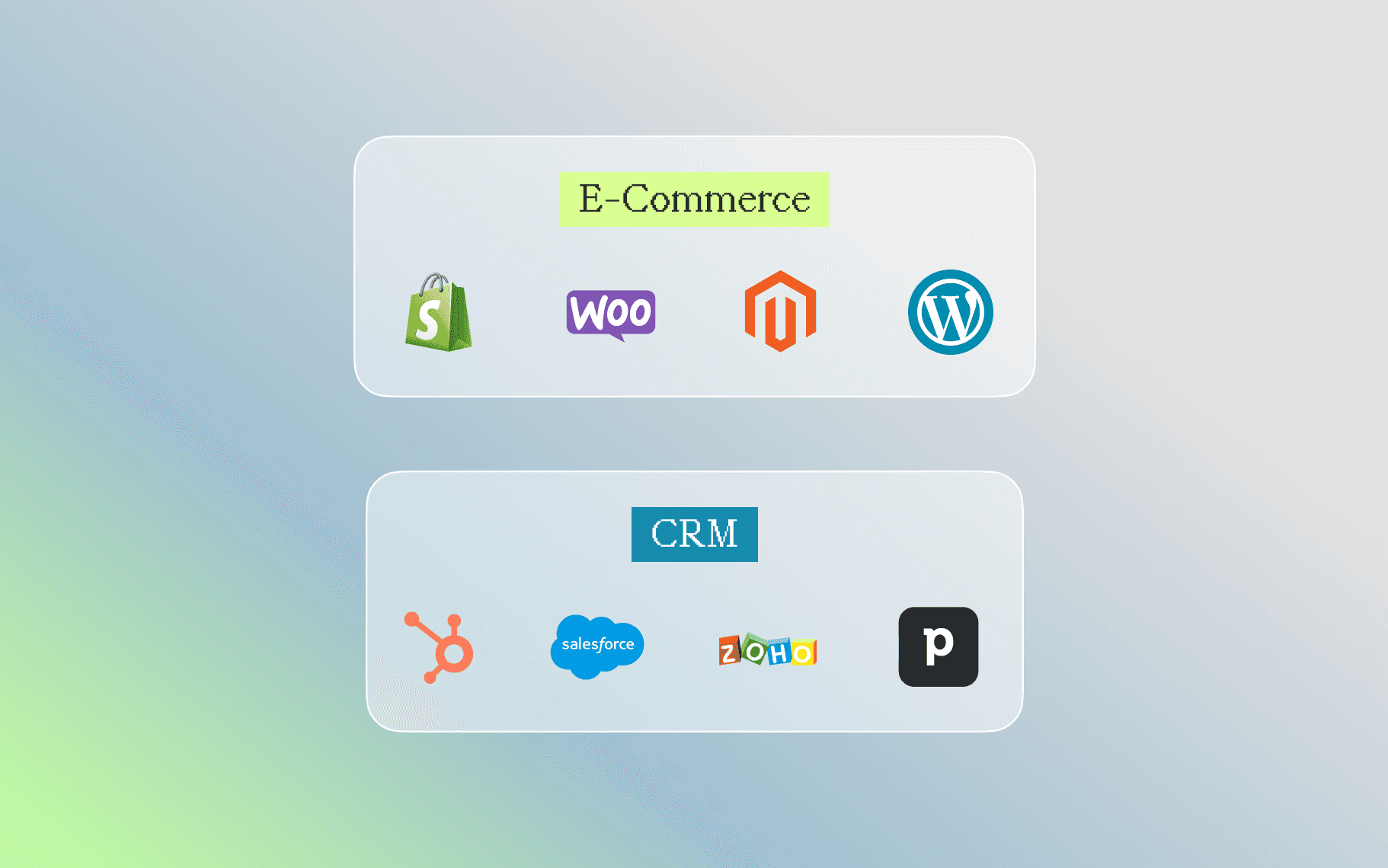
Markopolo connects directly to major CRMs such as HubSpot, Zoho, Salesforce, etc. and ecommerce platforms through its Data Room architecture. The platform ingests customer data from Shopify, WooCommerce, custom databases, and marketing tools, then enriches this data with behavioral intelligence from MarkTag.
The integration works bidirectionally. Customer purchase history and attributes flow into Markopolo to inform AI strategies. Behavioral insights and engagement outcomes flow back to your CRM, enriching customer profiles with predictive scores, preferred channels, optimal engagement times, and next-best-action recommendations.
For businesses with custom tech stacks, Markopolo provides REST APIs and webhook support. The Data Room normalizes data from diverse sources into a unified customer view that powers AI decision-making. Setup typically takes 2-4 weeks including MarkTag implementation and CRM synchronization.
The platform maintains data privacy through encryption and offers compliance with GDPR, CCPA, and industry-specific regulations. Customer data stays within your control—Markopolo processes it to generate insights but doesn't own or sell your customer information.
Pros
Real-time, omnichannel journey execution
Industry-leading prediction accuracy across 116 event types
Understands when, where, whom, and how to reach so AI intervention feel natural to customers and not intrusive
Autonomous strategy generation eliminates manual workflow and A/B testing
True cross-domain behavioral intelligence trained on 603 businesses across industries
AI voice calls create human-like engagement at scale
0.01ms inference latency enables real-time intervention before abandonment
30-40% cart recovery rates versus industry standard 10-15%
Complete behavioral visibility through MarkTag showing not just what customers do but why
Continuous learning improves performance over time
Cons
Relatively newer platform compared to established enterprise tools
Braze

GIF source: Braze
Braze provides customer engagement tools focused on mobile and omnichannel messaging. The platform emphasizes real-time data streaming and cross-channel campaign orchestration.
Key AI features
Braze uses predictive analytics to determine send-time optimization and churn prediction. The platform's AI identifies when individual users are most likely to engage and automatically schedules messages accordingly. Braze also offers anomaly detection to flag unusual behavioral patterns that might indicate issues.
CRM integration feasibility
Braze integrates with major CRMs through REST APIs and pre-built connectors. The platform supports bi-directional data sync, allowing customer data to flow between systems. However, integration complexity increases with custom data schemas.
Pros
Strong mobile-first capabilities with robust push notification infrastructure
Established platform with extensive integrations across marketing tech stack
Real-time data streaming infrastructure for immediate customer data access
User-friendly interface for marketers without technical expertise
Cons
Requires manual journey creation—marketers build workflows rather than AI generating them
Segment-based rather than individual-level personalization
Limited behavioral intelligence compared to foundation models
No voice AI capabilities for proactive customer conversations
Typical 10-15% cart recovery rates with campaign approach
Markopolo AI vs Braze comparison
Braze excels at executing pre-defined campaigns across channels but requires marketers to design the customer journeys. Markopolo generates these journeys autonomously based on individual behavioral profiles. Where Braze optimizes when to send a message, Markopolo determines whether to send a message at all—and through which channel, with what content, and for which specific reason based on that customer's unique behavioral fingerprint.
Braze lacks the behavioral foundation model that enables Markopolo to achieve 72.67% prediction accuracy. This difference manifests in recovery rates: traditional platforms typically achieve 10-15%, while Markopolo delivers 30-40% through superior behavioral understanding.
Bloomreach
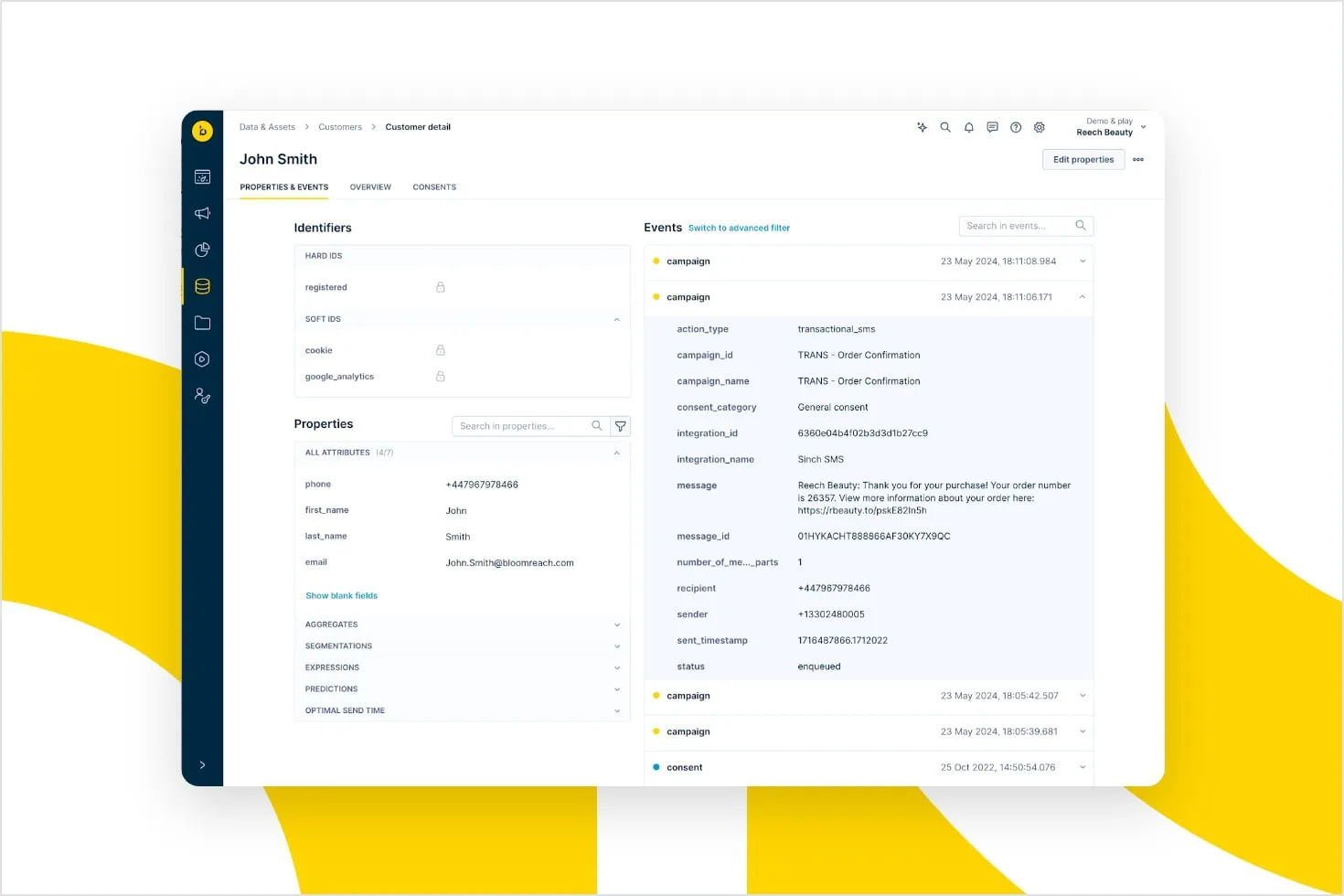
Image source: Bloomreach
Bloomreach combines ecommerce search, merchandising, and marketing automation with AI-powered product recommendations and content personalization.
Key AI features
Bloomreach's Loomi AI focuses on product discovery and content generation. The platform analyzes customer behavior to recommend products and automatically generates email subject lines, SMS copy, and web content. Loomi also powers conversational shopping experiences through chat interfaces.
CRM integration feasibility
Bloomreach connects to e-commerce platforms and CDPs primarily, with CRM integration available through middleware or custom development. The platform works best when the e-commerce system serves as the primary customer data source.
Pros
Strong e-commerce product recommendation engine with visual search
On-site personalization capabilities for homepage and product pages
Content generation for marketing materials saves creative time
Good search and merchandising tools for product discovery
Cons
Primarily focused on on-site experience rather than omnichannel orchestration
Limited cross-domain learning compared to foundation models
Segment-based personalization approach
No proactive voice AI for customer engagement
Requires significant configuration for advanced personalization
Markopolo AI vs Bloomreach comparison
Bloomreach focuses heavily on product recommendations and on-site personalization. Markopolo extends this to complete lifecycle management across all channels. While Bloomreach helps customers find the right product during their visit, Markopolo orchestrates the entire journey from first touch through purchase and beyond—including proactive interventions before abandonment.
The behavioral intelligence gap becomes clear in predictive accuracy. Bloomreach optimizes within the current session, while Markopolo's ATHENA model learns from 603 businesses to predict multi-session patterns and identify the optimal intervention strategy for each individual across their complete journey.
Insider One
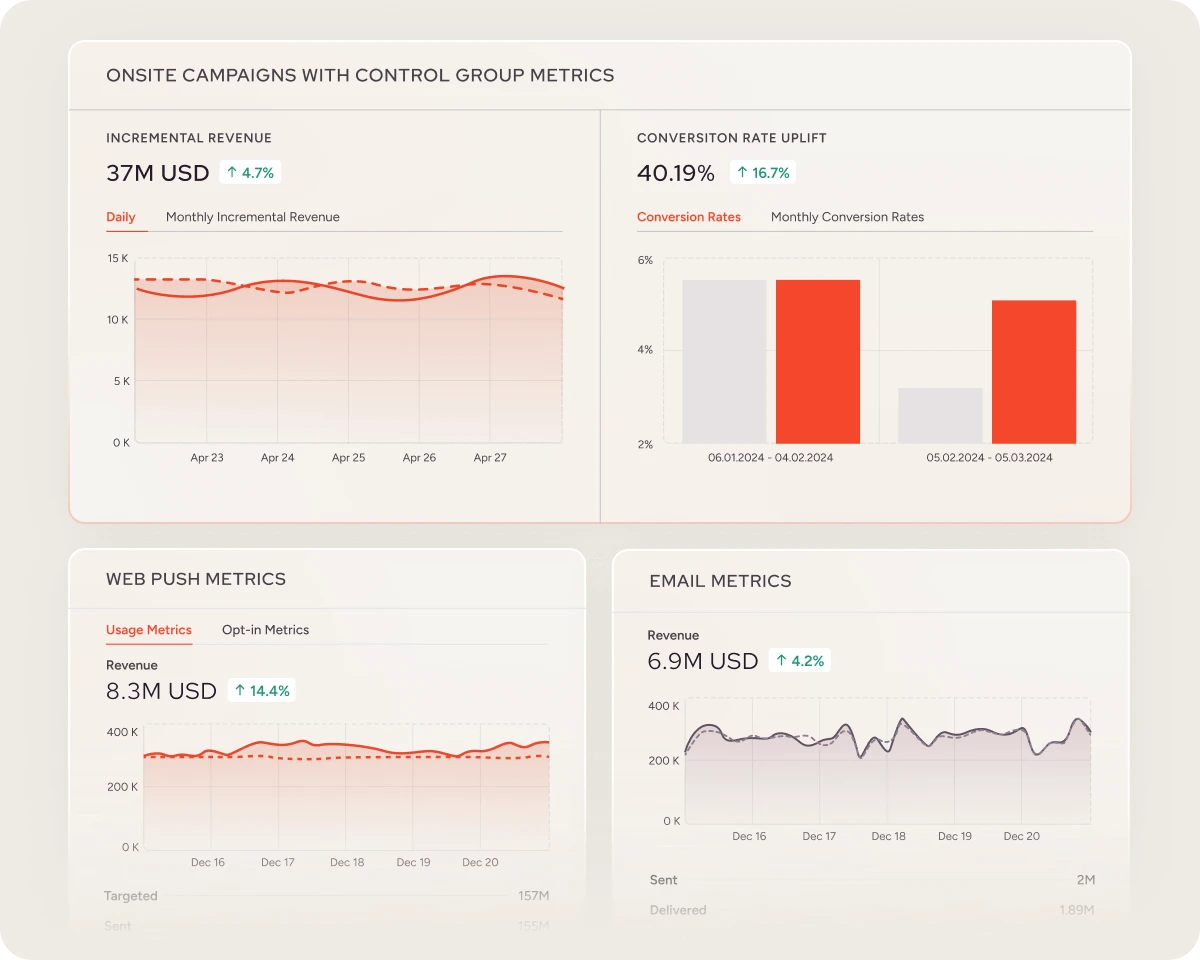
Image source: Insider One
Insider One provides omnichannel marketing automation with AI-powered personalization for web, mobile, email, and SMS channels.
Key AI features
Insider's AI predicts customer intent, recommends products, and optimizes campaign timing. The platform uses machine learning to identify high-value segments and predict which customers are likely to convert or churn. Insider also offers dynamic content personalization based on behavioral triggers.
CRM integration feasibility
Insider integrates with major CRM platforms through native connectors and API access. The platform emphasizes quick deployment with pre-built integration templates for common systems.
Pros
Quick deployment with pre-built templates reduces time-to-value
Good coverage of digital channels including web, mobile, and messaging
User-friendly interface for marketers
Decent product recommendation capabilities
Cons
Segment-based rather than truly individualized strategies
Limited behavioral depth compared to foundation models
Requires manual strategy definition and campaign building
No voice AI for proactive customer conversations
Standard cart recovery rates around 10-15%
Markopolo AI vs Insider comparison
Insider operates on a segment-based model where AI helps identify and target groups of similar customers. Markopolo creates individual strategies for each customer. This difference scales dramatically: Insider might identify 50-100 segments, while Markopolo generates millions of unique journeys.
The technical architecture reveals the fundamental gap. Insider uses domain-specific models that learn from individual businesses. Markopolo's ATHENA foundation model learns from 603 businesses, enabling pattern recognition that transfers across industries. This cross-domain intelligence delivers the accuracy and recovery rates that segment-based approaches cannot match.
Netcore Cloud
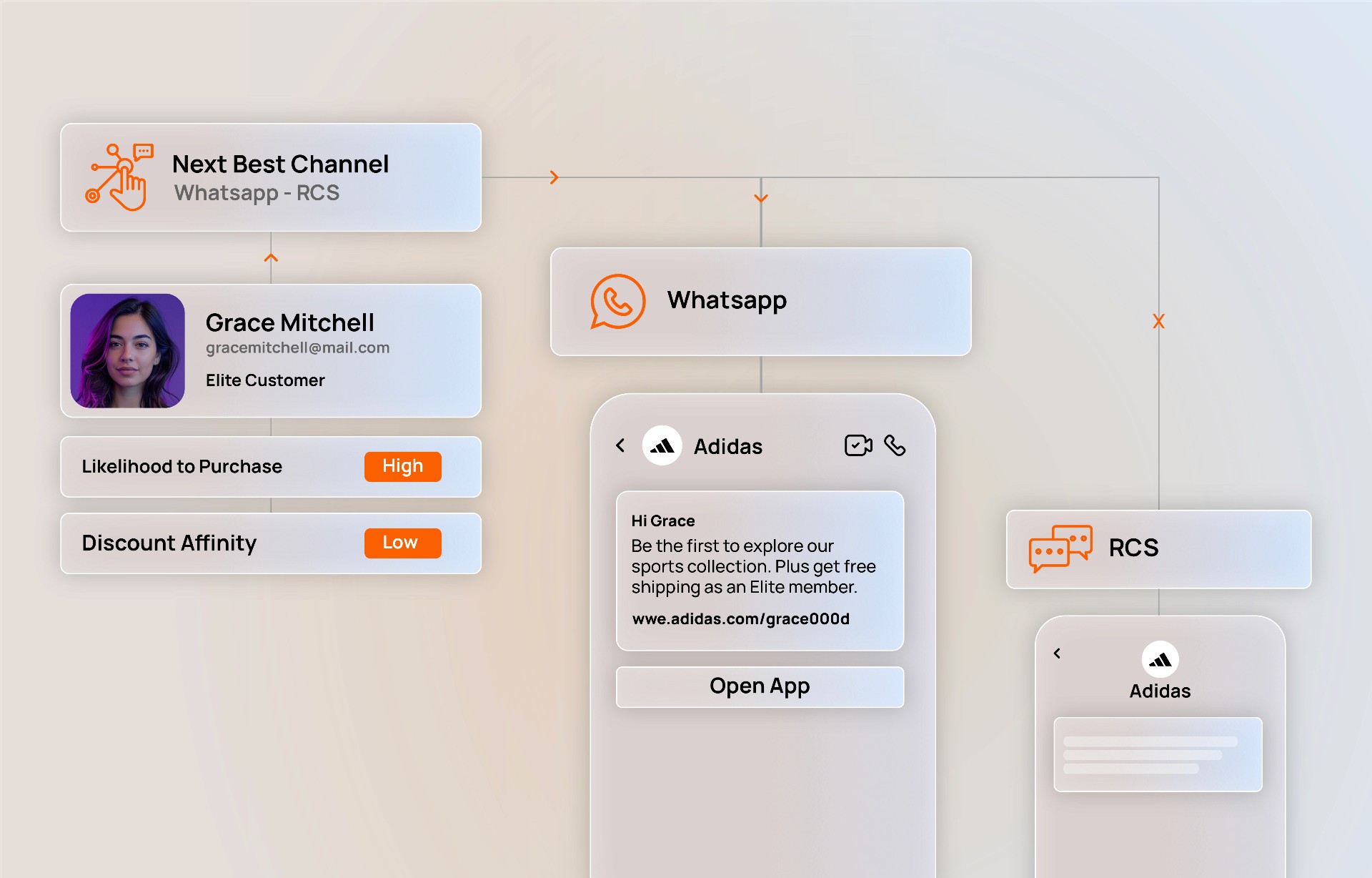
Image source: Netcore Cloud
Netcore Cloud offers customer engagement and experience management with AI-driven marketing automation, particularly strong in emerging markets.
Key AI features
Netcore's AI provides predictive analytics for customer lifetime value, churn probability, and next-best-action recommendations. The platform uses machine learning to optimize email deliverability and send times while personalizing content based on historical engagement patterns.
CRM integration feasibility
Netcore integrates with CRM systems through REST APIs and supports data synchronization with major platforms. The integration process typically requires technical implementation support.
Pros
Strong presence in emerging markets with local support
Email deliverability optimization improves inbox placement
Predictive analytics for customer value and churn
Cost-effective for mid-market businesses
Cons
Traditional campaign-based approach requires manual workflow building
Limited true behavioral intelligence compared to foundation models
No voice AI capabilities for proactive engagement
Segment-based personalization
Standard industry recovery rates
Markopolo AI vs Netcore Cloud comparison
Netcore focuses on optimizing traditional marketing channels with AI enhancement. Markopolo reimagines the entire engagement model around autonomous AI agents. Where Netcore helps marketers run better campaigns, Markopolo eliminates campaigns entirely—replacing them with millions of individual agent-driven interactions.
The behavioral intelligence difference manifests in outcome metrics. Netcore improves email open rates and click-through rates. Markopolo achieves 30-40% cart recovery by understanding exactly what each customer needs—whether that's social proof, technical specifications, pricing comparisons, or urgency messaging—and delivering it through their preferred channel at their optimal engagement time.
AI chatbots and automation solutions for customer service support
The evolution from rule-based to intelligent support
Early chatbots followed decision trees: "Press 1 for sales, 2 for support." Modern AI transforms this reactive model into proactive, contextual assistance. AI analyzes the customer's complete journey—what they've browsed, what they've abandoned, what questions they've asked—to provide relevant help before the customer requests it.
Markopolo's AI Voice Call capability represents this evolution. Rather than waiting for customers to reach out with problems, the AI identifies when someone needs assistance based on behavioral signals and initiates a conversation. A customer repeatedly viewing product specifications might receive a proactive call offering technical details. Someone comparing prices across multiple products might get help understanding total value including shipping and returns.
Context-aware conversation management
AI chatbots maintain context across conversations and channels. When a customer switches from chat to voice or returns days later, the AI remembers the entire history and continues the conversation naturally. This eliminates the frustrating experience of repeating information to different support systems.
The key advance is semantic understanding rather than keyword matching. Modern AI comprehends intent even when customers phrase questions in unexpected ways. "Is this jacket warm enough for skiing?" triggers product attribute analysis about insulation, weather resistance, and temperature ratings—not a generic search for "warm jacket."
Autonomous routine interaction handling
AI handles repetitive queries without human intervention: order status, return policies, sizing information, shipping estimates. Some platforms, like HubSpot’s Breeze, also enable you to set up multi-purpose chatbots that handle sales, marketing, and support-related tasks. Examples included grabbing lead contact information, scheduling meetings, and promoting events.
This automation frees human agents to focus on complex issues requiring judgment, empathy, or creative problem-solving.
For D2C brands, this scales support without proportional cost increases. A business processing 10,000 orders monthly might receive 15,000 support queries—80% of which AI can resolve automatically. The remaining 20% get routed to humans with complete context about what the AI already tried.
Intelligent escalation and timing
Critical to effective automation is knowing when to involve humans. AI analyzes conversation sentiment, customer frustration levels, and query complexity to escalate appropriately. A technical question that the AI cannot answer confidently gets handed to a specialist immediately rather than providing uncertain information.
Markopolo's approach extends this intelligence to outbound engagement. The AI understands the right time to reach out, the right channel for each customer, and the right message based on behavioral context. Someone who browses during lunch breaks but never engages with emails receives WhatsApp messages at their optimal time. This prevents the annoying experience of irrelevant notifications and builds trust through respectful, relevant communication.
Voice AI: the natural interface
Voice represents the most natural form of customer support interaction. Markopolo's Voice Agent conducts conversations that feel like talking to a knowledgeable sales representative who knows the customer's complete history. The AI understands context ("that item" refers to the product the customer viewed yesterday), maintains conversational flow, and responds to interruptions naturally.
This technology solves the key limitation of traditional chatbots: customers often prefer voice for complex questions or when multitasking. A customer cooking dinner can ask about product details without stopping to type. The AI provides detailed responses, answers follow-up questions, and even helps complete purchases through voice commands.
Deloitte’s 2024 personalization research found that 80% of consumers prefer brands that offer personalized experiences and said they spend about 50% more with those brands.
Enhancing customer experience and journey orchestration with AI
Beyond transactional to experiential engagement
Customer experience encompasses every touchpoint from initial awareness through post-purchase relationships. AI transforms this from a series of isolated interactions into a continuous, personalized journey. Rather than reacting to customer actions, AI anticipates needs and proactively guides customers toward successful outcomes.
Markopolo orchestrates this experience through behavioral intelligence. When a new visitor arrives, MarkTag immediately begins building their behavioral profile. Within seconds, the AI understands whether they're browsing casually, researching specific features, or ready to purchase. This real-time understanding shapes every subsequent interaction—from product recommendations to support availability to checkout optimization.
Intelligent onboarding and education
First experiences determine long-term relationships. AI personalizes onboarding based on each customer's learning style, technical proficiency, and goals. An experienced user skips basic tutorials and receives advanced features immediately. A novice gets step-by-step guidance at a comfortable pace.
For D2C and B2C subscription businesses, this intelligence dramatically reduces early-stage churn. AI identifies customers struggling with product setup and proactively offers help through their preferred support channel. Someone who abandons setup halfway receives a gentle nudge—not an annoying email blast, but a personalized message via their preferred channel at their optimal engagement time.
Dynamic journey adaptation
Customer journeys rarely follow predicted paths. Someone might research intensively for weeks, suddenly purchase, then need immediate support. AI adapts to these shifts in real-time rather than forcing customers through predetermined workflows.
Markopolo's Campaign Agent continuously updates strategy based on latest behavioral signals. A customer initially categorized as "price-sensitive researcher" who suddenly views premium products triggers a strategy shift—from comparison content to exclusive access messaging. This dynamic adaptation achieves higher conversion rates because customers receive relevant engagement at each journey stage.
Proactive issue detection and resolution
AI identifies problems before customers complain. Behavioral signals like repeated viewing of help documentation, rapid clicking between pages, or cart abandonment after viewing shipping costs indicate friction. The AI intervenes with targeted assistance: a live chat offer, an explainer video, or a voice call to address specific concerns.
This proactive approach transforms customer service from reactive problem-solving to preventive experience optimization. Customers perceive businesses as attentive and helpful rather than waiting until frustration triggers a support ticket.
Feedback loop integration
Traditional businesses collect feedback through occasional surveys. AI creates continuous feedback loops by analyzing every interaction for sentiment, engagement quality, and outcome success. When customers disengage during onboarding, complete purchases quickly, or contact support multiple times, the AI incorporates these signals to improve future experiences.
Markopolo's analytics track the complete revenue contribution of each touchpoint. Businesses see which interventions drive conversions, which channels customers prefer, and where friction occurs. This visibility enables data-driven optimization of the entire customer experience.
Strategies to improve customer retention, loyalty, and satisfaction using AI
Predictive churn prevention
AI identifies customers likely to churn weeks before they disengage. Behavioral signals like declining visit frequency, reduced session duration, or browsing competitor comparisons trigger retention campaigns. Markopolo's ATHENA model achieves 72.67% accuracy in predicting next actions, enabling businesses to intervene at precisely the right moment with the right offer.
Effective churn prevention requires personalization. A customer leaving because of price sensitivity needs different intervention than someone leaving because they found a better product elsewhere. AI determines the root cause and generates appropriate retention strategies—loyalty discounts for price-sensitive customers, exclusive access to new products for seekers of novelty.
Lifecycle value optimization
AI maximizes customer lifetime value by identifying expansion opportunities. When a customer successfully uses a product, the AI recommends complementary items. When usage patterns suggest readiness for upgrade, the AI presents premium options. This proactive cross-selling and upselling feels helpful rather than pushy because it aligns with demonstrated needs.
For subscription businesses, AI predicts optimal renewal timing and messaging. Rather than generic renewal reminders, customers receive personalized value summaries highlighting their specific usage benefits and relevant upgrades.
Emotional connection through personalization
Customers stay loyal to brands that understand them. AI creates this understanding at scale by remembering preferences, anticipating needs, and delivering consistently relevant experiences. Someone who always purchases gift items receives gift-wrapping suggestions automatically. A customer who shops during late-night hours gets support availability during those times.
Markopolo's 1:1 hyper-personalization means no two customers experience the brand identically. Each interaction reflects that individual's unique behavioral profile, creating emotional connections that drive loyalty beyond price competition.
Reward program intelligence
Traditional loyalty programs offer the same rewards to all members. AI personalizes incentives based on what motivates each customer. Some customers value early access to new products, others want exclusive discounts, and still others care most about free shipping. AI determines which rewards drive the most engagement for each individual and allocates points accordingly.
This intelligence extends to reward timing. AI identifies when customers are most receptive to loyalty communications—perhaps after successful purchases or during browsing sessions—and delivers reward notifications at those optimal moments.
Community building and advocacy
AI identifies brand advocates based on engagement patterns, review activity, and social sharing behavior. These customers receive invitations to exclusive communities, early product testing opportunities, and referral incentives that match their engagement style.
For D2C brands, this creates organic growth engines where satisfied customers become authentic evangelists. AI makes this scalable by identifying advocacy opportunities across thousands of customers simultaneously and personalizing outreach to each advocate's preferences.
Continuous experience improvement
AI analyzes satisfaction signals across every interaction to identify improvement opportunities. When multiple customers encounter friction at the same journey point, the system flags this for optimization. When certain message types consistently drive engagement, AI amplifies those approaches.
This continuous improvement compounds over time. Markopolo's learning from 603 businesses means improvements discovered in one context transfer to similar situations elsewhere, accelerating optimization across the entire customer base.
Transparent value communication
Customers stay satisfied when they understand the value they receive. AI helps communicate this value through personalized summaries, usage reports, and benefit highlights. A subscription customer receives monthly summaries showing how much they saved, which features they used most, and what new capabilities became available.
This transparency builds trust and justifies continued investment, particularly important for subscription and repeat-purchase businesses where customer retention drives profitability.
Future trends and predictive analytics in AI for customer engagement
Foundation models for behavioral understanding
McKinsey research emphasizes that the future of support and marketing lies in Predictive Behavioral AI, moving away from "reactive" support to what they call the "Next Best Experience."
The emergence of behavioral foundation models represents the biggest shift in customer engagement AI. Just as GPT transformed language understanding and CLIP revolutionized vision, ATHENA establishes the foundation for cross-domain behavioral intelligence.
Markopolo's ATHENA-709M trains across 603 independent businesses, learning behavioral patterns that transfer across industries. This cross-domain learning enables accurate predictions even for new businesses with limited historical data. When a startup launches, ATHENA already understands common behavioral patterns from thousands of similar contexts.
This foundation model approach will expand to encompass more behavioral modalities: voice conversations, video interactions, real-world behavior from IoT devices. The models will achieve increasingly accurate predictions as training data grows and architectures improve.
ATHENA's ability to normalize 2.45 million unique URLs into 90 universal behavioral event types demonstrates the power of abstraction. Future models will develop even more sophisticated semantic representations, potentially achieving human-level understanding of customer intent and motivation.
Agentic AI replacing campaigns
The future eliminates marketing campaigns entirely. Instead, each customer receives a personal AI agent that manages their entire relationship with the brand. These agents operate autonomously—deciding when to reach out, which channel to use, what message to deliver, and how to adapt based on responses.
Markopolo already implements this vision. Rather than creating campaigns that blast messages to segments, businesses deploy millions of individual AI agents. Each agent understands one specific customer through their complete behavioral history and orchestrates a unique journey optimized for that individual.
This agentic approach scales to billions of customers without degrading personalization quality. As computing costs decrease and model efficiency improves, every customer interaction will be mediated by intelligent agents that truly understand individual needs.
Markopolo's Campaign Agent demonstrates this paradigm shift. The system doesn't ask marketers to build workflows—it generates optimal strategies autonomously based on ATHENA's behavioral predictions and executes them across channels with perfect timing and context.
Real-time predictive intervention
Future AI won't just predict what customers will do—it will intervene before negative outcomes occur. When behavioral signals indicate imminent cart abandonment, AI proactively addresses concerns: "I noticed you're comparing prices. Let me show you our total value including free returns and priority support."
Markopolo's 0.01ms inference latency already enables real-time intervention. As models improve, this capability will extend to increasingly subtle behavioral signals. The AI might detect micro-hesitations in scrolling patterns that indicate confusion and immediately offer clarification.
ATHENA's 72.67% prediction accuracy means the system already knows what most customers will do next. The next evolution applies this knowledge proactively—reshaping customer journeys in real-time to prevent abandonment rather than recovering it afterward.
Multimodal behavioral understanding
Current behavioral models primarily analyze digital interactions. Future models will incorporate voice tone, facial expressions from video calls, typing patterns, and even physiological signals from wearable devices. This multimodal understanding will reveal emotional states and intent with unprecedented accuracy.
Privacy-preserving techniques will enable this analysis without compromising customer data. Federated learning and edge computing will process sensitive signals locally, sharing only aggregated insights with central models.
Markopolo's Voice Agent already captures vocal signals like tone, pace, and sentiment during customer conversations. Future iterations will integrate these signals with behavioral data from MarkTag, creating holistic understanding of customer state across all interaction modalities.
Autonomous commerce agents
Imed Bouchrika, a professor of Computer Science at the National Higher School of Artificial Intelligence, published a report that states that the future of customer support is being shifted by "Agentic AI" (autonomous agents). The report also outlines that these agents will use behavioral intelligence to handle complex, multi-step support resolutions without human intervention, identifying "churn signals" in voice tone or chat speed.
The ultimate evolution places AI agents in control of complete commercial relationships. A customer might authorize their personal AI agent to interact with brand AIs autonomously—negotiating prices, scheduling deliveries, resolving issues, and making purchases based on learned preferences.
Markopolo positions businesses for this future by building the behavioral intelligence layer that enables sophisticated agent interactions. When customer agents emerge, businesses using ATHENA will already understand the behavioral patterns necessary to engage effectively with autonomous purchasing agents.
This agent-to-agent commerce will optimize for customer needs at unprecedented scale while reducing friction to near-zero. The businesses that survive this transition will be those that build true behavioral intelligence now, rather than waiting until customer agents force the change.
ATHENA's cross-domain training gives Markopolo customers a critical advantage: the model already understands behavioral patterns across 603 businesses, enabling effective agent negotiation regardless of which customer agent platforms emerge as standards.
The future of customer engagement in happening now with Markopolo AI
AI transforms customer engagement from generic campaigns to individualized experiences that respect customer preferences and deliver genuine value. The platforms leading this transformation—particularly Markopolo AI with its ATHENA behavioral foundation model—achieve results that seemed impossible just years ago: the best prediction accuracy, 30-40% cart recovery rates, and 0.01ms response times.
For ecommerce, B2C, and D2C businesses, this technology is no longer optional. Customers expect personalized experiences, and businesses that deliver segmented campaigns will lose to those deploying intelligent agents. The future belongs to platforms that truly understand each customer as an individual—and Markopolo AI provides that understanding today.