A comprehensive guide to ecommerce email marketing: strategy, campaigns, automation, and growth
The birth of modern ecommerce email marketing can be traced back to the mid-1990s. Commercialization of the internet played a key role in driving this wave.
Nascent online stores started to send targeted newsletters, autoresponders, and promotional campaigns to their target audiences using free web-based email services like Hotmail (1996) and early email service providers (ESPs) such as Constant Contact (1995).
More than thirty years later, this marketing channel has evolved so much worldwide that navigating its many approaches may seem difficult for an ecommerce solopreneur or an established d2c brand. With all these important aspects in mind, our guide is designed to help you learn it better with actionable insights that your store can benefit from.
What is ecommerce email marketing (and why it's different from regular email marketing)
Email marketing in ecommerce is about online retailers sending targeted email campaigns to prospects and customers. Through this channel, brands can showcase products, build relationships, and drive sales for their online store.
Such as:
<product_viewed>
<cart_abandoned>
<purchase_completed>, etc.
So, this behavioral foundation makes email marketing different for ecommerce businesses. You can personalize every email based on the individual’s journey. The trigger, the timing, the content — all of it flows from transactional context and not a broadcast calendar.
How email marketing helps ecommerce brands grow
Recovers lost revenue
According to Results First, over 90% of online shoppers who leave your website without buying do not come back. But a well-timed abandoned cart email changes that. Cart recovery emails generate some of the highest revenue-per-recipient of any marketing channel, often 5 to 10 times more than a standard promotional send. That's because it arrives at the exact moment the buyer's intent is still warm, with the exact product they almost purchased.
Compounds intelligence over time
Every email you send teaches you something. Open rates tell you which subject lines resonate. Click patterns reveal which products a segment gravitates toward. And purchase history tells you when someone is due for a reorder. Over months, this data builds a progressively sharper picture of each customer. This means you can generate more relevant emails, which leads to higher conversion rates. Unlike paid ads that reset every time you stop spending, email knowledge compounds.
Increases customer loyalty
Retaining an existing customer is easier than acquiring a new one. Yet, most ecommerce brands invest almost nothing in post-purchase email. A simple sequence, like: a shipping confirmation → a usage tip with a review request → a reorder reminder; altogether keeps your brand present between purchases without feeling intrusive. Customers who buy twice are significantly more likely to buy a third time. This is why email is often the quietest and cheapest method for making that second purchase happen.
5. Optimizes campaigns based on funnel stage
Many marketers treat email as a closing tool. But it earns its keep much earlier too. Welcome sequences introduce new subscribers to your brand story before they're ready to buy. Educational content, on the other hand, builds trust with people still in research mode. And re-engagement campaigns rekindle interest from subscribers who've gone cold. Since you can segment and sequence your emails, you can easily meet buyers wherever they are in the conversion funnel. Be it at awareness, consideration, or decision, you can target them with different messages at different times.
6. Strengthens unified and omnichannel strategy
Email performs best when combined with SMS and other channels. D2C brands that are growing fastest treat it that way. When email is connected to the same behavioral data driving your SMS and WhatsApp touchpoints, every channel becomes aware of what the others have already said. A customer who opens your abandoned cart email but doesn't buy shouldn't receive the same message again via SMS. Instead, they should receive something that acknowledges where they are in the decision. That kind of coordinated, context-aware outreach feels less like marketing and more like a helpful nudge from a brand that actually pays attention.
Fundamentals of ecommerce email campaigns
Knowing the different types of ecommerce email campaigns separates a revenue-generating program from a cluttered inbox. The types of email campaigns for ecommerce fall into four clear categories:
Acquisition
Recovery
Retention
Promotional
Each plays a specific role in the customer lifecycle. Let’s learn about them in detail.
Acquisition emails
Before a customer ever buys, they need a reason to trust you. Acquisition emails do that work quietly and patiently. For ecommerce and D2C brands, these are the emails that turn a curious subscriber into a confident first-time buyer, often before a single discount is needed.
Welcome series

The best welcome emails do not try to do too much. A first-order discount, a clear pointer to bestsellers, and a warm handoff to your social community are more than most brands manage in their first three emails combined. That sequence introduces who you are and lowers the barrier to a first purchase. It also starts a relationship before the subscriber has ever spent a penny. With Markopolo AI, you can automatically launch this sequence by tailoring each email to a subscriber’s first on-site sessions, so the first impression truly matches their context.
Lead nurture

Some subscribers are not ready to buy. They may take a quiz, or download a guide, and browse twice without converting. Now they are sitting in your list just waiting to be convinced.
A good lead nurture email meets them at that exact stage. It presents a relevant recommendation by walking them through a clear next step, and points them toward content that builds confidence rather than pushing for a close. The quiet truth about this type of email is that it works best when it does not feel like marketing at all. The best AI email marketing tools track behavioral signals over multiple sessions to find subscribers still in research mode and deliver nurture content that matches their real decision pace.
Recovery emails
Every ecommerce store loses revenue daily to visitors who almost converted but did not. Recovery emails exist for exactly that gap. For online retail brands, they are often the highest-ROI emails in the entire program because the buying intent is already there. The job is simply to remove whatever got in the way.
Abandoned cart

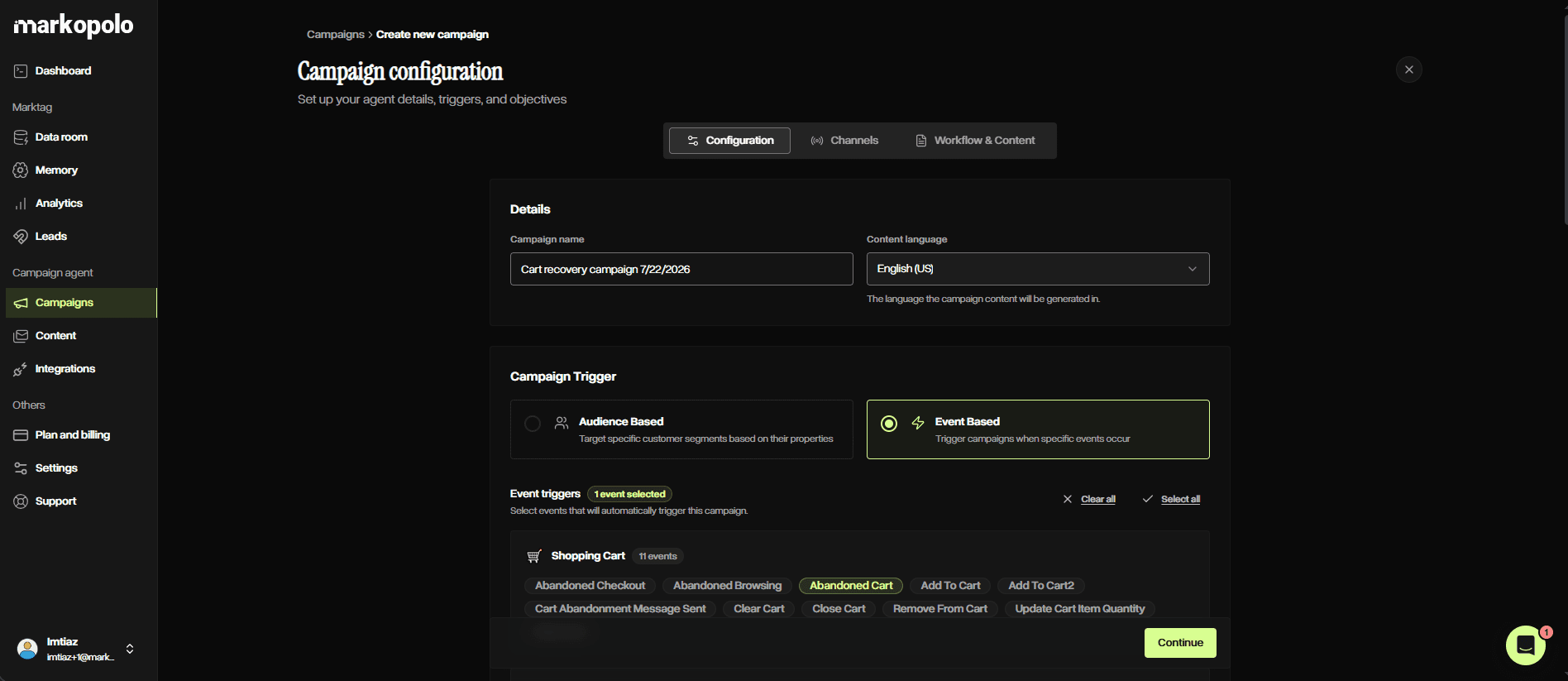
Did you ever notice something about a well-executed cart recovery email? It does not panic nor lead with a discount or open with three exclamation marks. It simply says, here are the things you left behind, they are still here, and here is why they are worth coming back for. That level of specificity, showing the exact items with a copy that matches what the buyer was already feeling, is what moves someone from "I'll do it later" to "I'll do it now." Ecommerce brands using Markopolo AI utilizes this unique recovery approach for each abandoner based on their behavioral profile.
Someone who spent time reading reviews gets a different message than someone who bounced quickly after checking the price. The intervention fits the person, not just the event.
Browse abandonment

Consider this: a visitor spent time on your site by comparing products and scrolling through category pages. That person even hovered on a few things that caught their interest. Then they left without adding anything to a cart. That is the research mode, and it is one of the most recoverable moments in the entire buyer journey.
The browse abandonment email works when it reflects what the person was actually looking at, framed around the benefit they seemed to be seeking rather than just the product name. AI-native email marketing solutions such as Markopolo AI can capture micro-behavioral signals as visitors browse, including dwell time, comparison patterns, and scroll behavior. It uses that data to build an email that speaks to what the visitor was genuinely drawn to rather than what they happened to click on.
Back-in-stock

Few emails convert as reliably as a well-timed back-in-stock alert. The subscriber already wanted the product. They were ready to buy, the inventory just was not there. When it comes back, the only job is to reach them fast, remind them what they missed, and give them a reason not to hesitate again. Social proof helps here, such as: over 1,500 five-star reviews and a "limited supply available" note do real work.
You need to track the original intent signal from when the visitor first showed interest. So when stock is restored, it triggers the alert to exactly the right people.
Retention emails
Winning a customer once is hard. Keeping them costs a fraction of that effort. For d2c and ecommerce brands, retention emails are where long-term revenue is quietly built. They show up after the purchase, between purchases, and when a customer has gone silent, doing the relational work that keeps a brand worth coming back to.
Post-purchase

The moment right after a purchase is one of the most underused windows in ecommerce email. The buyer is engaged, satisfied, and receptive, and yet most brands send nothing more than a shipping confirmation. A genuinely useful post-purchase email does more. It confirms the order is on the way and even add practical tips for getting the most out of the product. You can also set triggers to surface complementary items in a way that feels like helpful advice rather than an upsell. Think care instructions, usage tips, and a soft introduction to what else fits naturally with what was just bought.
Make sure your email marketing platform can context automatically from what was purchased and what the brand knows about that product category, and generate follow-up content that earns trust rather than spending it.
Cross-sell

The logic behind a great cross-sell email is simple. Someone already trusts you enough to buy. Now show them what completes the picture. Just look at the example above, a lipstick that pairs with a foundation they own. A setting mist and a blending brush that turn a single product into a full routine. Cross-sells that convert are the ones whose recommendation feels chosen, not generated. This is why you need to analyze browsing behavior across sessions to understand what a customer gravitates toward beyond what they have already bought.
Loyalty

A customer who has bought from you five times is not the same as one who bought once. They deserve to know you have noticed. A loyalty email that acknowledges a purchase milestone, updates the subscriber on their points balance, and invites them to refer to a friend works because it reflects a real relationship, not just a transaction. The tone matters as much as the offer. So, set triggers for loyalty touchpoints based on behavioral milestones rather than arbitrary time intervals. The email would arrive at a moment that actually feels meaningful, like right after a repeat purchase, and/or when sentiment toward the brand is at its highest.
Win-back

At some point, a customer who once bought regularly simply stops. No complaint, no unsubscribe, just silence. The win-back email is for exactly this person, and it works best when it is honest about the gap rather than pretending it did not happen.
"We miss your style" lands harder than another generic promo. Pair that acknowledgement with a curated selection based on what they previously showed interest in, add a time-limited exclusive offer, and you have the structure of a win-back that actually brings people back. Markopolo detects behavioral drift long before a customer fully churns, identifying when engagement is slowing, and triggers the win-back sequence at the point when recovery is still realistic rather than after the window has closed.
Promotional emails
Promotional emails are how ecommerce brands generate short-term revenue spikes, clear inventory, and introduce new products to their most engaged audience. When done well, they feel like insider access rather than a broadcast. When done poorly, they train subscribers to wait for discounts. The difference usually comes down to personalization and timing.
Seasonal

Winter coats at $98, $120, and $165, each shown on a real person in a snowy setting, with the original price crossed out and a single CTA to shop the collection. That kind of seasonal email works because everything in it points in the same direction. The creative, the copy, the pricing, and the urgency all serve the same moment.
What lifts it further is relevance. Sending a seasonal email to your full list is fine. But sending it with products selected specifically for each subscriber's purchase history and browsing behavior is what turns a campaign into actual revenue. You need to handle that personalization layer with AI based solutions. It can surface the seasonal items each individual is most likely to convert on rather than defaulting to the same bestsellers for everyone.
Flash sales

A countdown timer showing exactly how much time is left for a huge discount to go off is what creates FOMO (fear of missing out). It’s a great marketing tactic, and you should definitely try this with your customers when the moment is right.
Flash sale emails live or die on urgency, and urgency only works when it is delivered at the right moment. A pro tip for you is to send flash sale emails based on each subscriber's individual engagement patterns. Schedule the sends at the specific times they have historically opened, clicked, and purchased. That way, the countdown clock starts running when it has the most impact for that person, not when it was most convenient for you to hit send.
Product launches

Launch emails do not need to say much. One strong hero image, a product name, two or three key features called out clearly, and a single button. "Discover the new look."
The restraint is the point: when the product is genuinely new and genuinely good, the email's job is to get out of the way and let the product speak. So, you need to add precision in the audience. Rather than sending the launch to the full list, identify the subscribers who have browsed adjacent categories. Many ecommerce email marketing platforms such as Markopolo AI analyzes if the customer has shown interest in similar products, or purchased in that space before. Then, these platforms reach out to them while the framing still carries weight.
How to build an ecommerce email marketing strategy from scratch
Building a real email program means deciding what you want it to accomplish, who it should reach, and how it should behave at every stage of the customer lifecycle. You need to make these decisions before you even write a single subject line. The problem is that most ecommerce brands start with a tool and hope the strategy follows, but it rarely does. So, we’re here to help you map out the best strategies instead.
Set goals that tie to revenue
Open rates and click rates are useful signals, but they are not the point. A strategy built around vanity metrics optimizes for attention; a strategy built around revenue optimizes for outcomes. Set goals at the SKU level: which products need to move this quarter, which categories are underperforming, which customer segments have the highest reorder potential. When your targets are that specific, every campaign has a clear job, and you can tell whether it did that job or not. Markopolo's analytics layer tracks revenue contribution across every touchpoint, so you always know which email actually drove the purchase, not just which one got the click.
Build and segment your email list
A large list that is poorly segmented is often worse than a small list that is not. Irrelevant emails train subscribers to ignore you, and enough of them will damage your sender reputation before you notice the problem. Build your list with intent: use sign-up incentives that attract buyers, not just browsers, and capture behavioral data from day one. Markopolo's Audience Studio lets you create dynamic cohorts from real-time behavioral data, so your segments stay current without manual updates every time a subscriber's behavior changes.
Map email flows to the customer lifecycle
Every subscriber is somewhere on a journey from stranger to loyal buyer, and the right email depends entirely on where that person currently sits. A new subscriber needs a welcome sequence. A repeat visitor who has not converted needs nurturing. A recent buyer needs a post-purchase touchpoint. Someone who has not opened in 90 days needs a win-back. Mapping your flows to these stages first, before deciding on content or cadence, keeps your program from becoming a collection of disconnected campaigns and turns it into something that actually follows the customer.
Personalize content, offers, and send cadence
Personalization in ecommerce email is not about using someone's first name. It is about showing the right product, making the right offer, and sending at the right time, all based on what that specific person has actually done. Someone who browses premium categories does not need a discount; someone who has compared prices three times probably does. Markopolo builds individual behavioral profiles for every subscriber, tracking not just what they bought but how they shop, so the content, offer, and timing of each email can be calibrated to the person rather than the segment.
Test, optimize, and document your playbook with AI
Testing without documentation is just experimentation. The goal is to build a playbook: a record of what worked, for which segment, at which stage of the journey, so every insight compounds over time rather than disappearing after the campaign ends. Run structured A/B tests on subject lines, send times, offer types, and content formats. Then capture what you learn. Markopolo's AI continuously optimizes across these variables and surfaces performance patterns across campaigns, turning individual test results into strategic intelligence that makes the next campaign smarter than the last.
Tips on email marketing automation for ecommerce
Automation is where email marketing either earns its keep or becomes noise. The difference between a program that generates consistent revenue and one that subscribers tune out comes down to five things: behavioral targeting, automated triggers, conditional logic, timing, and multi-step workflows. Add autonomous AI to that mix and the whole system starts to operate with a level of precision that manual campaign building cannot match.
1:1 hyper-personalize the welcome series
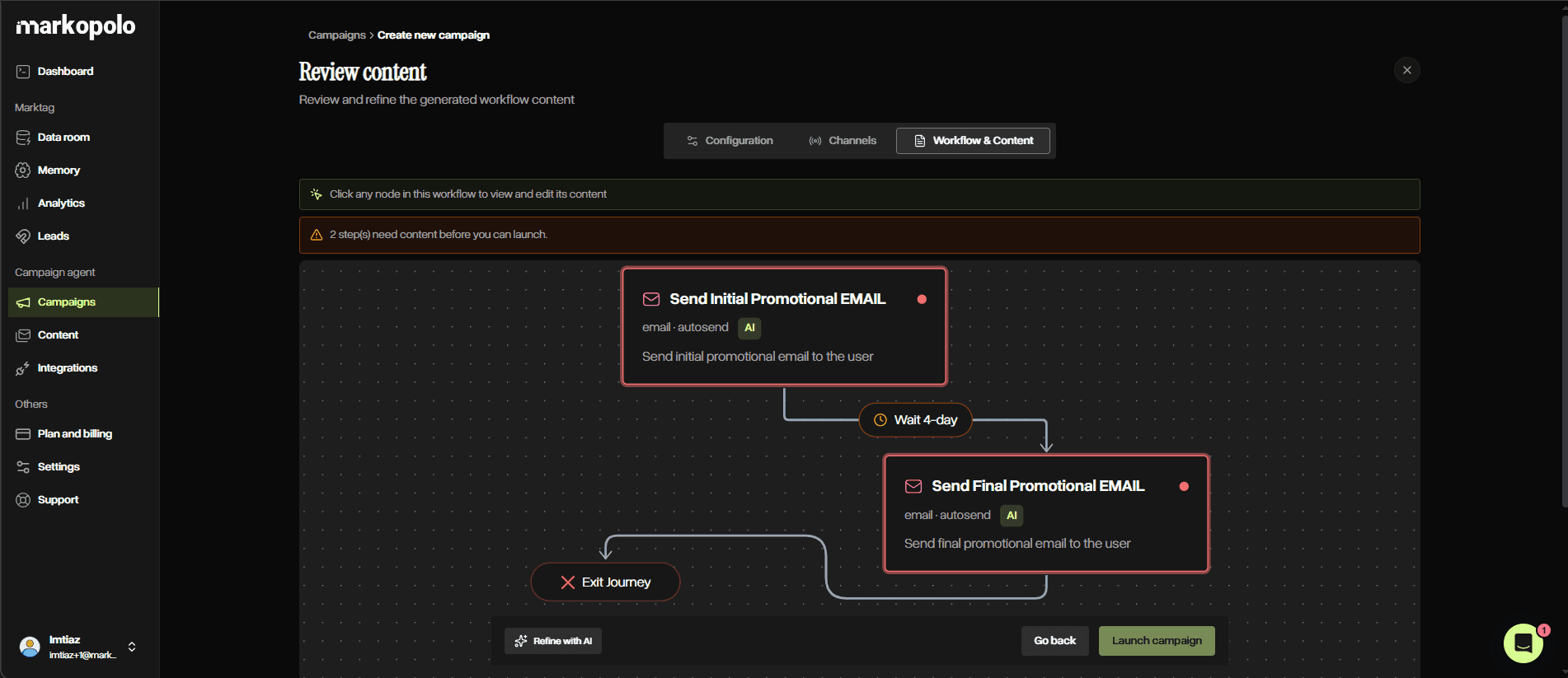
A welcome series is not a single email. It is the first conversation you have with a subscriber, and like any conversation, it should adapt based on how the other person responds. If someone clicks through to a product page in email one, email two should acknowledge that interest. If they do not open at all, the sequence should adjust the subject line before it tries again. Markopolo's Campaign Agent builds welcome sequences that branch based on real-time subscriber behavior, so every new contact moves through a path that reflects what they are actually doing rather than a fixed flow that ignores it.
Customize the behavioral triggers
The problem with most trigger-based email programs is that the triggers are too blunt. Cart abandoned: send email. Product viewed: send email. The behavior is the same for everyone, so the response is the same for everyone, and the results plateau. What actually moves the needle is matching the trigger to the behavioral context behind it. A first-time visitor who abandoned is not the same as a repeat buyer who abandoned. Someone who viewed a product for 45 seconds while comparing three competitors is not the same as someone who landed on the page and left in eight seconds. Markopolo reads that context and adjusts the trigger response accordingly, so the email that goes out is calibrated to the specific moment, not just the event.
Automate proactive triggers for retention and loyalty
Most retention automation is reactive: wait for something bad to happen, then respond. A customer has not ordered in 90 days, triggering a win-back. That approach is better than nothing, but it is still playing catch-up. The more effective model is proactive: identify the behavioral signals that precede disengagement and intervene before the customer actually goes quiet. The best solution is to detect when a previously active subscriber starts to pull back. Watch for signs like declining session frequency or shallower browsing depth. Then trigger a retention or loyalty touchpoint at the moment the relationship can still be saved, not after it has fully cooled.
Use segmentation with dynamic personalization
Static segments become wrong the moment a subscriber's behavior changes. Someone who was a first-time buyer last month might qualify as a high-value repeat customer this week. A subscriber who was price-sensitive six months ago might be browsing premium categories today. Dynamic segmentation solves this by updating cohorts in real time based on live behavioral data. Yyou should build segments from behavioral signals captured across every session and channel, so the targeting stays accurate without requiring manual intervention every time a subscriber's status changes.
Utilize autonomous agentic AI
The ceiling of traditional email automation is the workflow you build. Every path, every branch, every trigger has to be anticipated and configured by a human. Autonomous AI removes that ceiling. Rather than executing a predefined flow, an AI revenue agent reads each subscriber's full behavioral context and decides in real time what that person needs, on which channel, in which tone, and at which moment. Markopolo AI deploys individual AI agents for each subscriber, each one operating with the same goal: move this specific person toward a purchase in the way most likely to work for them, based on everything their behavior has already revealed.
Why should you use segmentation and 1:1 hyper-personalization in your emails

It is because sending the same email to your entire list is one of the fastest ways to lower engagement. B2c and d2c ecommerce brands that consistently outperform email benchmarks have already moved beyond broad segments. They now rely on targeting models built on behavioral data, purchase history, and predictive signals.
The good news is that this shift does not require a large team, but the right data and a system that knows how to act. In practice, high-performing email programs usually combine five targeting layers:
Behavioral segmentation groups subscribers based on what they actually do. This includes pages visited, time spent on products, items compared, and categories browsed. These actions often reveal far more intent than basic demographic information.
RFM-based segmentation adds another important layer. By analyzing purchase recency, frequency, and monetary value, brands can identify their highest-value buyers as well as customers who may be at risk of churn.
Predictive segmentation goes a step further. Models trained on historical behavior can estimate who is most likely to buy next, who might be approaching churn, and who is ready for a loyalty offer even before obvious signals appear.
Zero-party data adds another dimension. When subscribers share their preferences directly through quizzes, surveys, or preference centers, they reveal intent that behavioral tracking alone cannot fully capture.
1:1 hyper-personalization sits on top of these segmentation layers. Instead of sending a static message to a group, the email itself is dynamically generated for a single person at a specific moment, using their behavior, profile, and current context.
Markopolo AI combines all five by building cohorts that update dynamically as subscriber behavior evolves. So, every send from your brand is targeted against who that person is right now, not who they were when they first signed up.
Email deliverability: the invisible factor that kills ecommerce revenue
You can have the best subject line, the most relevant offer, and the most precisely timed send, and none of it matters if the email lands in spam. Deliverability is the infrastructure layer that most ecommerce brands neglect until it becomes a crisis, and by then the damage to sender reputation can take months to undo.
SPF, DKIM, DMARC
These three authentication protocols are the minimum technical requirement for being treated as a legitimate sender. SPF tells receiving mail servers which IP addresses are authorized to send on behalf of your domain. DKIM adds a cryptographic signature that verifies the message was not tampered with in transit. DMARC ties the two together and tells receiving servers what to do when a message fails authentication, whether to quarantine it, reject it, or let it through. Without all three configured correctly, even well-intentioned emails are more likely to be filtered, regardless of how good the content is.
One-click unsubscribe and consent
Google and Yahoo's 2024 bulk sender requirements made one-click unsubscribe mandatory for anyone sending more than 5,000 emails per day to Gmail addresses. Beyond compliance, it is simply good practice: a subscriber who wants to leave should be able to do so in one step, not three. Making it difficult to unsubscribe does not keep people engaged; it pushes them toward marking your emails as spam, which does far more damage to your sender reputation than a clean unsubscribe ever would.
List hygiene and sender reputation
Every email you send to an invalid address, a long-inactive contact, or someone who never engaged is a small vote against your sender reputation. Internet service providers track bounce rates, spam complaint rates, and engagement patterns, and they use that data to decide where your emails land. Regular list hygiene, removing hard bounces, suppressing unengaged subscribers, and flagging addresses with consistently low engagement, keeps your deliverable list clean and your reputation scores high. A smaller list of genuinely engaged subscribers will outperform a bloated list of cold contacts every time.
Domain warm-up and bulk sender rules
A new sending domain with no history looks suspicious to email providers. Sending high volumes immediately from a cold domain almost guarantees poor inbox placement. Warm-up is the process of gradually increasing send volume over several weeks to build a positive sending history before you scale. The same logic applies when switching email service providers or adding a new subdomain. Start low, monitor engagement closely, and increase volume incrementally. For brands sending at scale, staying within bulk sender guidelines and maintaining complaint rates below 0.1% is not optional; it is the baseline for staying out of spam folders consistently.
Your instinct is correct. The section feels thin because it is a series of short statements with almost no depth, explanation, or context. For SEO and reader trust (especially under EEAT), this part should teach the reader how to think about attribution, not just throw quick claims.
Below is a stronger version that keeps your original ideas but expands them with clarity, authority, and SEO depth.
Learn the traps of reporting email metrics and revenue attribution
One of the biggest challenges in ecommerce email marketing is understanding what revenue email is actually responsible for.
Most marketers eventually notice something strange. Multiple platforms claim credit for the exact same sale. So which one is correct?
The reality is that email attribution is messy, especially in a multi-channel customer journey. If you do not understand the common reporting traps, it becomes very easy to believe numbers that look impressive but do not reflect the real impact of your email program.
Below are the most common attribution pitfalls ecommerce marketers run into.
Open rates do not mean what you think
For years, open rate was the most widely used metric in email marketing. But today it is increasingly unreliable.
The main reason is Apple Mail Privacy Protection (MPP). Apple now pre-fetches tracking pixels when emails arrive in the inbox. This automatically records an “open” even if the recipient never actually reads the email.
As a result, open rate often reflects technical behavior from email clients rather than human engagement.
Instead of relying on opens, focus on metrics that indicate real interaction:
Click-through rate (CTR)
Click-to-open rate (CTOR)
Downstream purchase rate
These metrics show that a subscriber not only saw the email but took action because of it.
Multiple channels often claim the same sale
Customer journeys rarely happen in a straight line anymore. A typical path to purchase might look like this:
A shopper sees your Instagram ad on Monday
They open one of your emails on Wednesday
On Friday they Google your brand and buy
In this single purchase:
Your email platform claims the revenue
Meta Ads claims the revenue
Google Analytics logs it as organic search
Each platform is using its own attribution rules, which means the same order is counted multiple times across tools.
This is why channel reports can sometimes add up to far more than your actual store revenue.
3. Last-click attribution makes numbers look better than they are
A lot of ecommerce analytics tools still rely heavily on last-click attribution. This model gives 100 percent credit for a purchase to the final touchpoint before the conversion.
For example, if a customer:
clicked an email five days ago
later returned through direct traffic or search
then completed the purchase
The email platform may still count the entire order as email-generated revenue. While this can make email performance appear stronger, it often overestimates the true influence of the channel. In reality, the purchase may have been influenced by several interactions across ads, content, and email.
4. Holdout groups reveal the true impact of email
If you want to understand the real contribution of email marketing, there is a much more reliable method: holdout testing.
A holdout test works like this:
Randomly withhold an email from around 10 percent of the intended audience
Send the campaign to the remaining 90 percent
Compare the purchase rates between the two groups
If the group that received the email buys significantly more than the holdout group, the difference represents incremental lift caused by the email. This approach removes attribution guesswork and shows what would not have happened without the email campaign.
5. Multi-touch attribution gives a more balanced view
Because ecommerce journeys span multiple interactions, many marketers move toward multi-touch attribution models. Instead of giving all credit to the final click, these models distribute value across the customer journey.
Common examples include:
Linear attribution, where each touchpoint receives equal credit
Time-decay attribution, where interactions closer to the purchase receive more weight
Data-driven attribution, where machine learning estimates the contribution of each touchpoint
None of these models are perfect, but they are usually far more realistic than last-click attribution in a multi-channel environment.
6. Three metrics matter more than vanity numbers
With so many inflated metrics in email marketing, the best way to evaluate performance is to focus on a few core numbers that reflect real business impact. Three metrics are particularly useful for ecommerce email programs:
Revenue per email sent
This shows how much revenue each campaign generates relative to the number of messages delivered.
Revenue per subscriber per month
This measures the long-term value your email list produces over time.
Email gross margin
This calculates revenue generated from email minus the cost of discounts, promotions, and order fulfillment associated with those purchases.
Together, these metrics answer the most important question: is your email program actually generating profitable growth, or is it simply shifting revenue between channels with aggressive discounts?
Here is a tighter, stronger version that keeps the same length and structure, but improves clarity, authority, and reader guidance. It speaks directly to the reader, removes weak phrasing, and sounds more like a practitioner explaining what actually works.
Advanced playbook: what separates 6-figure email programs from everyone else
When you look at stores generating serious revenue from email, you will notice a different mindset. They treat email like a revenue engine rather than just a messaging channel. Here are the practices that separate high-performing programs from the rest:
Stop counting subscribers, start measuring list value
A list of 200,000 subscribers with 15% engagement is often worth less than a list of 40,000 people receiving the right message at the right time. Instead of focusing on list size, start segmenting by RFM: recency, frequency, and monetary value. Recent high-value buyers should receive early access or exclusives. Lapsed customers who used to buy frequently need a strong win-back reason, not another generic promotion. The metric you should care about is revenue per subscriber, not total subscriber count.
Choose the right time
“Tuesday at 10 AM” is an industry average which is not your subscriber’s schedule.
One person checks email during their morning commute. Another only opens messages late Sunday night. When you send a time-sensitive campaign such as a 24-hour sale or a back-in-stock alert, sending at the wrong moment can cost you the conversion. High-performing programs optimize send time per subscriber, using each person’s past engagement behavior to determine when they are most likely to open and click.
Remove unengaged subscribers
Inactive subscribers quietly damage your email program. They lower engagement rates, increase sending costs, and weaken your sender reputation with inbox providers.
You need a clear sunset policy. If someone has not opened or clicked in 90 to 180 days, send a final re-engagement campaign. If they still do not respond, remove them from your active list.
Even if your subscriber count drops, deliverability, engagement, and revenue per send will improve.
A/B test offers and frequency, not just subject lines
Subject line tests are useful, but they rarely change your profitability. The tests that actually move revenue are deeper:
Does free shipping outperform a 15% discount for your audience?
Does emailing your best customers twice a week increase revenue or trigger more unsubscribes?
Does 25% off generate enough incremental orders to justify the margin loss compared to 15%?
These experiments take longer to run, but they answer questions that directly affect your bottom line.
Run email like it has its own P&L
Revenue includes email-driven sales, upsells, and reactivations. Costs include platform fees, creative production, and the discounts you give away. That last line is where many email programs quietly lose margin.
If a customer would have purchased anyway, the discount becomes pure profit erosion. Tracking your net margin from email each month turns decisions about discount depth and send frequency into financial strategy rather than guesswork.
Unify your email with an omnichannel strategy
Email does not operate in isolation anymore. If someone opened your cart recovery email but did not convert, the SMS that follows should acknowledge that behavior and continue the conversation. If a push notification was ignored, the email should offer a different angle rather than repeating the same message.
The highest-performing programs connect email with SMS, WhatsApp, push notifications, and paid media using the same behavioral data layer. When each touchpoint builds on the previous one, the entire customer journey becomes more effective.
Final words
Ecommerce email marketing works best when it combines behavioral data with a clear strategy. Platforms such as Markopolo AI help brands automate segmentation and 1:1 hyper-personalization at scale. To make your ecommerce store's email campaigns even more powerful, focus on revenue impact, deliverability, and customer trust to build a program that grows sustainably over time.