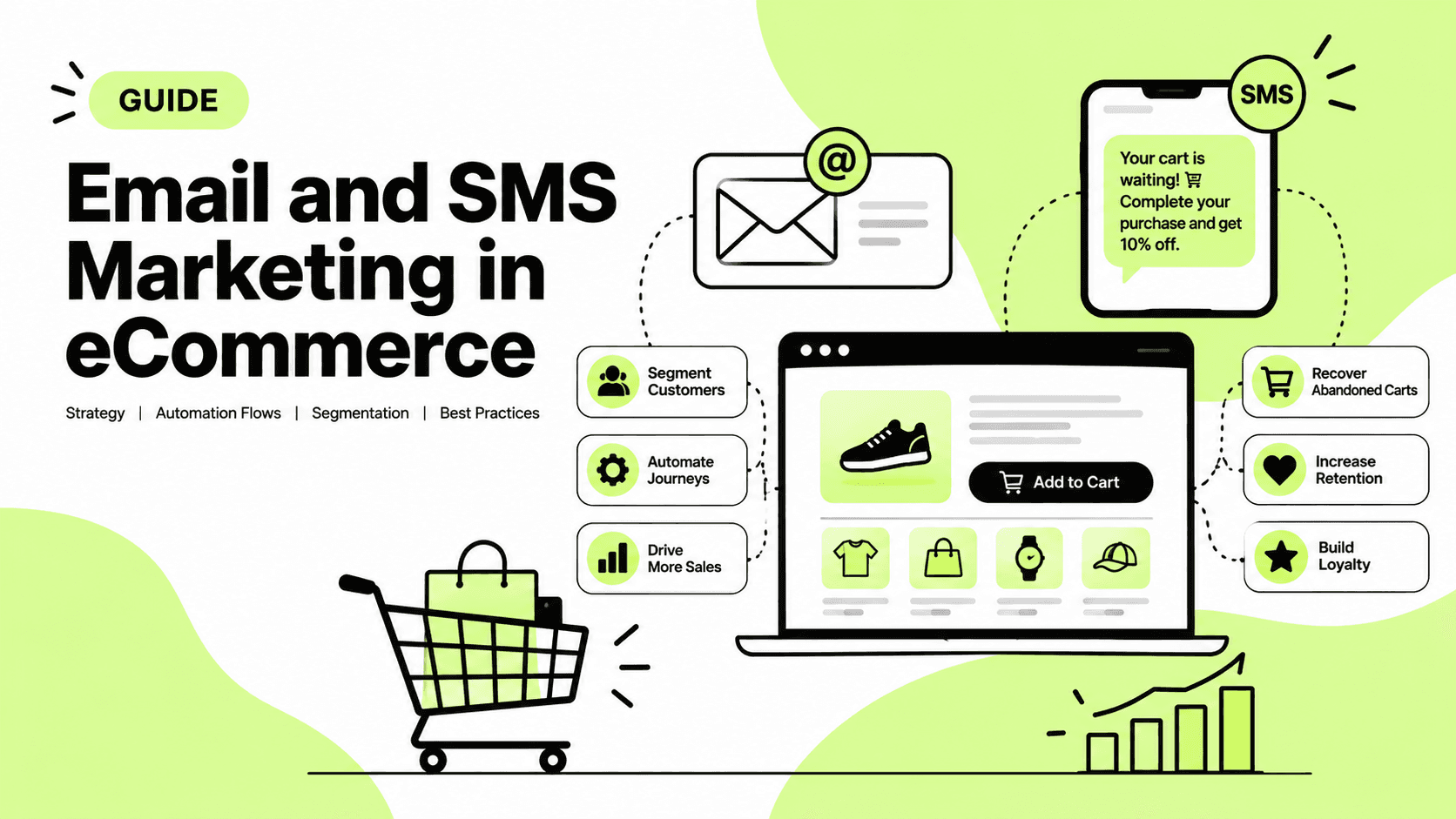
Email and SMS Marketing in eCommerce: Definition, Strategy, Flow and Best Practices (Comprehensive Guide)
Sirazum Monir Osmani
Email and SMS marketing in eCommerce refers to using emails and text messages to communicate with shoppers and customers.
Together, these two channels can support an omnichannel approach across the entire customer lifecycle, from welcoming a new subscriber to recovering an abandoned cart and re-engaging a previous customer.
Making the channels work together, however, requires more than simply sending both email and SMS. eCommerce businesses need a proper strategy for customer consent, customer data, segmentation, channel selection, automation, timing, frequency, and measurement.
This guide explains how email and SMS marketing for eCommerce works, how to combine the two channels, which automation flows matter most, how to segment customers, and which best practices help improve performance without overwhelming your audience.
What Is Email and SMS Marketing in eCommerce?
Email and SMS marketing in eCommerce is the coordinated use of email and text messaging to engage customers throughout their lifecycle using customer data, automation, and personalization.
The two channels form part of a broader omnichannel and lifecycle marketing approach. Instead of an eCommerce store treating every subscriber identically, customer data from its CRM, marketing platform, website, and purchase activity can determine which communication should reach each customer.
Email is generally suited to richer communication, while SMS is useful when the message needs to be concise and timely. A marketing automation system can coordinate both so customers receive relevant communication without unnecessarily receiving the same message twice.
How Does Email and SMS Marketing Work in eCommerce?
Email and SMS marketing in eCommerce works by using customer data, consent, behavior, and marketing automation to send relevant messages through the most appropriate channel.
Browsing activity, purchases, cart abandonment, product interests, and customer lifecycle stage can determine what a shopper receives and whether the message is delivered through email, SMS, or both.
Email is generally better suited for richer communication such as product recommendations, educational content, newsletters, promotions, and replenishment campaigns. SMS, on the other hand, is typically used for shorter and more time-sensitive communication such as limited-time offers, abandoned-checkout reminders, product updates, order confirmations, and shipping notifications.
SMS marketing is also permission-based, meaning customers must explicitly opt in before an eCommerce business can send them marketing text messages.
Combining SMS with email works best when the two channels complement each other rather than repeat the same message. For example, an abandoned-cart flow might begin with a detailed email and later use SMS for a concise reminder if the customer has not yet completed the purchase.
This coordinated approach allows eCommerce businesses to create more relevant customer journeys while using each channel according to its strengths.
Why Should eCommerce Businesses Combine Email and SMS Marketing?
eCommerce businesses should combine email and SMS marketing because coordinated channels create more customer touchpoints, improve engagement opportunities, strengthen retention, and support higher customer lifetime value.
This combination creates an omnichannel marketing experience in which communication can continue across the customer journey without depending on a single channel.
Email might provide detailed information about a new collection, for example, while SMS alerts high-intent customers that the collection is now available. Similarly, an abandoned-cart journey might begin with email and use SMS later when a timely reminder is appropriate.
The value comes from cross-channel communication rather than simply increasing message volume.
For eCommerce marketers and CRM managers, that distinction matters. Sending the same promotion through every available channel can quickly create fatigue. Coordinating email and SMS allows personalization, marketing automation, and customer preferences to determine which touchpoint is most appropriate.
Better coordination can support retention as well. Retention improves customer lifetime value, or LTV, because communication does not stop after the first conversion. Email and SMS can continue supporting post-purchase education, replenishment, loyalty, win-back, and repeat purchase journeys.
How to Build an Email and SMS Marketing Strategy for eCommerce?
Building an email and SMS marketing strategy in the eCommerce niche involves creating a coordinated system for permission, customer data, segmentation, channel selection, automation, timing, frequency, and measurement.
The steps for building an email and SMS marketing strategy are listed below.
Collect Customer Consent
Unify Customer Data
Segment Your Audience
Define Channel Roles
Create Automated Sequences
Time Your Messages
Manage Frequency
Measure Performance
1. Collect Customer Consent
Collecting customer consent means obtaining the appropriate opt-in permission from customers before sending them promotional email or SMS marketing messages.
Permission matters for both customer trust and compliance. Email and SMS should therefore have clear opt-in mechanisms rather than automatically treating every shopper as a marketing subscriber.
SMS deserves particular attention because consent requirements can vary across markets. eCommerce teams operating internationally should follow the applicable rules within each jurisdiction and give customers straightforward ways to unsubscribe.
2. Unify Customer Data
Unifying customer data means combining customer profiles and relevant first-party behavioral data into one system so those signals can inform marketing communication.
Without unified data, email and SMS frequently become separate marketing silos.
Your email platform may know that someone opened a campaign while your store knows they recently purchased, for example. Bringing those signals together makes it easier to avoid sending an inappropriate discount immediately after the customer has already bought the product.
Unified data can include product views, cart activity, purchases, order value, frequency, product category affinity, channel engagement, and other customer interactions.
3. Segment Your Audience
Segmenting your audience means grouping customers according to shared behavior, characteristics, or lifecycle stage so messaging can become more relevant to each group.
A new subscriber should not necessarily receive the same campaign as a loyal customer who has purchased ten times.
Useful eCommerce segments might include first-time subscribers, high-intent browsers, cart abandoners, recent customers, repeat buyers, high-value customers, inactive customers, and customers approaching a replenishment window.
Segmentation gives your email and SMS programs context instead of relying on one broad subscriber list.
4. Define Channel Roles
Defining channel roles means deciding which types of customer communication belong primarily on email and which situations are more appropriate for SMS.
Email can handle detailed communication such as product launches, newsletters, guides, collections, recommendations, and educational content.
SMS is often more suitable for concise, immediate communication such as limited-time announcements, order updates, reminders, and time-sensitive promotions.
These roles do not need to be rigid. They provide a framework that prevents both channels from automatically sending the same message.
5. Create Automated Sequences
Creating automated sequences means building trigger-based workflows that automatically send relevant communication after specific customer actions or changes in lifecycle stage.
A customer subscribing might trigger a welcome flow. Adding a product to the cart without purchasing might trigger an abandoned-cart sequence. Completing an order might trigger a post-purchase sequence.
Automation allows eCommerce teams to respond when behavior occurs rather than manually launching each message.
More importantly, a good flow of automation should consider what already happened across other channels before deciding what should happen next.
6. Time Your Messages
Timing your messages means delivering email and SMS when the communication is most likely to be relevant, useful, and well received by the customer.
Timing should consider both customer actions and the purpose of the message.
An abandoned-cart reminder may need to arrive comparatively quickly, while a replenishment message should reflect the expected consumption cycle of the purchased product.
The right timing can also vary among customers, making behavioral and historical engagement data useful when optimizing delivery.
7. Manage Frequency
Managing frequency means controlling how often customers receive email and SMS communication so your brand remains visible without overwhelming its audience.
Frequency becomes especially important when multiple campaigns and automated journeys operate simultaneously.
A customer could theoretically qualify for a newsletter, abandoned-cart flow, promotion, and product campaign on the same day. Without coordination, every workflow may send independently.
Frequency controls, suppression rules, and cross-channel awareness can help prevent that experience.
8. Measure Performance
Measuring performance means tracking campaign and customer outcomes so segmentation, personalization, timing, channel selection, and automation can be continuously improved.
Measurement should go beyond looking at individual messages in isolation.
If an SMS generates a click but the customer purchases after receiving an email later, your reporting should help you understand the broader journey. Likewise, personalization should ultimately be evaluated on outcomes such as conversion, repeat purchases, revenue, and retention rather than message engagement alone.
Measurement turns your strategy and flow of automation into an ongoing optimization process.
What are Email and SMS Marketing Automation Flows in eCommerce?
The essential email and SMS marketing automation flows in eCommerce include welcome sequences, abandoned-cart recovery, promotions, product launches, post-purchase communication, and win-back campaigns.
Welcome Series: A welcome series is an automated sequence sent after a shopper subscribes or otherwise becomes eligible for marketing communication. It introduces the brand, establishes expectations, and can personalize subsequent messages according to customer behavior or segmentation.
Abandoned Cart Recovery: Abandoned-cart recovery is an automated flow for customers who add products to their cart but leave without purchasing. Email can provide richer product context, while SMS may provide a concise reminder when consent and timing make the channel appropriate. The flow should normally stop once the customer completes the purchase.
Flash Sales and Promotions: Flash sale and promotional flows notify relevant customer segments about discounts or limited-time offers. Email can explain the promotion in detail, while SMS can support urgency for selected audiences instead of sending the promotion indiscriminately to every subscriber.
Product Launches: Product launch flows introduce new products, collections, restocks, or releases. Segmentation allows eCommerce marketers to prioritize shoppers whose purchase history or product interests indicate that the launch is likely to be relevant.
Post-Purchase and Shipping Updates: Post-purchase flows communicate after an order has been completed. They may include transactional shipping notifications alongside marketing communication such as product education, care instructions, complementary recommendations, review requests, or subsequent purchase opportunities where appropriate.
Win-Back Campaigns: Win-back campaigns target customers whose purchasing or engagement activity has declined. Email and SMS can encourage re-engagement based on previous purchases, customer value, category preferences, and the length of inactivity rather than relying on a generic discount for everyone.
These flows become considerably more useful when connected to customer behavior. Automation should respond to changes in intent rather than merely sending a fixed number of messages because a predetermined number of days has passed.
What is Email and SMS Segmentation in eCommerce?
Email and SMS segmentation in eCommerce groups customers by lifecycle stage, behavior, value, engagement, interests, and communication preferences so marketers can send email and SMS more selectively.
Segments can also use purchase history, product interest, channel preference, and RFM segmentation to determine which customers should receive particular communication.
RFM segmentation evaluates customers according to recency, frequency, and monetary value. That information can help distinguish a customer who purchased yesterday from someone who last purchased a year ago, even if both have historically spent the same amount.
Customer lifetime value can provide another useful dimension. High-LTV customers may deserve different communication, rewards, or service experiences than one-time buyers.
For lifecycle marketers, segmentation therefore answers more than who should receive this campaign? It can also help determine which channel, message, offer, and timing make the most sense.
How Often Should eCommerce Businesses Send Email and SMS?
eCommerce businesses should send email and SMS according to customer lifecycle stage, message relevance, engagement behavior, and individual channel preferences rather than using one universal frequency.
There is no single sending schedule that works for every eCommerce business.
A highly engaged subscriber may tolerate regular email campaigns, while an inactive subscriber might respond better to fewer, more relevant messages. SMS should generally be treated even more selectively because of its direct nature.
Frequency decisions should balance engagement against customer fatigue, email unsubscribes, and SMS opt-outs.
Your metrics can help identify when that balance begins to deteriorate. Rising unsubscribe rates, increasing SMS opt-outs, weakening engagement, and falling revenue per recipient may all indicate that volume is increasing faster than relevance.
What are the Important Metrics for Email and SMS Marketing in eCommerce?
Email and SMS marketing performance for eCommerce is measured using engagement, conversion, revenue, retention, opt-out, and customer value metrics across individual channels and the overall customer journey.
Email-specific metrics commonly include:
Open rate
Click-through rate
Unsubscribe rate
Conversion rate
Revenue per recipient
SMS-specific metrics can include:
Engagement rate
Click-through rate
SMS opt-out rate
Conversion rate
Revenue per recipient
Shared outcome metrics are often more important when evaluating the combined program. These can include conversion rate, revenue attribution, ROI, customer lifetime value, and repeat purchase rate.
For eCommerce CMOs and directors, this distinction is especially important. High engagement does not automatically mean that a lifecycle program is creating incremental business value.
Following best practices therefore means connecting channel-level metrics to commercial outcomes wherever possible.
What are the Best Practices for Email and SMS Marketing in eCommerce?
The best practices for email and SMS marketing in eCommerce include segmentation, personalization, channel coordination, proper timing, frequency control, behavioral automation, consent management, testing, measurement, and centralized orchestration.
Segment Audiences: Segmentation is the practice of grouping customers according to relevant customer attributes or behaviors. Segmentation matters because different shoppers have different needs, purchase histories, intent levels, and lifecycle stages.
Personalize Messages: Personalization is the process of adapting communication using individual customer context. Useful personalization goes beyond inserting a first name and can reflect browsed products, purchase history, affinities, lifecycle stage, or recent behavior.
Coordinate Channels: Channel coordination means determining how email and SMS should work together during a customer journey. Coordination reduces duplicate messaging and allows one channel to complement another.
Use Appropriate Timing: Appropriate timing means delivering communication when it matches the customer's situation. Behavioral timing can make a campaign more useful than sending every message according to a fixed calendar.
Avoid Over-Messaging: Avoiding over-messaging means controlling campaign and automation volume across channels. Frequency controls matter because customers experience your brand as one company even when several marketing workflows are operating behind the scenes.
Use Behavioral Triggers: Behavioral triggers are customer actions or events that initiate automated communication. Product views, cart abandonment, purchases, inactivity, and repeat browsing can provide more useful context than static schedules alone.
Respect Consent: Respecting consent means sending marketing messages only through channels for which the appropriate customer permission has been obtained. Clear subscription and opt-out processes protect both customer trust and campaign quality.
Test Campaigns: Campaign testing means comparing variables such as messaging, timing, offers, formats, or channel sequences. Testing helps eCommerce teams learn what works for their own customers instead of relying entirely on general benchmarks.
Monitor Performance: Monitoring performance means evaluating both campaign-level metrics and longer-term customer outcomes. The results should then inform future segmentation, personalization, channel selection, and frequency.
Use an Omnichannel Platform: An omnichannel platform centralizes customer data, segmentation, automation, and communication across channels. A platform like Markopolo AI can help eCommerce teams coordinate email and SMS alongside other channels instead of operating them as disconnected systems.
The central principle behind these best practices is relevance. Sending more messages does not automatically produce better marketing; improving the match between the customer, message, channel, and moment is usually the more sustainable objective.
Are Platforms Necessary for Email and SMS Marketing in eCommerce?
Yes, email and SMS marketing platforms for eCommerce are practically necessary because automation, segmentation, personalization, customer data, and campaign coordination become difficult to manage manually at scale.
Manual email and SMS campaigns cannot efficiently track large amounts of customer behavior, manage growing subscriber lists, or automatically respond to individual actions at the right time.
An email and SMS marketing platform solves this by connecting customer information with campaign execution.
Platforms can support common eCommerce programs such as abandoned-cart reminders, welcome sequences, promotional campaigns, product launches, win-back sequences, and post-purchase messages.
More advanced platforms can also coordinate what happens across channels. A platform like Markopolo AI, for example, can bring segmentation, behavioral triggers, personalization, and automated communication into a broader omnichannel marketing environment.
For an eCommerce CRM manager, that can reduce the operational complexity of managing customer journeys across separate tools.
How Does Markopolo AI Use AI for eCommerce Email and SMS Marketing?
Markopolo AI uses artificial intelligence to enhance eCommerce email and SMS marketing by converting shopper behavior into customer intelligence and using that intelligence to personalize marketing decisions.
Its behavioral data layer, MarkTag, captures customer interactions and converts those signals into behavioral profiles. Markopolo AI's built-in Athena model can then use this behavioral intelligence to understand customer intent and support next-action decisions.
For an eCommerce marketer, this means personalization can go beyond inserting someone's first name or placing customers into broad segments.
A shopper repeatedly researching a particular product, someone leaving during checkout, and an existing customer approaching their typical repurchase period represent different situations. Markopolo AI can use behavioral and historical information to personalize communication around those situations.
That intelligence can then power email and SMS for browse abandonment, cart recovery, checkout recovery, post-purchase communication, customer retention, loyalty, replenishment, or other lifecycle campaigns. Marketers building these workflows can combine the principles in an email marketing automation guide for eCommerce with behavioral triggers, while applying SMS marketing automation strategies for eCommerce to deliver timely messages when a shorter, more immediate touchpoint is appropriate.
The same behavioral context can also continue across WhatsApp, push notifications, and AI voice rather than resetting whenever the channel changes.
Compared with other eCommerce email and SMS marketing software, the main difference is therefore the emphasis on behavior-driven 1:1 decisioning across channels.
For teams choosing the right platform, that approach is particularly relevant when the objective is no longer simply to send more automated email and SMS campaigns, but to make each customer interaction progressively more relevant.