Personalized customer engagement strategies and best solutions for B2C and D2C ecommerce businesses in 2026
Personalized customer engagement tailors interactions to individual customer's unique behaviors, preferences, and needs through AI and data analytics. Ecommerce brands achieve boosted loyalty and revenue with this approach. Markopolo AI optimizes these strategies for D2C and B2C retail, delivering hyper-personalized outreach that drives results.
The era of generic marketing is over. Today, customers expect brands to understand them as individuals. They want relevant messages at the right time on the right channel. Businesses that deliver this experience win. Those that don't lose revenue every day.
This guide covers everything B2C and D2C ecommerce brands need to know about personalized customer engagement in 2026. You'll learn what works, which tools deliver results, and how to build strategies that convert.
What is customer engagement personalization?
Customer engagement personalization means treating each customer as a unique individual rather than a segment. It goes far beyond adding a first name to an email. True personalization understands customer behavior, preferences, timing, and channel choices. It then uses this understanding to create relevant experiences at every touchpoint. When done right, personalization makes customers feel understood. Customers receive messages that match their needs at moments when they're ready to act. This approach drives higher conversion rates, stronger loyalty, and better customer lifetime value.
How does 1:1 hyper-personalization help B2C and D2C ecommerce brands?
Higher conversion rates through relevance
Hyper-personalization delivers the right message to the right person at the right time. This relevance drives action. When a customer receives product recommendations based on their actual browsing behavior, they're more likely to buy. When abandoned cart messages address their specific hesitations, recovery rates improve dramatically. Generic campaigns convert at 10-15%. Personalized journeys can reach 30-40% conversion rates. The difference is understanding individual intent rather than applying broad assumptions.
Reduced customer acquisition costs
According to Harvard Business Review, acquiring new customers costs 5 to 25 times more than retaining existing ones. Hyper-personalization helps brands maximize the value of every customer relationship. It identifies the optimal moment to re-engage inactive customers before they churn. It recognizes which customers need discounts and which respond better to social proof. This precision reduces wasted spend on irrelevant outreach. Marketing budgets work harder when every message targets the right behavior.
Stronger brand loyalty and repeat purchases
Customers remember how brands make them feel. When every interaction feels relevant and helpful, loyalty grows naturally. Hyper-personalization creates these positive experiences consistently. It ensures customers never feel bombarded with irrelevant messages. Instead, they receive valuable communications that respect their preferences. This approach builds trust over time. Trust leads to repeat purchases and word-of-mouth recommendations.
5 best personalized engagement platforms for B2C and D2C ecommerce brands: comparison, features, pros, and cons
Platform | Best for | Channels | Starting price | Personalization approach |
|---|---|---|---|---|
Markopolo AI | E-commerce revenue recovery | Email, SMS, WhatsApp, Push, AI Voice | $49/month | Individual AI agents with behavioral vectorization |
Klaviyo | E-commerce email and SMS | Email, SMS, WhatsApp, Push | Free (250 contacts); $20/month (500+ contacts) | Segment-based with predictive analytics |
Braze | Enterprise cross-channel | Email, SMS, Push, In-app, WhatsApp | ~$60,000/year (custom quotes) | Rule-based journey orchestration |
Attentive | SMS-first marketing | SMS, Email, RCS | Custom quotes (~$300/month platform fee + messaging) | Audience segmentation with AI send-time optimization |
HubSpot | B2B inbound marketing | Email, Live chat, Forms, Social | Free tier; $15/month (Starter); $800/month (Professional) | Property-based personalization with workflows |
Markopolo AI
Markopolo is an AI-native omnichannel customer engagement platform that represents a fundamental shift for ecommerce brands. Instead of creating static workflows applied to segments, Markopolo creates individual AI revenue agents for each individual customer. Each agent understands the complete behavioral context of one person and orchestrates a unique journey designed specifically for them.
Why is Markopolo AI the best customer engagement platform for 1:1 personalization?
Markopolo goes beyond basic event tracking to build a deeper, semantic understanding of what each customer actually needs. Its ability to tailor communication at the individual level is unusually advanced, even among modern personalization platforms.
The system can run outreach campaigns across email, voice calls, SMS, WhatsApp, and push notifications. Markopolo AI is fully context-aware, so it keeps communication consistent and connected across every channel. For example, if Jacob abandons his cart and receives an email, Markopolo can follow up with an SMS a few days later to remind him that stock is running low for that product or that a limited-time offer is still available.
Markopolo’s 1:1 hyper-personalization capabilities outperform any other customer engagement platforms on the market. It can identify which customers are price sensitive, who needs more proof of product quality, and who is in the top or bottom of the funnel (TOFU or BOFU). This enables Markopolo to deliver truly individualized communication that significantly increases sales and revenue for B2C and D2C retail brands.
The platform's data collection layer is called MarkTag, which is a behavioral intelligence system that transforms customer actions into mathematical understanding. MarkTag captures every micro-interaction including mouse movements, hesitation patterns, comparison behavior, and scroll depth. It turns all those tiny user actions into a very detailed “profile number” (384-dimensional vectors) for each person, which captures what that specific person seems to want right now. It then sends these data to its AI “ATHENA” which predicts what the individual is likely to do next with industry leading accuracy.
Markopolo's AI orchestration engine uses this behavioral intelligence to generate completely unique strategies for each customer in under 50 milliseconds. Every journey adapts in real-time with perfect context based on customer responses and changing behavior.
Markopolo’s 1:1 hyper-personalization capabilities
Behavioral vectorization
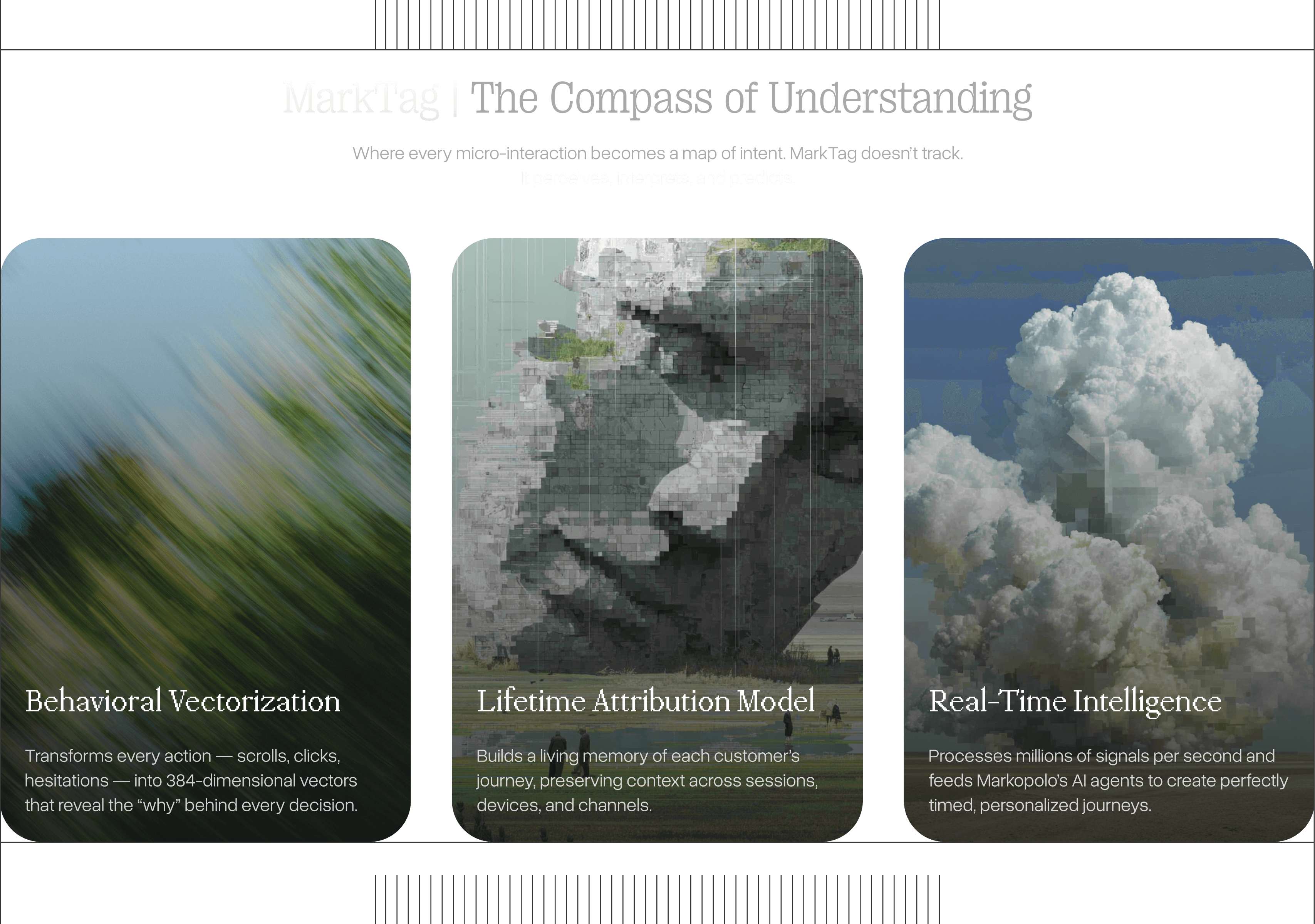
MarkTag creates a complete behavioral fingerprint for every visitor. This 384-dimensional vector captures intent patterns, emotional state inference, purchase probability, and optimal intervention timing. Traditional tools see isolated events. Markopolo sees the complete picture of individual behavior.
Real-time journey generation
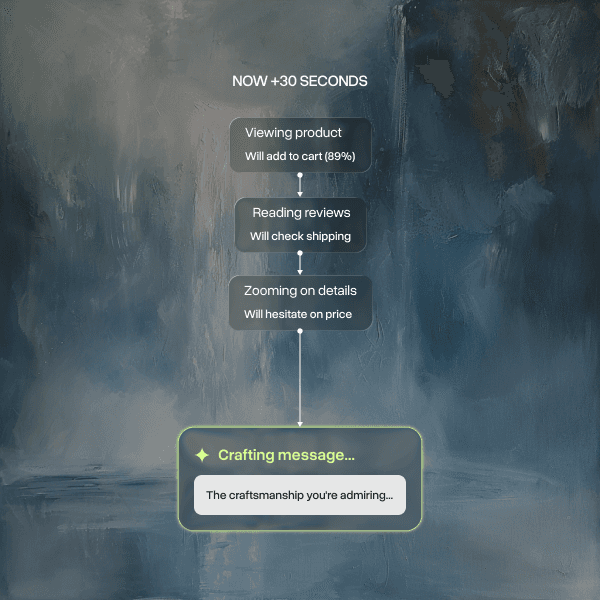
The AI creates unique recovery strategies in under 50 milliseconds. No two customers receive identical journeys. Each path reflects individual context including time preferences, channel affinity, price sensitivity, and decision-making style.
Omnichannel orchestration
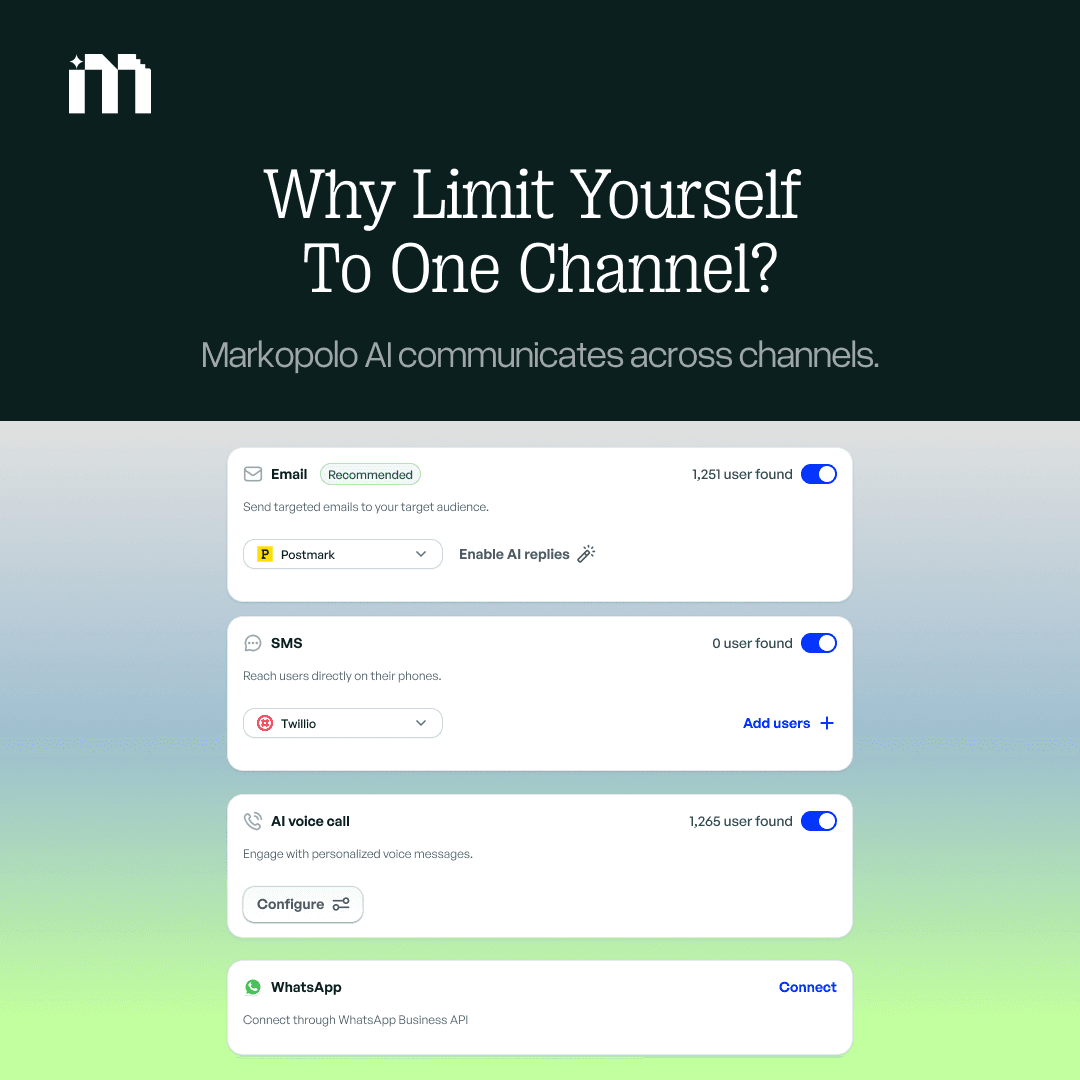
Campaigns execute seamlessly across email, SMS, WhatsApp, push notifications, and AI voice calls. The system selects optimal channels based on each customer's engagement history. Timing adjusts to individual activity patterns.
Lifetime attribution modeling
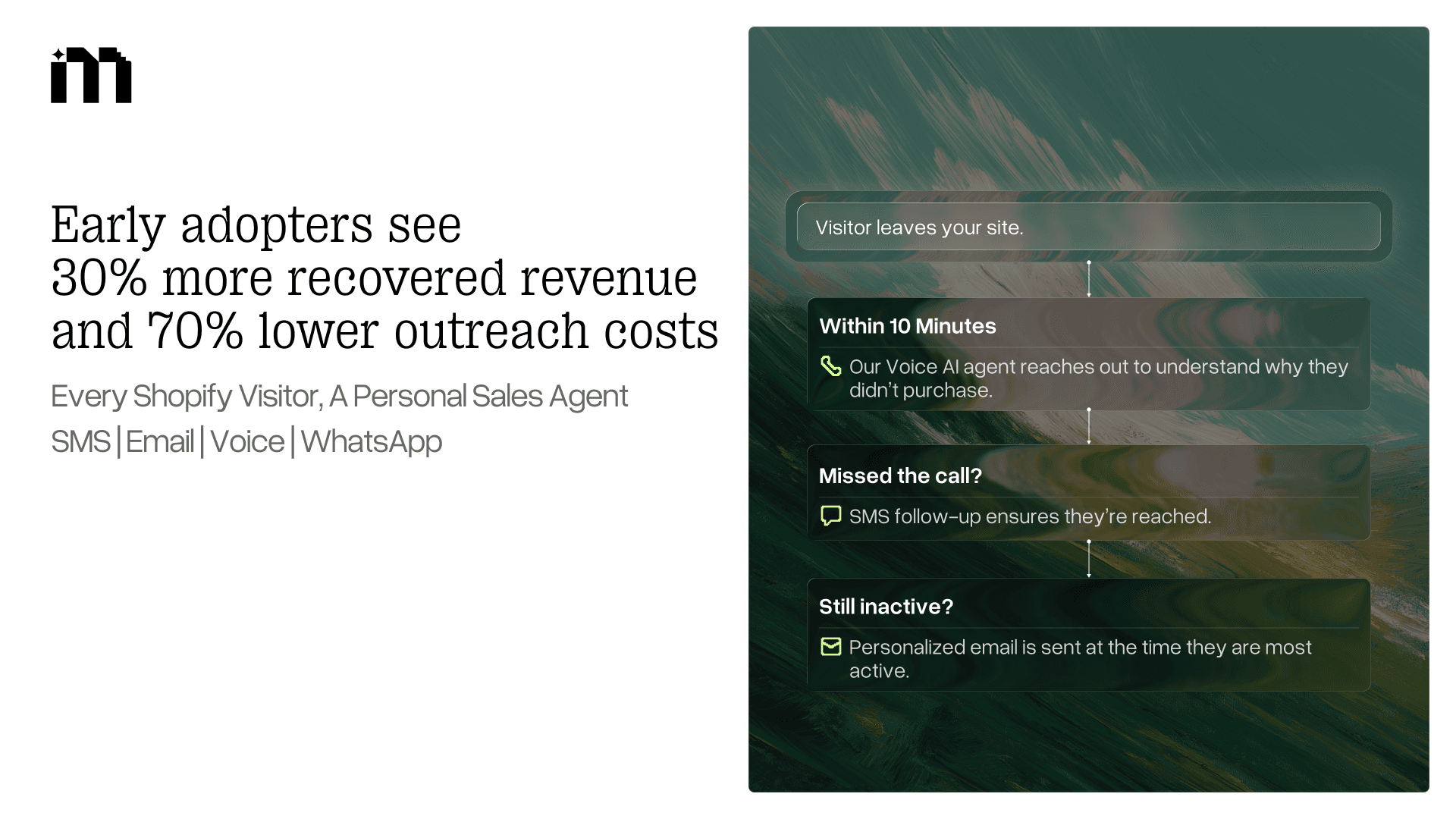
Every touchpoint connects in a complete attribution tensor. The system identifies causal relationships in purchase decisions rather than simple correlation. This intelligence improves with every interaction.
Predictive intervention
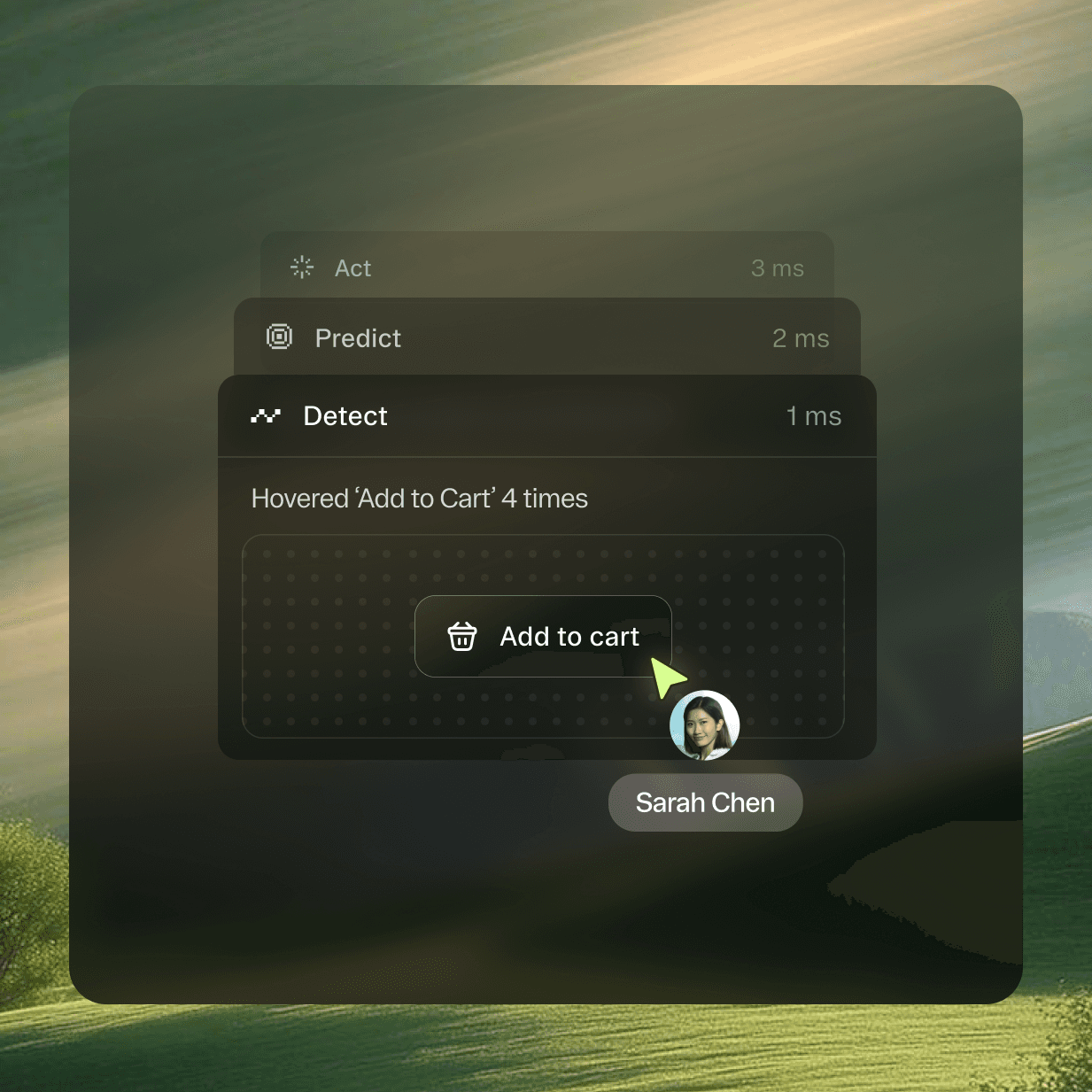
The AI predicts what will influence each specific customer. It identifies optimal intervention points before abandonment occurs. Proactive engagement replaces reactive recovery.
Pros
Creates truly individual journeys rather than segment-based workflows
Processes millions of events per second into actionable intelligence
Achieves 25-40% cart recovery rates versus industry standard of 10-15%
Includes AI voice calling capabilities for human-like conversations
Continuously learns and improves for each individual customer
Value-based pricing aligns platform success with merchant success
Cons
Advanced capabilities may exceed needs of very small businesses
Klaviyo
Klaviyo has established itself as a popular email and SMS marketing platform for ecommerce brands. The platform offers strong integration with Shopify and other major ecommerce platforms. It provides tools for building automated email flows, SMS campaigns, and customer segments based on purchase history and behavior.
Personalization capabilities
Klaviyo enables segment-based personalization using customer data like purchase history, browsing behavior, and demographic information. Users can create dynamic content blocks that change based on segment membership. The platform supports product recommendations within emails based on past purchases. Predictive analytics estimate customer lifetime value and churn risk at the segment level.
Pros
Deep native integrations with major ecommerce platforms
Extensive template library for email campaigns
Strong reporting and analytics dashboards
Active user community and educational resources
Cons
Personalization operates at segment level rather than individual level
Requires manual workflow creation and ongoing optimization
SMS capabilities less developed than dedicated SMS platforms
Pricing scales quickly with list size
Comparing Klaviyo vs Markopolo AI for personalized outreach
Klaviyo applies human-created workflows to customer segments. Markopolo creates unique AI-generated journeys for each individual. Klaviyo requires marketers to anticipate customer needs when building flows. Markopolo's AI recognizes individual intent in real-time and adapts accordingly. Klaviyo excels at email marketing fundamentals. Markopolo delivers true 1:1 personalization across all channels including voice.
Braze
Braze positions itself as a customer engagement platform for enterprise brands. The platform supports multiple channels including email, push notifications, in-app messaging, and SMS. It emphasizes real-time data processing and cross-channel campaign coordination.
Personalization capabilities
Braze offers Canvas, a visual journey builder for creating multi-step campaigns. Users can personalize messages using customer attributes and event data. The platform supports dynamic content based on user properties. Liquid templating enables conditional message variations. Connected Content pulls external data into messages at send time.
Pros
Supports complex multi-channel campaign orchestration
Strong real-time data processing capabilities
Robust API for custom integrations
Enterprise-grade security and compliance features
Cons
Steep learning curve for advanced features
Pricing structure favors large enterprise budgets
Personalization still relies on predefined rules and segments
Voice channel not included in core platform
Comparing Braze vs Markopolo AI for personalized outreach
Braze provides tools for marketers to build sophisticated journeys manually. Markopolo generates optimal journeys automatically using AI. Braze requires significant expertise to maximize platform capabilities. Markopolo's intelligence layer handles strategy creation autonomously. Braze serves enterprise teams with dedicated marketing operations resources. Markopolo delivers enterprise-level personalization accessible to teams of any size.
Attentive
Attentive focuses primarily on SMS and email marketing for ecommerce and retail brands. The platform emphasizes list growth through on-site opt-in units and two-tap mobile sign-up experiences. It has built a reputation for high SMS deliverability and compliance management.
Personalization capabilities
Attentive enables message personalization based on subscriber attributes and shopping behavior. Users can create triggered journeys for events like cart abandonment and browse abandonment. The platform offers AI-powered send time optimization to improve open rates. Audience segmentation uses purchase history, engagement, and custom properties.
Pros
Strong SMS deliverability and compliance infrastructure
Effective subscriber acquisition tools
Clean user interface for campaign creation
Good integrations with major ecommerce platforms
Cons
Primarily focused on SMS with email as secondary channel
No voice or WhatsApp channel support
Personalization limited to segment-based approaches
Journey automation less sophisticated than competitors
Comparing Attentive vs Markopolo AI for personalized outreach
Attentive excels at SMS marketing fundamentals and list building. Markopolo provides true omnichannel orchestration including voice AI. Attentive personalizes messages based on segments and triggers. Markopolo creates individual strategies using behavioral vectorization. Attentive requires manual journey design and optimization. Markopolo's AI generates and refines customer engagement strategies autonomously for each customer.
HubSpot
HubSpot offers a comprehensive marketing, sales, and service platform. Its Marketing Hub includes email marketing, social media management, content management, and marketing automation. The platform serves businesses across B2B and B2C markets with varying complexity needs.
Personalization capabilities
HubSpot enables website personalization based on visitor attributes and behavior. Smart content changes page elements for different audience segments. Email personalization uses contact properties and list membership. Workflows trigger actions based on form submissions, page views, and other events. The platform supports basic recommendation engines for content.
Pros
All-in-one platform combining marketing, sales, and service
Free tier available for businesses getting started
Extensive educational content and certification programs
Strong CRM foundation for contact management
Cons
Personalization capabilities more suited to B2B than fast-paced ecommerce
Advanced features require expensive premium tiers
Real-time behavioral processing less sophisticated
No native voice channel or WhatsApp integration
Comparing HubSpot vs Markopolo AI for personalized outreach
HubSpot provides broad marketing capabilities across many use cases. Markopolo specializes in ecommerce revenue recovery and personalized engagement. HubSpot's personalization works at the segment and property level. Markopolo's behavioral vectorization understands individual intent and context. HubSpot excels for businesses needing integrated CRM and marketing. Markopolo delivers deeper personalization for brands focused on ecommerce conversion.
7 personalization strategies and engagement practices for better customer experience
Capture behavioral signals beyond basic events
Go beyond tracking page views and purchases. Monitor micro-interactions like scroll depth, hover patterns, and comparison behavior. These signals reveal intent before customers take obvious actions. Understanding hesitation patterns helps identify the right intervention. Price comparison behavior indicates discount sensitivity. Social proof seeking suggests the need for reviews rather than offers.
Create dynamic content that adapts in real-time
Static templates limit personalization effectiveness, especially when brands fail to use conversational AI for customer engagement to adapt messages in real time. Dynamic content changes based on individual context at the moment of delivery. Product recommendations should reflect current browsing sessions, not just past purchases. Message tone should match customer engagement history. Offers should align with actual price sensitivity rather than broad assumptions.
Optimize timing based on individual patterns
Generic send time optimization uses aggregate data. True personalization identifies when each individual engages most actively. Some customers browse during lunch breaks. Others shop after children go to bed. Matching outreach to individual activity windows dramatically improves engagement. The right message at the wrong time often fails to convert.
Match channels to individual preferences
Every customer has preferred communication channels. Some respond quickly to SMS. Others engage better through email or WhatsApp. Testing reveals individual channel affinity over time. Respecting these preferences improves response rates and reduces unsubscribe risk. Multi-channel strategies should sequence based on individual response patterns rather than fixed rules.
Use social proof strategically based on need
Not every customer requires social proof to convert. Some make quick decisions based on product information alone. Others need extensive validation from reviews and testimonials. Identifying social proof requirements at the individual level improves relevance. High-confidence buyers may find excessive reviews unnecessary. Hesitant researchers benefit from additional validation.
Personalize the path, not just the message
Message personalization matters, but journey personalization matters more. Two customers abandoning identical carts may need completely different recovery sequences. One might respond to immediate urgency messaging. Another might need three days of consideration time. Individual journey orchestration outperforms one-size-fits-all flows consistently.
Learn and adapt continuously from outcomes
Personalization improves through feedback loops. Every customer response provides data for future optimization. Effective systems track what works for each individual over time. They identify patterns in successful conversions. They recognize warning signs of disengagement. Continuous learning compounds personalization effectiveness month over month.
Customer journey mapping and orchestration
Understanding individual journey stages
Customer journeys vary dramatically between individuals. Some customers progress from awareness to purchase in a single session. Others research across multiple visits over weeks. Recognizing where each individual stands in their decision process enables appropriate engagement. Early-stage visitors need different content than ready-to-buy customers. Journey stage identification drives relevant outreach.
Identifying optimal intervention points
Every journey contains moments where intervention can accelerate conversion. Identifying these points requires behavioral understanding beyond simple event tracking. Signs of momentum slowdown indicate opportunities for assistance. Comparison behavior suggests competitive consideration. Cart additions without checkout progression reveal friction points. Real-time customer engagement enables timely response.
Orchestrating across touchpoints seamlessly
Customers interact with brands across multiple channels and sessions. Effective orchestration connects these interactions into coherent experiences. Previous email engagement should inform subsequent SMS outreach. Website behavior should influence retargeting content. Voice conversations should reflect complete interaction history. Disconnected touchpoints frustrate customers and waste opportunities.
Measuring journey effectiveness at the individual level
Aggregate metrics hide individual journey performance. Some customers convert quickly with minimal touchpoints. Others require extended nurturing sequences. Understanding journey effectiveness requires individual-level analysis. Which interventions accelerated specific conversions? Which messages caused disengagement? Individual attribution enables continuous journey improvement.
Improving customer loyalty and engagement metrics through 1:1 personalization
Increasing customer lifetime value
Personalization extends customer relationships by delivering ongoing relevance. Customers stay engaged with brands that consistently understand their needs. Repeat purchase rates improve when recommendations match actual preferences. Cross-sell opportunities become natural suggestions rather than intrusive promotions. Lifetime value grows through sustained relevance over time.
Reducing churn through early intervention
Disengagement signals often appear before customers explicitly churn. Declining open rates, reduced site visits, and longer purchase gaps indicate risk. Individual-level monitoring identifies these signals for specific customers. Timely intervention with relevant re-engagement can prevent loss. Generic win-back campaigns perform poorly compared to personalized approaches.
Building emotional connection through relevance
Customers develop loyalty to brands that respect their individuality. Relevant communication builds positive associations over time. Irrelevant bombardment damages brand perception regardless of content quality. Personalization demonstrates that brands value customer relationships enough to understand preferences. This emotional connection translates to stronger loyalty metrics.
Driving advocacy through exceptional experiences
Satisfied customers recommend brands to others. Exceptional personalization creates memorable experiences worth sharing. When every interaction feels tailored and timely, customers notice. Word-of-mouth recommendations from delighted customers drive efficient acquisition. Advocacy metrics improve as personalization quality increases.
Omnichannel, chatbot, and service personalization
Creating consistent cross-channel experiences
Customers expect brands to recognize them across channels. Starting a conversation on chat and continuing through email should feel seamless. Purchase history should inform support interactions regardless of channel. Consistent personalization builds trust. Disconnected experiences suggest brands don't truly understand their customers.
Personalizing automated conversations
Chatbots and automated responses benefit from individual context. Generic bot scripts frustrate customers seeking specific help. Personalized automation references relevant purchase history and previous interactions. It anticipates likely questions based on individual behavior. Intelligent automation feels helpful rather than robotic.
Integrating service data into engagement strategies
Customer service interactions reveal valuable preference and issue data. Support ticket topics indicate unmet needs. Resolution satisfaction affects ongoing engagement. Integrating service intelligence into marketing personalization improves relevance. Customers who experienced problems need different outreach than satisfied purchasers.
User-centric design and individualized experiences
Adapting interfaces to individual preferences
Website experiences can adapt based on individual behavior and preferences. Returning visitors may benefit from streamlined navigation to preferred categories. New visitors need broader discovery options. Mobile behavior patterns differ from desktop browsing. Personalized interfaces reduce friction and improve conversion.
Respecting individual communication boundaries
Personalization must balance relevance with respect for customer preferences. Some customers welcome frequent communication. Others prefer minimal contact. Frequency preferences vary by channel and content type. Effective personalization recognizes and adapts to individual tolerance levels. Pushing beyond preferences damages relationships.
Testing personalization effectiveness individually
A/B testing at the segment level misses individual variation. Some personalization approaches work better for specific behavior types. Individual-level testing identifies what resonates with each customer. Over time, this creates increasingly refined personalization for every person. Aggregate testing averages away important individual insights.
Why is Markopolo AI best for 1:1 personalized customer engagement
True individual understanding through behavioral vectorization
Markopolo's MarkTag technology creates genuine individual understanding. Each customer becomes a 384-dimensional vector representing their complete behavioral fingerprint. This captures intent, preferences, timing patterns, and decision-making style in mathematical form. No other platform transforms behavior into intelligence at this depth. Segments disappear. Individuals emerge.
Autonomous journey creation at scale
Creating unique journeys for millions of customers manually is impossible. Markopolo's AI generates optimal strategies for each individual automatically. The system processes behavioral vectors and context in under 50 milliseconds. It selects channels, timing, content, and sequencing based on individual intelligence. Marketing teams gain an AI revenue force working continuously for every customer.
Continuous compound learning
Markopolo's intelligence improves with every interaction. Each customer response refines future personalization for that individual. Patterns discovered across millions of journeys inform strategy optimization. The platform grows smarter over time through continuous learning. Month one delivers strong results. Month twelve delivers exceptional performance. This compound intelligence effect creates sustainable competitive advantage for brands committed to true personalization.