Customer engagement has changed. Businesses no longer win by sending mass emails or running generic campaigns. They win by understanding each customer as an individual. This guide covers the best unified customer engagement platforms, proven strategies, and practical approaches for e-commerce, B2C, and D2C brands in 2026.
What is unified customer engagement?
Unified customer engagement connects all customer touchpoints into one intelligent system. It combines data from websites, apps, emails, SMS, WhatsApp, and voice calls to create a complete picture of each customer. Instead of treating channels as separate silos, unified engagement orchestrates them together. A customer browsing products on mobile gets a relevant WhatsApp message later. Someone who abandons their cart receives outreach through their preferred channel at their optimal time. The goal is simple: understand each person's behavior, preferences, and intent, then respond with the right message through the right channel at the right moment.
Top 5 unified customer engagement platforms and integrated software solutions
Markopolo AI
Markopolo AI is a unified customer engagement platform built for e-commerce and D2C businesses. It unifies customer data, builds intelligent cohorts, and runs hyper-personalized omnichannel campaigns autonomously. The platform creates individual AI sales agents for each visitor rather than grouping customers into broad segments.
Unified orchestration capabilities
Data room and behavioral intelligence
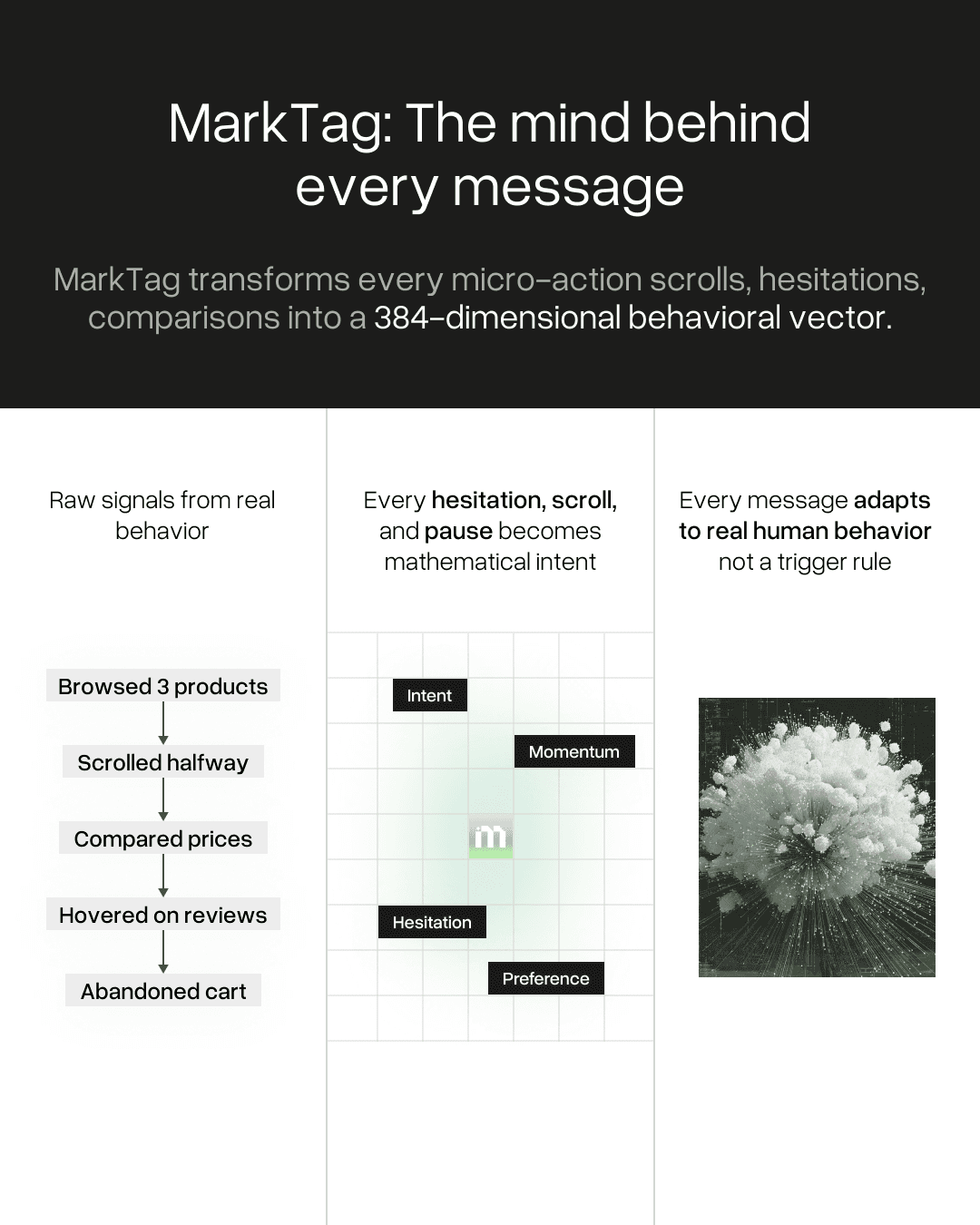
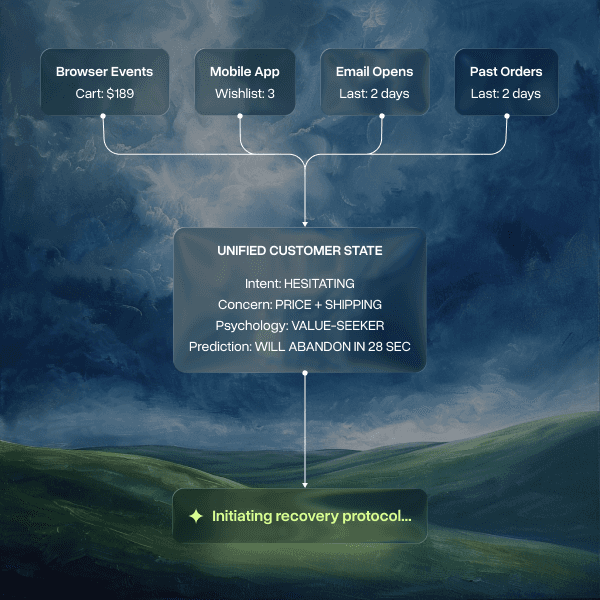
MarkTag, the platform's data foundation, collects and vectorizes every customer event across channels. It goes beyond basic tracking to create 384-dimensional behavioral vectors for each user. These vectors capture hesitation patterns, comparison behaviors, purchase windows, and micro-interactions that predict intent. The system builds a complete lifetime attribution model that identifies what actually causes purchase decisions.
Audience studio and dynamic segmentation
The Audience Studio creates self-updating customer cohorts from real-time behavioral data. Users can select from AI-powered segmentation templates or use natural language prompts to build custom audiences. Categories include high engagement users, recent product viewers, potential gems, and frequent shoppers. Audiences update automatically as customer behavior changes.
Campaign agent and omnichannel execution

The Campaign Agent launches personalized campaigns across email, SMS, push notifications, WhatsApp, and voice calls with minimal setup, making it one of the most powerful omnichannel customer engagement platforms for B2C and D2C brands. Users choose between event-based or audience-based triggers, select products, define objectives, and configure discounts. The AI generates content autonomously or tweaks user-written content based on audience data and knowledge base information.
Voice agent and human-like conversations
The Voice Agent engages leads and customers with context-driven voice calls that sound like real sales representatives. It uses conversational AI for customer engagement to keep interactions natural and dynamic. It handles conversations at scale, creates call summaries, and maintains full transcripts. This channel reaches customers who prefer phone conversations or need complex questions answered.
Pros
Creates unique journey for each individual customer instead of segments
Processes behavioral data into 384-dimensional vectors for deep understanding
Supports six channels including AI voice calls
Generates 30-40% cart recovery rates versus industry standard 10-15%
Autonomous content generation from knowledge base
Real-time performance analytics across all touchpoints
Value-based pricing aligned with merchant success
Cons
Advanced features have learning curve for new users
Klaviyo
Klaviyo is an email and SMS marketing platform popular among Shopify merchants. It focuses on owned marketing channels and provides strong e-commerce integrations.
Unified orchestration capabilities
Data collection and customer profiles
Klaviyo collects customer data from e-commerce platforms, websites, and third-party integrations. It builds customer profiles with purchase history, browsing behavior, and engagement metrics. The platform syncs data from Shopify, WooCommerce, and other platforms automatically.
Segmentation and list management
The platform offers segment builders based on customer properties, behaviors, and predictive analytics. Users create segments using if-then logic and multiple conditions. Segments update as customers meet or no longer meet criteria.
Flow automation and triggers
Klaviyo flows automate email and SMS sequences based on triggers like cart abandonment, browse abandonment, and post-purchase events. Users build flows with drag-and-drop editors and conditional splits. Templates provide starting points for common e-commerce scenarios.
Reporting and attribution
The platform tracks revenue attribution, campaign performance, and customer lifetime value. Dashboards show email and SMS metrics alongside revenue data. Users compare flow performance and identify optimization opportunities.
Pros
Strong Shopify integration
Extensive template library
Predictive analytics for customer lifetime value
Large user community and resources
Cons
Limited to email and SMS channels
Segment-based approach treats groups identically
Static workflows cannot adapt to individual behavior in real-time
No voice or WhatsApp channel support
Pricing scales quickly with contact list size
Klaviyo vs Markopolo AI for unified customer engagement
Klaviyo works well for email and SMS but lacks true unified engagement. It groups customers into segments and sends identical messages to each group. Markopolo AI creates individual journeys for each customer based on their unique behavioral vector. While Klaviyo maxes out at 10-15% cart recovery with optimized flows, Markopolo AI achieves 30-40% by understanding each person's intent, timing preferences, and channel affinity. For businesses wanting unified omnichannel orchestration with AI-driven personalization, Markopolo AI provides capabilities Klaviyo cannot match.
Braze
Braze is an enterprise customer engagement platform used by large brands across industries. It supports multiple channels and offers journey orchestration features.
Unified orchestration capabilities
Cross-channel messaging
Braze delivers messages through email, push notifications, SMS, in-app messages, and content cards. The platform coordinates timing across channels to avoid message fatigue. Users set channel preferences and frequency caps.
Canvas journey builder
Canvas allows marketers to build multi-step customer journeys with branching logic. Users create paths based on customer actions, attributes, and random splits. The visual builder shows journey flow and performance metrics.
Real-time data processing
Braze processes customer events in real-time and updates user profiles immediately. This enables triggered messages based on recent actions. The platform handles high event volumes for enterprise-scale operations.
Personalization and liquid templating
The platform uses Liquid templating language for dynamic content personalization. Users insert customer attributes, conditional logic, and connected content. Personalization extends beyond first name to behavioral data.
Pros
Enterprise-grade scalability
Strong real-time data processing
Comprehensive API for custom integrations
Advanced journey building capabilities
Cons
Segment-based rather than individual-level personalization
Complex setup requires technical resources
Rule-based engines cannot truly understand customer intent
No native AI voice channel
Enterprise pricing excludes smaller businesses
Braze vs Markopolo AI for unified customer engagement
Braze offers powerful journey building but relies on segments and rules. Marketers must manually create workflows and guess which paths work for which groups. Markopolo AI eliminates this guesswork by generating unique strategies for each individual in real-time. Where Braze requires teams to build and maintain complex canvases, Markopolo AI autonomously orchestrates millions of individual journeys. The AI understands behavioral vectors, not just events, enabling it to predict optimal intervention points and channel preferences. For e-commerce businesses seeking intelligent automation over manual configuration, Markopolo AI delivers superior results.
HubSpot Marketing Hub
HubSpot Marketing Hub is part of the broader HubSpot CRM platform. It serves B2B and B2C companies with marketing automation, content management, and analytics.
Unified orchestration capabilities
CRM-powered marketing
HubSpot connects marketing activities directly to CRM records. Every email open, page visit, and form submission updates the contact record. Sales and marketing teams see the same customer data.
Workflow automation
Users build automated workflows triggered by contact properties, behaviors, and list membership. Workflows send emails, update properties, create tasks, and trigger notifications. Visual editors show workflow logic and enrollment criteria.
Content and landing pages
The platform includes tools for creating landing pages, blog posts, and website content. Forms capture leads and add them to workflows. A/B testing optimizes page performance.
Attribution reporting
HubSpot tracks which marketing touchpoints influence conversions. Reports show first-touch, last-touch, and multi-touch attribution models. Users understand which channels drive results.
Pros
Integrated CRM and marketing platform
Strong content management tools
Comprehensive free tier for small businesses
Extensive app marketplace
Cons
Built for B2B sales cycles, not e-commerce speed
CRM-centric rather than behavior-centric
Workflow builders require manual setup and maintenance
Cannot process real-time behavioral vectors
Limited channel options compared to e-commerce specialists
HubSpot vs Markopolo AI for unified customer engagement
HubSpot excels at B2B marketing with long sales cycles but struggles with e-commerce demands. Its workflow approach requires marketers to predict customer paths in advance. Markopolo AI was purpose-built for e-commerce and D2C, understanding fast-moving customer journeys that change by the minute. While HubSpot treats marketing as a series of manual workflows, Markopolo AI deploys AI agents that think and adapt for each customer. For online retailers looking to use ai for customer engagement, Markopolo provides the speed and intelligence that HubSpot's B2B architecture cannot deliver.
Iterable
Iterable is a cross-channel marketing platform focused on growth marketers. It emphasizes experimentation and data-driven campaign optimization.
Unified orchestration capabilities
Workflow studio
Iterable's Workflow Studio creates automated campaigns across email, push, SMS, and in-app channels. Users build journeys with triggers, delays, filters, and actions. The visual interface shows campaign flow and metrics.
Catalog and personalization
The Catalog feature stores product and content data for personalization. Users create dynamic content based on customer preferences and behaviors. Recommendations pull from catalog items.
Experiments and optimization
Built-in experimentation tools test subject lines, content, send times, and journeys. Users run A/B and multivariate tests with statistical significance tracking. Winning variants can auto-select.
Data feeds and integrations
Iterable ingests data through APIs, webhooks, and direct integrations. Event data triggers campaigns and updates user profiles. The platform connects with data warehouses and CDPs.
Pros
Strong experimentation capabilities
Flexible data model
Modern API-first architecture
Good cross-channel coordination
Cons
Segment-based personalization limits individual relevance
Manual campaign building required
No AI voice channel
Experimentation requires statistical knowledge
Pricing based on user volume
Iterable vs Markopolo AI for unified customer engagement
Iterable helps marketers test and iterate on campaigns, but humans still design the experiments. Marketers hypothesize which segments respond to which messages, then test their guesses. Markopolo AI removes this limitation by letting AI generate and execute personalized strategies for each individual. Instead of running experiments across segments, the platform learns optimal approaches per customer through behavioral vectorization. Iterable optimizes campaigns; Markopolo AI optimizes for each person. For businesses wanting true 1:1 engagement at scale, Markopolo AI provides intelligence that experimentation alone cannot achieve.
Omnichannel customer journey mapping and experience orchestration
What is omnichannel journey mapping
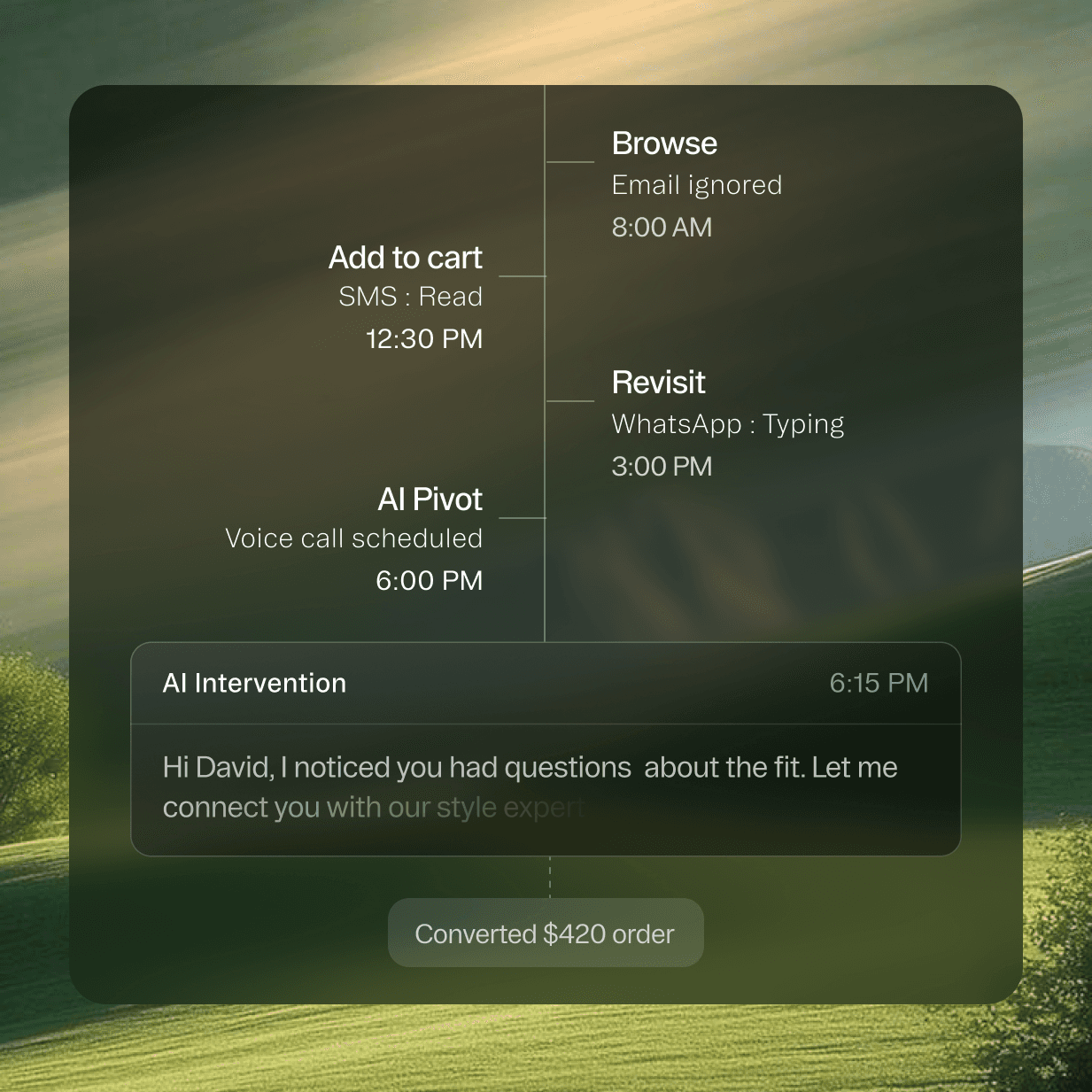
Omnichannel journey mapping tracks every customer interaction across all channels in one unified view. A complete map shows website visits, email opens, SMS clicks, WhatsApp conversations, and voice calls on a single timeline. This approach reveals how customers actually move toward purchase rather than how marketers assume they move. Traditional analytics treat each channel as separate. Omnichannel mapping connects the dots to show that the same person browsed on mobile, opened an email on desktop, and purchased after a WhatsApp message.
How experience orchestration coordinates customer touchpoints
Experience orchestration turns journey insights into coordinated actions across channels. When a customer browses products on mobile during lunch, the system notes this pattern. It might send a WhatsApp message at 7 PM when engagement data shows higher response rates. If the customer opens but does not purchase, an AI voice call could follow the next day with product details. Orchestration ensures each touchpoint builds on previous interactions rather than repeating or contradicting them.
Moving from segment-based flows to individual journeys
Traditional approaches map journeys but leave orchestration to manual workflows. Marketers create flows for segments and hope the timing works for most people. Modern orchestration platforms like Markopolo AI generate unique journeys for each individual instead. The AI considers behavioral vectors, channel preferences, timing patterns, and intent signals. One price-sensitive customer gets a discount offer via SMS. Another customer who values social proof receives customer reviews via WhatsApp. Same cart abandonment, completely different journeys based on individual understanding.
Real-time adaptation and continuous optimization
Effective orchestration requires real-time data processing, channel flexibility, and intelligent decision-making. Static rules cannot adapt to changing customer behavior. AI-driven real-time customer engagement systems process new signals and adjust strategies continuously throughout each journey. If a customer suddenly engages differently than predicted, the system updates its approach immediately. The result is journeys that feel personal because they respond to actual behavior, not predetermined paths.
6 strategies and best practices for unified customer engagement
Build a complete behavioral data foundation
Start by capturing every customer interaction across all touchpoints. Website clicks, scroll depth, product views, cart actions, email engagement, and support conversations all matter. Traditional analytics track events as isolated data points. Advanced systems like MarkTag transform these events into behavioral vectors that capture intent, not just actions. The richer the data foundation, the better the engagement decisions.
Treat customers as individuals, not segments
Segments group people with surface-level similarities but different underlying needs. One abandoned cart segment includes impulse buyers, comparison shoppers, price-sensitive customers, and technical validators. Sending them identical recovery emails wastes opportunities. Individual-level understanding recognizes these differences and responds accordingly. The goal is one visitor, one agent, one journey—repeated millions of times.
Orchestrate channels based on customer preferences
Each customer prefers different channels at different times. Some check email in the morning but respond to WhatsApp in the evening. Others ignore SMS but answer voice calls. Unified engagement learns these preferences from behavior and honors them. Forcing customers into channels they dislike reduces engagement and damages relationships.
Use AI to generate personalized strategies
Human marketers cannot create unique strategies for millions of individuals. AI can. Modern platforms generate personalized customer engagement strategies in milliseconds based on behavioral data, business goals, inventory levels, and margin requirements. The AI decides when to reach out, which channel to use, what message to send, and whether to offer discounts. Human oversight sets guardrails; AI handles execution.
Measure understanding, not just engagement
Open rates and click rates show message performance but miss deeper insights. Behavioral vectorization reveals whether you actually understand customers. Do you know their intent? Their purchase readiness? Their validation needs? Platforms that measure understanding build compound intelligence over time. Each interaction makes future interactions smarter.
Continuously learn and adapt
Customer behavior changes. Purchase patterns shift with seasons, trends, and life events. Static workflows become outdated. Effective unified engagement systems learn continuously from outcomes and adjust strategies. If a customer responds differently than predicted, the system updates its understanding and tries a better approach next time.
Implementing a unified single customer view with data analytics
Connect all data sources to one platform
A single customer view requires data from every source: e-commerce platforms, CRM systems, email providers, advertising platforms, and support tools. Data silos create incomplete pictures. When a customer calls support about an order, that context should inform marketing messages. Unified platforms like Markopolo AI centralize data through integrations, APIs, and data uploads to build complete customer profiles.
Transform raw data into actionable intelligence
Collecting data is not enough. Raw events need processing into meaningful signals. Behavioral vectorization transforms actions into mathematical representations that AI can understand and act upon. A 384-dimensional vector captures hesitation patterns, comparison behaviors, price sensitivity, and social proof requirements. This intelligence enables predictions and personalized strategies that raw data alone cannot support.
Maintain data quality and freshness
Stale data leads to irrelevant engagement. Customer profiles need real-time updates as behavior changes. A customer who purchased yesterday should not receive cart recovery emails today. Unified systems process events in real-time and update profiles immediately. Data quality checks identify inconsistencies and duplicates that would corrupt the single customer view.
Respect privacy while maximizing relevance
Customers share data expecting relevant experiences in return. Unified engagement must balance personalization with privacy. Clear consent, transparent data usage, and easy opt-out options build trust. Privacy-safe cross-merchant learning improves intelligence without exposing individual data. The best platforms deliver highly relevant experiences while respecting customer boundaries.
Improving customer engagement through AI, automation, and best practices
Deploy AI for real-time decision making
Human decision-making cannot scale to millions of customers. AI makes real-time decisions about timing, channels, messages, and offers for each individual. When a customer shows purchase intent, the AI acts within milliseconds. It considers the full behavioral context and selects the optimal intervention. This speed and scale transforms engagement from reactive to proactive.
Automate routine tasks to focus on strategy
Automation handles repetitive tasks like sending scheduled messages, updating segments, and generating reports. This frees marketing teams to focus on strategy, creative development, and customer insights. The goal is not replacing humans but amplifying their impact. One marketer supported by AI orchestration can achieve what previously required entire teams.
Test and optimize continuously
Even AI-driven systems benefit from testing. A/B tests validate hypotheses about messaging, timing, and offers. Multivariate tests explore combinations. Automated optimization selects winning variants and applies learnings. The difference is scale: traditional testing optimizes campaigns while AI testing optimizes for each individual.
Combine automation with human oversight
AI handles execution but humans set direction. Marketing teams define brand voice, approval workflows, discount limits, and ethical boundaries. They review AI-generated content before launch or establish confidence thresholds for autonomous sending. This combination captures AI efficiency while maintaining brand control and quality standards.
Why is Markopolo AI the best solution for unified customer engagement
Built for individual understanding, not segments
Most customer engagement platforms group customers into segments and apply identical treatments. Markopolo AI creates a unique AI revenue agent for each visitor. These agents observe behavioral fingerprints through MarkTag, understand intent through vectorized intelligence, orchestrate personalized journeys, execute across channels, and learn continuously. One visitor, one agent, one journey—multiplied by millions.
Purpose-built for e-commerce and D2C
Markopolo AI was designed specifically for e-commerce speed and D2C relationships. The platform understands fast-moving customer journeys, rapid purchase decisions, and the need for real-time response. Unlike B2B-focused tools adapted for e-commerce, every feature addresses online retail challenges: cart abandonment, browse abandonment, post-purchase engagement, and customer reactivation.
True omnichannel orchestration with AI voice
The platform coordinates email, SMS, push notifications, WhatsApp, and AI voice calls in unified journeys. Voice agents engage customers with human-like conversations at scale—a capability most competitors lack entirely. Channel selection happens automatically based on customer preferences and behavioral signals. The AI knows that Sarah responds to WhatsApp at 7 PM but prefers voice calls for complex questions.
Proven results that exceed industry standards
Traditional tools achieve 10-15% cart recovery rates with optimized workflows. Markopolo AI delivers 30-40% recovery through perfect personalization. The difference comes from understanding: instead of guessing which segment a customer belongs to, the AI knows their exact context, intent, and optimal intervention approach. Each customer gets exactly what they need, when they need it, through the channel they prefer.